

The short answer
COVID-19 vaccination can cause documented injuries, including myocarditis and vaccine-induced clotting syndromes, but the size and distribution of every risk are not settled. The Caribbean needs independent surveillance, serious case investigation, accessible treatment and transparent publication of results.
Publication record
Transparent responsibility and verification details for this Caribbean Issues publication.
- Published
- Updated
- No later revision recorded
- Responsible byline
- Caribbean Issues
- Verification
- Editorially reviewed under our published method
- Sources listed
- 48 sources listed below
- Primary topic
- Caribbean Health, Wellness and CDSS
COVID-19 vaccination injured people and contributed to documented deaths. Regulators eventually acknowledged myocarditis, pericarditis and a dangerous clotting syndrome, but surveillance was passive, autopsies were inconsistent and no standard route into care was established for persistent illness. Embalmers have reported unusual white fibrous structures, and laboratory researchers now say some submitted samples differ from ordinary clots. The full prevalence and cause remain unsettled because the decisive controlled studies were never done. The Caribbean should stop borrowing other countries’ assurances and conduct its own transparent investigation.
What the evidence shows about myocarditis, persistent illness, unusual post-mortem clots, cancer signals and treatment—and why the region needs an independent investigation
If you have unexplained chest pain, shortness of breath, fainting, a racing or irregular heartbeat, sudden weakness on one side, trouble speaking, or a severe new headache, seek urgent medical care. Do not wait for an online theory to tell you the cause.
The short answer
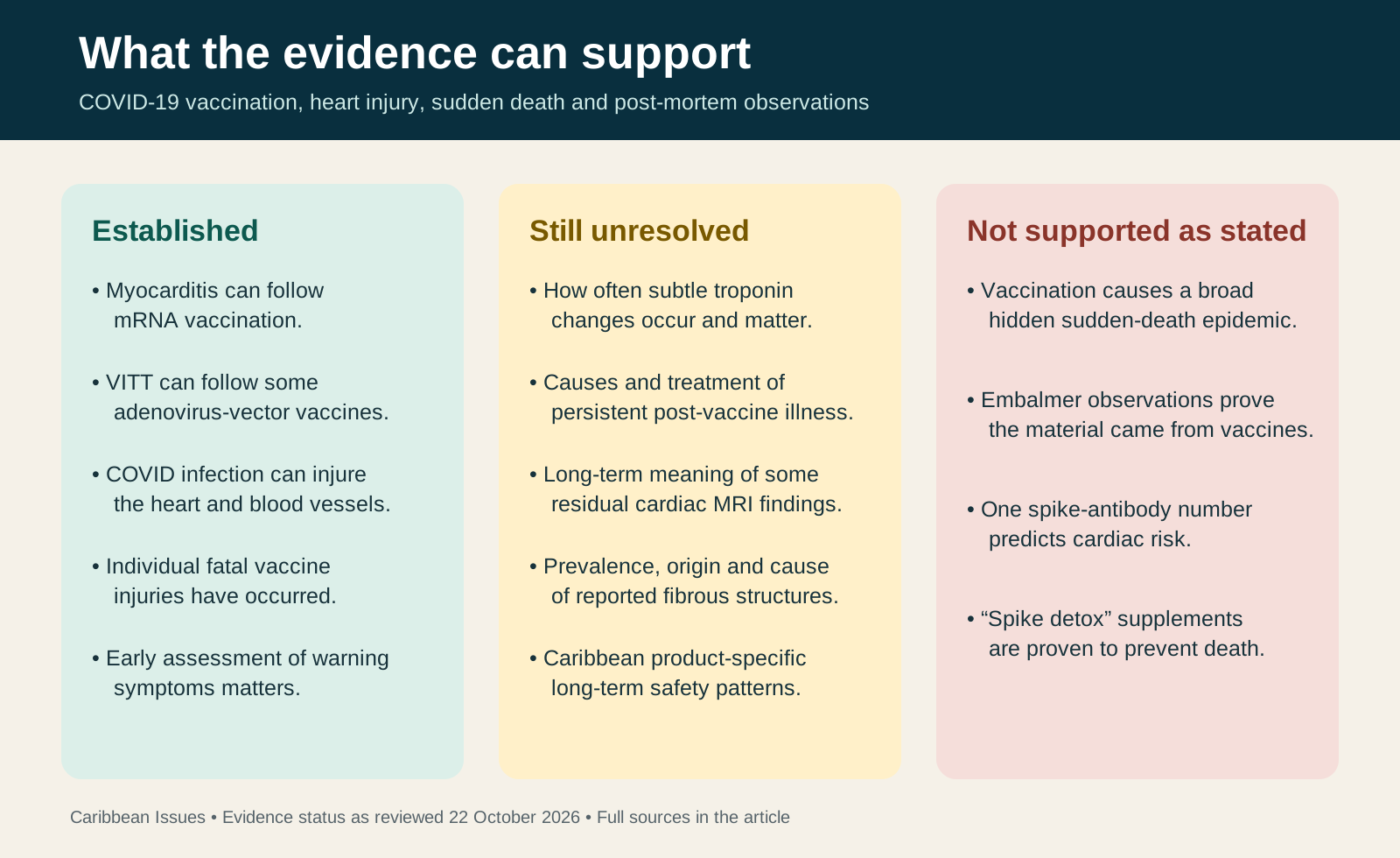
Four statements can all be true at once.
The responsible Caribbean position is therefore simple: no automatic exoneration, no automatic conviction—open the records, examine the tissue, follow the patients and publish the results.
- COVID-19 vaccines can cause serious injuries. The clearest examples are myocarditis and pericarditis after mRNA vaccines, with the highest reported rates in adolescent and young adult males, and vaccine-induced immune thrombotic thrombocytopenia (VITT) after adenovirus-vector vaccines such as AstraZeneca and Johnson & Johnson. Reported rates vary by product, dose, age, sex, case definition and surveillance system.
- COVID-19 infection can also damage the heart and blood vessels. It raises the risk of clots, rhythm problems, heart inflammation and other cardiovascular illness. Infection and vaccination are not interchangeable exposures, and the balance of risk varies by age, sex, product, dose and a person’s health.
- Reports of long, pale, fibrous material found during embalming deserve controlled investigation. A 2026 survey records a striking pattern reported by embalmers. It did not test the material, verify medical records, compare vaccinated with unvaccinated bodies, or establish whether the structures formed before death, after death or during embalming. It is a signal, not a verdict.
- Large population studies have not detected a general increase in sudden death after vaccination. These studies are important, but they are not a final audit. Administrative coding can miss subclinical myocarditis, autopsies are uneven, exposure groups differ, and a small vulnerable subgroup can disappear inside a reassuring population average. The evidence has not demonstrated a widespread vaccine-caused sudden-death epidemic; it has also not answered every product-, dose-, age-, sex- and susceptibility-specific question.
The first failure was not scientific uncertainty. It was how uncertainty was communicated
Authorities asked the public to accept rapidly developed products during an emergency while repeatedly using broad words such as “safe” and “effective.” Those terms hid important differences: risk was not identical for a 19-year-old man and an 80-year-old woman; Pfizer, Moderna, AstraZeneca, Johnson & Johnson and other products did not have identical safety profiles; and preventing severe disease was different from preventing infection or transmission.
Pharmaceutical companies controlled pivotal trial data and benefited financially from worldwide purchasing. Governments negotiated contracts, promoted uptake, imposed mandates in some settings and also operated the systems expected to identify harm. Regulators relied heavily on manufacturer submissions while post-authorisation surveillance depended substantially on clinicians and patients recognising and reporting possible events. These are structural conflicts even when every individual acts in good faith.
The same institutions later assessing safety had reputational and policy stakes in the campaign’s success. That does not make their data false. It means independence, raw-data access and outside replication were especially necessary. They were too limited.
The opposing side also has incentives. Private clinics, supplement sellers, subscriber-funded commentators, advocacy organisations and political movements can gain money, reach or influence from alarming interpretations. That does not make their observations false either. Financial and ideological scrutiny belongs on every side.
This article therefore applies one rule throughout: disclose who collected the data, who paid, what was measured, what was left unmeasured and whether another team could reproduce the finding.
First, understand the words
Myocarditis means inflammation of the heart muscle. Pericarditis means inflammation of the sac around the heart. When both occur, clinicians may use myopericarditis. Symptoms can include chest pain, shortness of breath, palpitations, unusual fatigue or reduced exercise tolerance. Severe cases can cause heart failure, dangerous rhythms or death, although many vaccine-associated cases identified in hospitals have improved with rest and treatment.
Myocardial injury means a blood marker called troponin has risen above a defined level, showing stress or damage to heart-muscle cells. It does not automatically mean clinical myocarditis. Exercise, kidney disease and several other conditions can raise troponin. A diagnosis depends on the whole picture: symptoms, timing, electrocardiogram (ECG), repeat blood tests, imaging and sometimes other investigations.
Sudden cardiac death is an unexpected death caused by the heart, including deaths produced by lethal rhythms. Coronary disease, inherited electrical disorders, cardiomyopathy, myocarditis, drugs and other causes can produce it. A death that occurs after a vaccination is not automatically caused by it; nor should timing be dismissed without review.
VITT is a specific immune clotting disorder involving thrombosis, low platelets, a very high D-dimer and antibodies against platelet factor 4. It was linked mainly to AstraZeneca and Johnson & Johnson vaccines. The diagnostic window used in specialist guidance is 4–42 days after vaccination, with the peak presentation period reported as days 6–14. That defined syndrome should not be stretched into an explanation for every clot found months or years later. American Society of Hematology guidance [1]
What is firmly established about vaccine-associated heart inflammation
Multiple safety systems and epidemiological studies support a causal association between mRNA COVID-19 vaccination and myocarditis or pericarditis. The highest reported rates occur in adolescent and young adult males, with case clustering during the first seven days and after dose two in the original two-dose schedules. Product and dose interval matter. CDC clinical considerations [2]
Frequency claims need a denominator. Rates differ sharply across studies because researchers use different age groups, products, dose numbers, time windows and case definitions. A pooled 2023 review estimated about 19.7 myocarditis cases per million vaccine doses, while reporting a higher pooled rate after SARS-CoV-2 infection; pooled estimates should not be applied as one universal personal risk. Systematic review [3] A Canadian study covering 18.9 million mRNA doses reported lower overall myocarditis/pericarditis rates after vaccination than after infection and lower rates with longer intervals between doses. Canadian multi-provincial study [4]
Hospital studies report symptom improvement and discharge for the majority of identified patients, but discharge must not be translated into complete biological recovery. In a French national study of people aged 12–49 who were hospitalised with myocarditis, the post-vaccine group recorded 32 composite cardiovascular events among 558 patients during follow-up, compared with 497 among 3,779 patients with conventional myocarditis. French long-term prognosis study [5] Follow-up imaging studies in adolescents have identified persistent late gadolinium enhancement—possible scar—after symptoms and heart function improved. Its long-term meaning is still being studied. One-year cardiovascular assessment [6]
The measured outcomes show improvement for many hospitalised patients and unresolved imaging or symptoms for a subset. Longer follow-up is required to quantify their future risk.
UK physician and medical commentator Philip McMillan has pressed this point in public discussions: discharge from hospital should not be confused with complete biological recovery. A 2025 Australian cohort found long-term myocardial fibrosis on MRI in selected patients evaluated for vaccine-associated myocarditis, at a median 548 days after vaccination. The study had a small, voluntary sample and did not connect the scans to later clinical events. Open Heart study [7] A separate cohort found minimal late gadolinium enhancement persisted in 10 of 21 followed patients, while heart function and oedema normalised and no adverse cardiac events occurred during median clinical follow-up of about eight months. Clinical MRI follow-up [8] The unanswered question is how much future rhythm or heart-failure risk those residual findings carry.
The dispute over “silent” or subclinical myocarditis
The paper named in the public debate, COVID-19 Vaccine-Induced Subclinical Myopericarditis: Pathophysiology, Diagnosis, and Clinical Management, is a 2025 review by Peter McCullough, Nathaniel Mead and Nicolas Hulscher. It argues that low-grade vaccine-associated cardiac injury is under-recognised and may increase later arrhythmia and sudden-death risk. It cites prospective troponin studies and proposes tests for spike antibodies, circulating spike or vaccine mRNA, plus a “spike detoxification” regimen. The review [9]
Parts of its warning rest on real evidence. Vaccine-associated myocarditis exists. A Basel study actively tested 777 hospital employees three days after a Moderna booster and adjudicated myocardial injury in 22 people, or 2.8 percent. Most cases were mild; 20 of the 22 were women, reflecting both the female-heavy study population and the sex-specific threshold used. The study measured short-lived troponin changes, not a 2.8 percent rate of clinical myocarditis or sudden-death risk. Basel study [10]
Other prospective work does not reproduce a general 1–3 percent injury rate. A blinded before-and-after cardiac MRI study of 67 people found no imaging, ECG or biochemical evidence of subclinical myocarditis after vaccination. With 67 participants, the study cannot reliably quantify events occurring at rates below its detection capacity or within narrowly defined subgroups. CMR cohort [11] A 2026 randomised, placebo-controlled crossover trial in 981 participants aged 12–30 found troponin elevations after both vaccine and placebo, more of them after placebo, and no clinical myocarditis. Moderna employees authored and funded the trial. Randomisation gives it value, but manufacturer control is a material conflict and independent replication remains necessary. Randomised trial [12]
The McCullough review therefore identifies a question that merits continued study, but it overreaches when it turns a small group of heterogeneous biomarker studies into an estimated 1–3 percent injury rate per dose and then links that estimate to future sudden death without direct outcome evidence.
Its proposed routine spike-antibody thresholds and “detox” treatments are also unvalidated. The review itself says there are no blinded, placebo-controlled trials showing that nattokinase, bromelain and curcumin prevent cardiac events after vaccination. No established clinical guideline recognises an anti-spike level above 1,000 U/mL as a cardiac-risk test. Antibody values vary by assay, time, infection history and vaccination history. Self-treating with nattokinase or blood thinners can increase bleeding risk or interact with medication. These products should not replace diagnosis or supervised treatment.
That is not censorship of an emerging idea. It is the line between a hypothesis and a treatment proven to help patients.
Can vaccine-associated myocarditis be fatal?
Yes. Autopsies and case reports have described deaths in which myocarditis soon after vaccination was judged a likely cause or contributor. A German series of 25 deaths occurring within 20 days of vaccination attributed four to acute myocarditis after excluding other major causes. That selected series cannot supply a population rate. German autopsy series [13] A Japanese report described focal myocarditis around the cardiac conduction system in a 40-year-old man who developed fatal arrhythmia two days after his second mRNA dose. Japanese case report [14]
Case reports identify possible harms. They cannot calculate frequency or determine whether the same pattern explains a population trend. That requires denominators and comparison groups.
McCullough and colleagues also assembled a systematic review of 28 published autopsy cases and judged all of them likely to have been caused by vaccination. Autopsy review [15] Because the review began with selected published cases in which vaccination was already suspected, it cannot measure incidence or determine whether the same findings were more common than in comparable unvaccinated deaths. Its case-level assessments should be considered beside national mortality studies and controlled autopsy research.
The largest newer studies do not show a broad sudden-death signal. A 2026 Ontario analysis drew from about 6.4 million apparently healthy people aged 12–50 and found no increased sudden-death rate in the six weeks after dose one, two or later doses. It depended on administrative definitions, excluded many people with recorded illness and cannot resolve mechanisms in individual deaths without complete autopsies. Ontario study [16] An Oregon review of 1,292 deaths among people aged 16–30 found no association, but acknowledged incomplete out-of-state vaccination data and the limitations of death certificates. Oregon review [17] Linked English records found no overall increase in cardiac or all-cause death after vaccination among ages 12–29, while reporting increased cardiac mortality in young women after a first non-mRNA dose. That signal should not be buried because the overall average was reassuring. England study [18]
A French national cohort of 28.7 million adults aged 18–59 found no increase in four-year all-cause mortality among mRNA-vaccinated people. The groups differed substantially: vaccinated people were generally more connected to healthcare and less socially disadvantaged. Statistical adjustment cannot guarantee removal of this “healthy vaccinee” effect. The study weighs against an effect large enough to raise mortality across the full vaccinated cohort, but all-cause mortality is a blunt instrument for detecting injury concentrated by age, sex, dose or genetic susceptibility. French cohort [19]
Population averages cannot acquit or diagnose an individual case. A fatal injury can be real even when total mortality does not rise, and a death after vaccination can still have an unrelated cause. Only serious case investigation can separate the two.
What about the long white “clots” reported by embalmers?
In July 2026, Thomas Haviland, Laura Kasner and Daniel Santiago published four years of anonymous surveys of embalmers in the United States, Canada, the United Kingdom, Australia and New Zealand. Across 808 responses, 66–83 percent of respondents in each survey year said they had seen unusual white fibrous structures. Their estimates suggested the material appeared in 19–27 percent of bodies. Embalmer survey [20]
Those numbers sound alarming. Here is what the study does—and does not—show.
It does show that many participating embalmers consistently reported something they considered different from familiar post-mortem clots and troublesome during embalming. Their experience deserves respect. The paper openly calls the observation a possible safety signal requiring forensic and laboratory work.
It does not show prevalence among all bodies. Participation was voluntary, the sample was not random, response rates were unknown, and an embalmer who had noticed an unusual structure may have been more likely to answer. The 19–27 percent figures were respondents’ estimates, not counts verified against case logs.
It does not establish composition. No standard photograph, histology, immunohistochemistry, proteomics or chemical analysis was required. The survey collected no tissue samples.
It does not establish cause. It collected no vaccination records, infection histories, causes of death, medications, time from death to embalming or matched control group. Reports began rising around 2020–2021, a period containing mass SARS-CoV-2 infection, mass vaccination, changing death patterns and changes in funeral practice.
It cannot determine when the structures formed. Formaldehyde cross-links proteins and can change the appearance and texture of material already inside vessels. The authors explicitly acknowledge that they cannot prove the structures predated embalming or were independent of it.
The defensible conclusion is: a repeated occupational observation was allowed to circulate for years without the large, independent pathology programme capable of confirming or refuting it. The survey does not prove that vaccines caused structures in one quarter of bodies. Institutional failure to investigate promptly does not prove the claim either, but it left a vacuum in which neither the public nor embalmers could obtain a trustworthy answer.
The ideal study would collect material before embalming, photograph it in place, compare it with ordinary post-mortem and antemortem thrombi, test its protein and cellular composition, and link each case—under ethical safeguards—to age, sex, cause of death, COVID infection, vaccination product and dates, anticoagulant use and post-mortem interval. Controls must come from the same time and setting. Independent laboratories should receive blinded samples. Until that is done, certainty in either direction is premature.
What laboratory analysis of the reported casts shows
In September 2026, Bruce Rapley and Matt Shelton published Convergent Evidence for a Distinct Intravascular Matrix. They reported histology, inductively coupled plasma mass spectrometry and proteomic analysis of what they call anomalous intravascular casts. Their abstract describes dense fibrinous architecture, sparse cells, limited Lines of Zahn, unusual elemental proportions, 541 human proteins, abnormal proportions of fibrinogen chains and very little plasminogen. The authors conclude that the samples are not adequately explained as ordinary post-mortem clots or conventional thrombi. Rapley and Shelton paper [21]
This is more informative than photographs and recollection. It means the material itself has now been subjected to several laboratory techniques. It does not, on the information publicly available, show that COVID vaccination created the material. The abstract does not state the number of deceased people represented, provide their infection and vaccination records, describe contemporaneous control samples, or establish how sample collection and embalming affected the results. “Lines of Zahn” can support formation while blood was moving, but their interpretation depends on histology and context; their presence alone does not identify a trigger.
Philip McMillan’s October 2026 interview with Rapley and Shelton makes the appropriate next question explicit: connect the material, the patient and the biological sequence. McMillan interview [22] That requires independently replicated, blinded comparison of pre-embalming material from people with documented vaccination, infection and clinical histories.
The laboratory findings provide preliminary evidence that at least some submitted structures have unusual features. Controlled forensic evidence has not yet established their population prevalence, whether all objects described as “white clots” are the same entity, or whether vaccination, infection, severe illness, medication, post-mortem change, embalming—or a combination—caused them. Rapley and Shelton’s measurements should now be replicated by forensic pathology laboratories using documented cases and matched controls.
COVID-19 vaccination, cancer and the claim of “turbo cancer”
People use the phrase “turbo cancer” to describe a cancer that appears unexpectedly, grows quickly, returns after remission or presents at an advanced stage soon after COVID-19 vaccination. It is not a recognised diagnostic category and has no agreed case definition. That does not make every underlying observation false. It means the phrase cannot be counted in a cancer registry or tested scientifically until it is translated into measurable questions.
Those questions include:
No single case report or national average can answer all five.
- Did the incidence of a defined cancer change after vaccination, compared with an appropriate unvaccinated or pre-vaccination population?.
- Did age at diagnosis, tumour grade, stage, growth rate, recurrence interval or treatment response change?.
- Is any change related to a specific product, dose number or time window?.
- Can infection, delayed screening, healthcare disruption, demographic change and improved detection explain the pattern?.
- Is there reproducible pathology or molecular evidence connecting an exposure to a tumour?.
The South Korean cohort reported measurable cancer associations
A 2025 study used South Korean National Health Insurance data covering 8.4 million people from 2021 through 2023. After propensity-score matching, its principal comparison included 595,007 unvaccinated and 2,380,028 vaccinated people. Within one year, the vaccinated group had higher recorded diagnosis hazards for six cancers:
Cancer | Reported hazard ratio | 95% confidence interval — Thyroid | 1.35 | 1.21–1.51 — Gastric | 1.34 | 1.13–1.58 — Colorectal | 1.28 | 1.12–1.47 — Lung | 1.53 | 1.25–1.87 — Breast | 1.20 | 1.07–1.34 — Prostate | 1.69 | 1.35–2.11
South Korean cohort [23]
These results should be reported exactly rather than dismissed or inflated. They show statistical associations between vaccination status and cancers diagnosed within one year. They do not establish that vaccination initiated those cancers.
Cancer development usually precedes diagnosis by more than a year. A tumour discovered several months after an injection may already have been present but undetected. Vaccinated and unvaccinated groups can differ in screening, use of healthcare, income, underlying illness and willingness to enter official systems. Propensity matching adjusts recorded variables; it cannot correct unrecorded differences. The study tested 29 cancer categories and many subgroups, which increases the chance of positive findings unless multiple comparisons are handled rigorously. Its short follow-up also prevents evaluation of longer latency.
A 2026 methodological commentary rated the evidence as low confidence because of detection bias, residual confounding, short latency and analytical design. It recommended a target-trial reanalysis, time-varying vaccination status, healthcare-utilisation matching, exclusion of cancers found in the first 6–12 months, correction for multiple testing and at least ten years of follow-up. Methodological commentary [24]
Those criticisms are reasons to reanalyse and replicate the signal, not reasons to pretend the reported hazard ratios do not exist.
The Italian cohort found a second signal, with inconsistent patterns
A 2025 study followed 296,015 residents of Pescara province for as long as 30 months. Cancer hospitalisation occurred in 0.85 percent of the unvaccinated group and 1.15 percent of people who received at least one dose. After adjustment, the reported hazard ratio was 1.23 for one or more doses and 1.09 for three or more doses. The site-specific estimates included:
Italian cohort [25]
The pattern was not consistent across infection status, cancer site, dose group or lag time. A higher dose count did not produce a higher overall estimate, and some analyses found lower hazards. The authors described their results as preliminary and specifically identified healthy-vaccinee bias, different healthcare use and unmeasured confounding. The outcome was hospitalisation carrying a cancer code, not laboratory proof that a new cancer began after vaccination.
The Korean and Italian studies therefore do not prove “turbo cancer.” Together, they provide enough of a signal to justify independent, preregistered studies using cancer-registry pathology, diagnosis stage, screening history, infection history, vaccine product and dose, and sufficient follow-up.
- Breast cancer hospitalisation: HR 1. 54 after one or more doses and 1.36 after three or more doses.
- Bladder cancer hospitalisation: HR 1. 62 after one or more doses and 1.43 after three or more doses.
- Colorectal cancer hospitalisation: HR 1. 35 after one or more doses; the three-dose estimate did not meet the study’s statistical threshold.
What the case reports show
Published reports describe lymphoma appearing or progressing after vaccination. One paper documented rapid progression of marginal-zone B-cell lymphoma after a Pfizer dose. Marginal-zone lymphoma report [26] Another described extranodal NK/T-cell lymphoma at the injected arm. NK/T-cell lymphoma report [27] A 2026 scoping review found 69 publications describing malignancy or progression after vaccination, infection or both, covering 333 people outside the population studies. Fifty-five of the 69 publications were case reports or small series. Cancer-signal scoping review [28]
These reports establish that the sequence has occurred: vaccination, followed by a cancer diagnosis or observed progression. Some contain striking clinical, imaging or pathological details. They cannot calculate how much more frequently the same cancers occurred among vaccinated people than among comparable unvaccinated people. Publication bias also matters: an unusual temporal sequence is more likely to be written up than an ordinary cancer course.
For a patient, this distinction should never be used to close the case. A temporal relationship should be recorded, the tumour properly typed and the case reported. For a publication, timing should be described as timing unless tissue or comparative data establish more.
Biological mechanisms proposed in the literature
Researchers have proposed several routes through which vaccination might theoretically influence an existing tumour or cancer surveillance:
Mechanistic plausibility matters, but a plausible chain can contain an unproven link. Each proposal needs dose-relevant experiments, human tissue, controls and replication.
There is also evidence that does not fit a universal cancer-promoting effect. A 2025 Nature study reported that patients with melanoma or non-small-cell lung cancer who received an mRNA COVID-19 vaccine within 100 days of starting immune-checkpoint therapy had improved survival, apparently through immune activation that made tumours more responsive to treatment. Cancer-immunotherapy study [29] This does not disprove harm in another biological setting. It shows that mRNA-triggered immune effects are context-dependent and that “stimulates immunity” and “suppresses immunity” cannot be applied as universal slogans.
- Transient immune redistribution or suppression. Changes in lymphocytes, interferon signalling or inflammatory pathways might temporarily affect immune surveillance in a susceptible person.
- Repeated antigen and inflammatory stimulation. Spike expression, lipid nanoparticles and immune activation could theoretically affect a tumour microenvironment or a pre-existing lymphoid clone.
- IgG4 class switching after repeated mRNA exposure. This has been documented immunologically; whether it reduces anti-tumour surveillance in humans has not been established.
- Modified RNA and innate immunity. N1-methylpseudouridine changes how innate sensors respond to vaccine RNA. Claims that this produces cancer in vaccinated humans remain mechanistic hypotheses rather than demonstrated clinical pathways.
- Residual DNA from manufacturing. Independent investigators have reported DNA fragments in mRNA vaccine vials. Detecting fragments is not the same as demonstrating entry into a cell nucleus, integration into the human genome, transformation of a cell and formation of a tumour. Each step requires evidence.
- Reactivation or acceleration of an existing cancer. A strong immune stimulus could plausibly reveal lymph-node disease on imaging or coincide with progression already underway. That is different from creating a new solid tumour in weeks.
Pandemic disruption is a competing cause that must be measured
Screening programmes were interrupted, diagnostic appointments were delayed and treatment pathways were disrupted during the pandemic. A cancer that would have been found at stage I in 2020 may have appeared at stage III later. COVID-19 infection itself produces inflammation and immune changes that are also being studied for possible effects on cancer. Obesity, alcohol use, metabolic illness, environmental exposure and population ageing continued at the same time.
These factors cannot be invoked as a blanket explanation any more than vaccination can. A serious study must measure them.
What the Caribbean should do about the cancer signal
Caribbean states should link cancer registries, vaccination records, laboratory-confirmed infection records and death certification under an independent protocol. The analysis should be performed by age, sex, country, cancer site, stage, grade, product, dose and time since exposure. Researchers should publish absolute rates as well as relative estimates.
The region should specifically track:
The protocol, statistical plan and exclusions should be published before analysts see the outcome. An independent team should reproduce the work. Pharmaceutical companies, campaign organisations and government communications units should have no power to suppress an unfavourable result.
- New cancer diagnoses by month and age group from at least 2015 onward.
- Stage at diagnosis, tumour grade and metastatic presentation.
- Relapse intervals among people previously in remission.
- Haematological cancers separately from solid tumours.
- Screening volumes, waiting times and missed appointments.
- Prior COVID infections, including the number and severity of infections.
- Vaccine product, lot, dose dates and mixed-product schedules.
- Pathology findings in unusually fast-progressing or unexpected cases.
What patients and clinicians should do
No one should ignore a breast or testicular lump, unexplained bleeding, persistent swollen lymph node, unexplained weight loss, changing mole, new bowel habit, persistent cough or unexplained pain because the symptom began after infection or vaccination. Investigation for cancer should proceed through established diagnostic pathways.
Record the exposure timeline, but do not let an argument about cause delay imaging, biopsy or treatment. A swollen lymph node shortly after vaccination may reflect immune activation; one that persists, grows or has concerning features requires clinical assessment. People already living with cancer should discuss vaccination timing and new symptoms with their oncology team, which can interpret scans in the context of recent immune stimulation.
The present evidence supports investigation and surveillance. It does not support telling every vaccinated person that cancer is expected, nor telling a patient with an unusual cancer course that a vaccine relationship is impossible. Both statements exceed the data.
Vaccine injury is wider than myocarditis—but still poorly mapped
People have reported persistent fatigue, exercise intolerance, brain fog, dizziness, tinnitus, neuropathic symptoms and autonomic problems after vaccination. A Yale LISTEN study described 241 adults who self-identified as having post-vaccination syndrome. Participants reported substantial illness and poor health. The study was designed to describe their experience, not determine incidence or prove causation, and it had no population control group. Yale LISTEN report [30]
Patient-led work helped bring this population into view. Brianne Dressen, an AstraZeneca trial participant who developed persistent symptoms and later co-founded React19, co-authored a 2023 peer-reviewed paper examining what three vaccine and drug trials promised participants about medical care for research injuries and how those promises operated after alleged injuries. Trial-injury coverage paper [31] The case-based paper cannot determine incidence, but it documents an accountability problem: people who become ill during a trial may face uncertainty about diagnosis, payment and access to the records needed to investigate what happened.
Several researchers have proposed mechanisms worth testing. Joachim Gerlach, Prakash Salunke and colleagues reviewed possible immune, vascular and neurological pathways behind reported post-vaccination events. Neurological mechanisms review [32] The review is hypothesis-generating; it does not establish how often any mechanism occurs or whether a proposed treatment works. Gastroenterologist Sabine Hazan’s peer-reviewed work associates depleted Bifidobacterium and reduced microbial diversity with severe COVID-19, while a conference abstract followed only four people before and after mRNA vaccination and reported reduced Bifidobacterium at six to nine months without significant vaccine complications. COVID microbiome study [33] Four-person vaccine abstract [34] That sample cannot establish persistent vaccine damage or justify faecal transplantation as treatment, but it identifies a microbiome question suitable for larger controlled studies.
These limitations do not make the patients imaginary. They mean clinicians need a careful differential diagnosis: prior or unnoticed COVID infection, long COVID, heart disease, endocrine disorders, anaemia, autoimmune disease, medication effects and other causes can overlap. Patients need investigation and symptom-directed care, not reflexive dismissal and not a one-size-fits-all “detox.”
This is where health systems often fail. When a condition lacks a settled diagnostic code or biomarker, the patient can be pushed between specialties. Caribbean systems should create a pathway that starts with the symptoms and functional impairment, records the timing of infection and vaccination, rules out treatable causes and follows the patient over time.
Infection belongs in the same investigation
SARS-CoV-2 is not merely a respiratory virus. It can inflame vessels, disturb clotting and affect the heart. A large US veterans cohort found increased cardiovascular risks for a year after infection, including rhythm disorders, inflammatory heart disease, ischaemic disease and thrombosis, with risk rising alongside acute illness severity. The cohort was older and predominantly male, so its absolute risks cannot be directly transferred to every Caribbean population. Long-term cardiovascular outcomes [35]
Comparisons between infection and vaccination require care. Infection risk changes with variant, prior immunity, treatment and severity. Vaccine risk changes by product, age, sex, dose and interval. Studies that average everyone together can hide a higher risk in one subgroup. Still, research covering millions of people generally finds that infection produces more cardiovascular illness overall than vaccination.
This matters because a clinic or autopsy that asks only “Was this person vaccinated?” is doing an incomplete investigation. It must also ask: How many infections? When? How severe? Was there long COVID? What were the person’s blood pressure, diabetes status, family history, medicines and prior symptoms?
Why the Caribbean cannot copy another country’s answer
The Caribbean entered the pandemic with a heavy cardiovascular burden. CARPHA reports that noncommunicable diseases cause most deaths in the region and that cardiovascular disease accounts for about 30.8 percent of NCD deaths. CARPHA NCD overview [36] PAHO’s latest regional estimates place Haiti, Jamaica, Guyana, Saint Vincent and the Grenadines, and Saint Kitts and Nevis among the countries with the Americas’ highest age-standardised cardiovascular mortality. PAHO cardiovascular burden [37]
That baseline changes the practical question. A sudden death in the Caribbean may involve undiagnosed hypertension, diabetes, coronary disease, an inherited rhythm disorder, prior COVID injury, a vaccine reaction—or more than one factor. If we reduce the investigation to a political argument about vaccines, we will miss preventable deaths from all of them.
The region also used a different vaccine mix from North America. In CARICOM safety reports from 2021, AstraZeneca accounted for 76 percent of reported vaccine products, Pfizer 19 percent and smaller shares came from Sinopharm, Johnson & Johnson and Sputnik V. CARPHA recorded 73 adverse-event reports and three adverse events of special interest per 100,000 doses, while warning of local under-reporting. Reports described events occurring after vaccination; they were not all proven to have been caused by it. CARPHA safety-reporting study [38]
This product history means Caribbean record reviews should retain the exact brand, lot, dose and date. VITT was tied mainly to adenovirus-vector products, while the clearest myocarditis signal followed mRNA products. A database that records only “COVID vaccinated: yes/no” throws away the information needed to learn.
Treatment: what can be done, what is proposed and what still needs a trial
There is no single treatment called “vaccine-injury treatment” because the label can cover different conditions. A person with myocarditis, immune thrombocytopenia, vaccine-induced immune thrombotic thrombocytopenia, an allergic reaction, dysautonomia or unexplained fatigue does not need the same therapy. Treatment starts by defining the problem that can actually be measured.
Treat the recognised complication first
For diagnosed myocarditis or pericarditis, treatment depends on severity and presentation. Stable patients may receive supportive care, temporary exercise restriction and clinician-directed anti-inflammatory treatment for pericardial chest pain. Heart failure, impaired pumping function or dangerous rhythms require guideline-directed cardiac treatment and monitoring. The 2025 European Society of Cardiology consensus lists supportive care, exercise restriction and symptom-directed anti-inflammatory treatment, with heart-failure and arrhythmia therapy for complicated cases. ESC clinical consensus [39]
The same principle applies elsewhere. A clotting syndrome with low platelets requires urgent specialist assessment because anticoagulant choice, immune treatment and bleeding risk matter. Neuropathy, postural tachycardia, thyroid disease, anaemia, autoimmune illness and recurrent infection each have different investigations and treatments. Giving every patient the same supplement or drug stack can delay the diagnosis that determines the appropriate care.
McCullough’s proposed spike-directed protocol
Peter McCullough and colleagues propose nattokinase, bromelain and curcumin as a base regimen intended to break down spike-related material, reduce inflammation and address microthrombi. Their peer-reviewed article provides a biological rationale assembled from laboratory studies, pharmacology and literature concerning the individual substances. McCullough protocol paper [40]
That is a treatment hypothesis, not a demonstrated clinical result. The publication did not randomise patients with post-vaccination illness to the three-agent regimen or placebo, and it did not show that the combination reduces symptoms, hospitalisation, arrhythmia, cancer or death. The authors themselves describe a proposed protocol. A proper trial would define the syndrome, record concurrent infection, measure baseline function and biomarkers, pre-specify outcomes, track adverse events and compare the regimen with placebo or usual care.
The safety question is practical. Nattokinase can affect clotting; curcumin and bromelain can interact with medicines and may add to bleeding risk. People taking anticoagulants, antiplatelet drugs or preparing for surgery need clinical review before using them. “Available without prescription” does not mean appropriate for every patient.
Kory and I-RECOVER
Pierre Kory and the Independent Medical Alliance’s I-RECOVER programme offers a broader clinician-developed protocol for persistent post-vaccination symptoms. It combines symptom-based assessment with multiple prescription drugs, supplements and lifestyle measures. It has helped create a vocabulary and clinical community for patients who were struggling to find care. I-RECOVER post-vaccine protocol [41]
The complete protocol has not been validated against placebo or usual care in a randomised trial. Because it contains numerous interventions, improvement in an individual patient cannot reveal which element helped, whether recovery would have occurred without it or which patients face harm. Components should be considered one at a time, linked to a documented problem, checked for interactions and stopped when ineffective or harmful. Patient-reported improvement is a reason to study a treatment, not a substitute for a controlled comparison.
What Zelenko’s work contributes to treatment
Vladimir Zelenko’s protocol addressed early acute infection. His retrospective case series compared 141 laboratory-confirmed, risk-stratified outpatients treated with zinc, low-dose hydroxychloroquine and azithromycin with an untreated public reference group and reported fewer hospitalisations and deaths among treated patients. Zelenko case series [42] The patients were not randomised, the comparison group came from a different setting, treatment selection was not blinded and unmeasured differences could explain some or all of the result. The study does not establish a treatment for post-vaccination illness, but it reinforces three useful service principles: patients need a way to contact a clinician early; risk should be assessed before severe deterioration; and outpatient systems should actively follow higher-risk people rather than instruct everyone to wait at home until breathing becomes difficult.
Those principles can be adopted without copying an unproven drug combination. Hydroxychloroquine and azithromycin can both affect cardiac rhythm, making unsupervised use especially inappropriate for someone with palpitations, myocarditis or an unexplained collapse. Caribbean primary-care networks can offer rapid assessment of new chest pain, breathing difficulty, neurological symptoms or functional decline after infection or vaccination, with referral thresholds and follow-up calls.
A fair path forward for proposed treatments
Health authorities should not dismiss these protocols without testing them, and clinicians should not advertise them as established cures before testing. Caribbean universities and hospitals could run pragmatic trials with transparent protocols, independent safety monitoring and outcomes that matter to patients: ability to work, exercise tolerance, symptom burden, hospitalisation, rhythm disturbance and serious adverse effects.
Until those trials exist, care should follow an evidence ladder:
- Treat emergencies and recognised diagnoses using condition-specific guidance.
- Investigate persistent symptoms and correct identifiable problems.
- Use rehabilitation, pacing or graded return to activity according to the diagnosis and the patient’s response—not as a forced programme through worsening symptoms.
- Discuss experimental or off-label treatment with a clinician who reviews interactions, records baseline measures and follows outcomes.
- Report both improvement and harm so that future patients inherit evidence rather than anecdotes alone.
If symptoms are happening now
Seek urgent care for unexplained chest pain, shortness of breath, fainting, a sustained racing or irregular heartbeat, coughing blood, one-sided leg swelling, sudden weakness, speech or vision change, or a severe unusual headache. The timing after infection or vaccination is useful history, but emergency treatment comes first.
For suspected myocarditis, an initial clinical assessment commonly includes an ECG, troponin and inflammatory markers. Normal results make acute myocarditis less likely; abnormal results or concerning symptoms may require repeat testing, echocardiography, cardiac MRI or specialist review. CDC clinical pathway [2]
If symptoms have lasted for weeks or months
Prepare a one-page timeline: infections and test dates; vaccine brand, lot if available and dose dates; onset of each symptom; emergency visits; medication and supplement use; and what makes symptoms better or worse. Ask a clinician to assess the symptoms rather than arguing over a label at the first visit.
Possible evaluation depends on symptoms and resources. It may include physical examination, lying and standing heart rate and blood pressure, ECG, full blood count, kidney and thyroid tests, glucose, electrolytes and targeted cardiac testing. More testing is not always better: blanket troponin, D-dimer, antibody or imaging screens in people without symptoms can produce false alarms and waste scarce capacity.
If myocarditis is diagnosed, avoid strenuous exercise until a clinician confirms recovery. The 2025 European Society of Cardiology guideline recommends restricting physical activity during the acute phase and individualising return to work and exercise based on clinical remission. ESC guideline [43]
Report a suspected adverse event through the national health authority or CARPHA’s VigiCarib pathway. Reporting does not prove causation; it creates the data from which signals can be detected. Keep copies of the submission and medical records.
What not to do
- Do not begin aspirin, anticoagulants, nattokinase or multiple “spike detox” supplements because of a social-media post. Bleeding and drug interactions are real.
- Do not use a spike-antibody result as a stand-alone diagnosis of heart damage.
- Do not exercise through chest pain, fainting, marked breathlessness or a new irregular heartbeat.
- Do not assume every new illness is vaccine injury—or allow a clinician to assume it cannot be.
1. Create one regional clinical pathway
CARPHA, national ministries, cardiology societies, emergency physicians and primary-care associations should publish one plain-language pathway for suspected post-vaccination and post-COVID cardiovascular illness. It should define red flags, first-line tests, referral criteria, exercise advice, follow-up and the process for evaluating future doses after a serious reaction.
2. Open multidisciplinary assessment clinics
Small states do not need a separate clinic in every hospital. A hub-and-spoke service can connect primary care with cardiology, neurology, immunology, rehabilitation and mental-health support. The entry requirement should be persistent symptoms and impairment, not prior agreement on cause.
3. Repair adverse-event reporting
CARPHA has already identified under-reporting. Every clinic and pharmacy should be able to file a simple electronic AEFI report. Records should capture product, lot, dose, date, prior infections, time to symptoms, tests, diagnosis and outcome. Countries should publish regular de-identified summaries with observed-versus-expected analysis, rather than raw counts that invite misinterpretation.
4. Build a sudden-death protocol
Every unexplained death in a younger person should trigger a standard minimum investigation where law and resources permit: scene and medical history, toxicology, detailed heart examination, retained tissue, histology of the conduction system when indicated, review of infection and vaccination timelines, and referral of first-degree relatives for inherited cardiac-risk assessment when appropriate.
Death certificates that say only “cardiac arrest” record the mechanism, not the cause. Better certification and autopsy capacity will save living relatives, whatever the eventual relationship to COVID or vaccination.
5. Test the embalmer signal properly
Caribbean pathology departments and funeral-professional associations can establish a prospective sentinel study. Embalmers should photograph and log unusual vascular material using a standard form and notify a forensic pathologist. Selected samples should be collected before preservative injection, chain-of-custody documented and laboratory teams blinded to vaccination status. The protocol and de-identified results should be public.
6. Protect patients from financial ruin
Governments should publish a transparent pathway for evaluation, treatment costs and compensation where causation is reasonably established. A person with a documented or medically plausible injury should not have to become a campaigner to access care. Decisions need published criteria, independent review and appeal.
Canada offers one model of what public listening can accomplish and where its limits lie. Member of Parliament Dean Allison convened four days of independent hearings in September 2026 for people reporting vaccine injury and their families, while using parliamentary questions to seek records on compensation, autopsy standards, adverse-event reporting and mandates. House of Commons record [44] Inquiry record [45] Testimony can preserve records, expose barriers and generate research questions. Because the event was a listening inquiry rather than a statutory commission or medical causality process, its accounts still require clinical and epidemiological investigation.
7. Make defibrillation ordinary
Regardless of cause, faster response to cardiac arrest saves lives. Schools, sports grounds, airports, ferries, large workplaces and community centres need mapped automated external defibrillators, maintained batteries and trained staff. Emergency dispatchers should know each device’s location. This measure helps victims of myocarditis, coronary disease, inherited arrhythmia and other causes alike.
8. Treat cardiovascular prevention as part of the answer
Blood-pressure detection, diabetes control, smoking cessation, lipid treatment, safe physical activity and access to primary care will prevent far more Caribbean deaths than any single debate about one exposure. Investigating vaccine injury should strengthen this work, not displace it.
The public compact we need
People who believe they were injured deserve respectful assessment, documentation and follow-up. Families who lose someone suddenly deserve a serious investigation. Embalmers who report an unfamiliar pattern deserve a scientific response rather than ridicule.
The same scrutiny must apply to every preferred explanation. A survey is not a tissue analysis. A case report is not an incidence rate. A temporal association is not automatically causation. A regulator’s conclusion is not independent replication. A manufacturer-funded trial is not free of conflict. A reassuring population average does not mean no individual was harmed.
The Caribbean should refuse institutional defensiveness, pharmaceutical influence, political opportunism and viral certainty alike. The standard is radical transparency with disciplined proof.
Publish the product-specific data. Fund long-term follow-up. Preserve tissue. Investigate sudden deaths. Create a route into care. Admit what remains unknown. Correct claims when better evidence arrives.
That is how a region protects confidence without demanding blind trust—and protects injured people without turning their suffering into evidence for claims the science has not established.
---
Useful Caribbean Issues links
Use the Caribbean Destination Finder to compare islands, travel conditions and practical destination information.
Explore Caribbean Issues Music, where reporting and regional questions are carried into original songs.
Get future evidence-led Caribbean investigations through the Caribbean Issues briefing.
- Explore Caribbean destinations and regional connections with the Caribbean Destination Finder [46].
- Hear reporting transformed into original Caribbean music at Caribbean Issues Music [47].
- Get future evidence-led Caribbean investigations through the Caribbean Issues briefing [48].
Questions readers are asking
Can COVID-19 vaccination cause myocarditis?
Yes. A causal association is established, particularly after mRNA vaccination, with reported rates varying by product, dose, age, sex, interval and case definition.
Can vaccine-associated myocarditis be fatal?
Documented fatal cases exist, including autopsy-confirmed reports. Case reports establish possibility but do not measure how frequently a fatal outcome occurs.
Do the reported white post-mortem structures prove vaccine causation?
No. Laboratory work reports unusual features in some submitted structures, but controlled studies have not established prevalence, timing or whether vaccination, infection, illness, medication, post-mortem change or embalming caused them.
Do COVID-19 vaccines cause turbo cancer?
“Turbo cancer” is not a recognised diagnosis. Some observational studies report cancer associations that require reanalysis and longer follow-up, while present evidence does not establish a general causal syndrome.
Is there a proven treatment for post-vaccination illness?
There is no single proven treatment package. Recognised complications should receive condition-specific care, while proposed multidrug or supplement protocols still require controlled clinical trials.
What did Peter McCullough propose for treatment?
McCullough and colleagues proposed nattokinase, bromelain and curcumin based on biological rationale. The combination has not demonstrated clinical benefit in a randomised controlled trial and can create interaction or bleeding concerns.
What does Vladimir Zelenko’s work contribute?
His published case series concerned early treatment of acute COVID-19, not vaccine injury. Its most useful policy contribution is the case for early risk assessment, accessible outpatient care and active follow-up.
What should the Caribbean do next?
The region should establish linked surveillance, multidisciplinary assessment, standard sudden-death and autopsy protocols, controlled investigation of reported post-mortem material, transparent treatment trials and accessible reporting and compensation pathways.
Sources and documentation
Sources are consolidated here so the investigation reads continuously while the record remains directly inspectable. Evidence roles describe how a source is used; they are not automatic truth scores.
Supports: Supports the evidence or analysis presented in “First, understand the words”.
Currency: Verified within the last 45 days.
Supports: Supports the evidence or analysis presented in “What is firmly established about vaccine-associated heart inflammation”.
Currency: Verified within the last 45 days.
Supports: Supports the evidence or analysis presented in “What is firmly established about vaccine-associated heart inflammation”.
Currency: Verified within the last 45 days.
Supports: Supports the evidence or analysis presented in “What is firmly established about vaccine-associated heart inflammation”.
Currency: Verified within the last 45 days.
Supports: Supports the evidence or analysis presented in “What is firmly established about vaccine-associated heart inflammation”.
Currency: Verified within the last 45 days.
Supports: Supports the evidence or analysis presented in “What is firmly established about vaccine-associated heart inflammation”.
Currency: Verified within the last 45 days.
Supports: Supports the evidence or analysis presented in “What is firmly established about vaccine-associated heart inflammation”.
Currency: Verified within the last 45 days.
Supports: Supports the evidence or analysis presented in “What is firmly established about vaccine-associated heart inflammation”.
Currency: Verified within the last 45 days.
Supports: Supports the evidence or analysis presented in “The dispute over “silent” or subclinical myocarditis”.
Currency: Verified within the last 45 days.
Supports: Supports the evidence or analysis presented in “The dispute over “silent” or subclinical myocarditis”.
Currency: Verified within the last 45 days.
Supports: Supports the evidence or analysis presented in “The dispute over “silent” or subclinical myocarditis”.
Currency: Verified within the last 45 days.
Supports: Supports the evidence or analysis presented in “The dispute over “silent” or subclinical myocarditis”.
Currency: Verified within the last 45 days.
Supports: Supports the evidence or analysis presented in “Can vaccine-associated myocarditis be fatal?”.
Currency: Verified within the last 45 days.
Supports: Supports the evidence or analysis presented in “Can vaccine-associated myocarditis be fatal?”.
Currency: Verified within the last 45 days.
Supports: Supports the evidence or analysis presented in “Can vaccine-associated myocarditis be fatal?”.
Currency: Verified within the last 45 days.
Supports: Supports the evidence or analysis presented in “Can vaccine-associated myocarditis be fatal?”.
Currency: Verified within the last 45 days.
Supports: Supports the evidence or analysis presented in “Can vaccine-associated myocarditis be fatal?”.
Currency: Verified within the last 45 days.
Supports: Supports the evidence or analysis presented in “Can vaccine-associated myocarditis be fatal?”.
Currency: Verified within the last 45 days.
Supports: Supports the evidence or analysis presented in “Can vaccine-associated myocarditis be fatal?”.
Currency: Verified within the last 45 days.
Supports: Supports the evidence or analysis presented in “What about the long white “clots” reported by embalmers?”.
Currency: Verified within the last 45 days.
Supports: Supports the evidence or analysis presented in “What laboratory analysis of the reported casts shows”.
Currency: Verified within the last 45 days.
Supports: Supports the evidence or analysis presented in “What laboratory analysis of the reported casts shows”.
Currency: Verified within the last 45 days.
Supports: Supports the evidence or analysis presented in “The South Korean cohort reported measurable cancer associations”.
Currency: Verified within the last 45 days.
Supports: Supports the evidence or analysis presented in “The South Korean cohort reported measurable cancer associations”.
Currency: Verified within the last 45 days.
Supports: Supports the evidence or analysis presented in “The Italian cohort found a second signal, with inconsistent patterns”.
Currency: Verified within the last 45 days.
Supports: Supports the evidence or analysis presented in “What the case reports show”.
Currency: Verified within the last 45 days.
Supports: Supports the evidence or analysis presented in “What the case reports show”.
Currency: Verified within the last 45 days.
Supports: Supports the evidence or analysis presented in “What the case reports show”.
Currency: Verified within the last 45 days.
Supports: Supports the evidence or analysis presented in “Biological mechanisms proposed in the literature”.
Currency: Verified within the last 45 days.
Supports: Supports the evidence or analysis presented in “Vaccine injury is wider than myocarditis—but still poorly mapped”.
Currency: Verified within the last 45 days.
Supports: Supports the evidence or analysis presented in “Vaccine injury is wider than myocarditis—but still poorly mapped”.
Currency: Verified within the last 45 days.
Supports: Supports the evidence or analysis presented in “Vaccine injury is wider than myocarditis—but still poorly mapped”.
Currency: Verified within the last 45 days.
Supports: Supports the evidence or analysis presented in “Vaccine injury is wider than myocarditis—but still poorly mapped”.
Currency: Verified within the last 45 days.
Supports: Supports the evidence or analysis presented in “Vaccine injury is wider than myocarditis—but still poorly mapped”.
Currency: Verified within the last 45 days.
Supports: Supports the evidence or analysis presented in “Infection belongs in the same investigation”.
Currency: Verified within the last 45 days.
Supports: Supports the evidence or analysis presented in “Why the Caribbean cannot copy another country’s answer”.
Currency: Verified within the last 45 days.
Supports: Supports the evidence or analysis presented in “Why the Caribbean cannot copy another country’s answer”.
Currency: Verified within the last 45 days.
Supports: Supports the evidence or analysis presented in “Why the Caribbean cannot copy another country’s answer”.
Currency: Verified within the last 45 days.
Supports: Supports the evidence or analysis presented in “Treat the recognised complication first”.
Currency: Verified within the last 45 days.
Supports: Supports the evidence or analysis presented in “McCullough’s proposed spike-directed protocol”.
Currency: Verified within the last 45 days.
Supports: Supports the evidence or analysis presented in “Kory and I-RECOVER”.
Currency: Verified within the last 45 days.
Supports: Supports the evidence or analysis presented in “What Zelenko’s work contributes to treatment”.
Currency: Verified within the last 45 days.
Supports: Supports the evidence or analysis presented in “If symptoms have lasted for weeks or months”.
Currency: Verified within the last 45 days.
Supports: Supports the evidence or analysis presented in “6. Protect patients from financial ruin”.
Currency: Verified within the last 45 days.
Supports: Supports the evidence or analysis presented in “6. Protect patients from financial ruin”.
Currency: Verified within the last 45 days.
Supports: Supports the evidence or analysis presented in “Useful Caribbean Issues links”.
Currency: Verified within the last 45 days.
Supports: Supports the evidence or analysis presented in “Useful Caribbean Issues links”.
Currency: Verified within the last 45 days.
Supports: Supports the evidence or analysis presented in “Useful Caribbean Issues links”.
Currency: Verified within the last 45 days.
Editorial standards, corrections and AI-assistance policy · Privacy and data use
Caribbean Issues Reader Forum
What is your view?
Rate the usefulness of this analysis, respond to its evidence and add knowledge from the Caribbean or diaspora. Comments are reviewed before publication.
Was this analysis useful?
How would you describe it?
Reader discussion
Loading approved comments…