
The short answer
Tonight at Penno's Wharf in St. George's, Bermuda continues a consultation that is not really about membership. It is about who Bermuda has already decided to be.
Publication record
Transparent responsibility and verification details for this Caribbean Issues publication.
- Published
- Updated
- No later revision recorded
- Responsible byline
- Caribbean Issues
- Verification
- Editorially reviewed under our published method
- Sources listed
- 10 sources listed below
- Primary topic
- Caribbean History, Culture and Identity
“We are in the room but not at the table. We participate but we do not decide.”
The central argument
— Alexa Lightbourne, Minister of Home Affairs, House of Assembly, March 9, 2026
Tonight at 7:00 PM, in the cruise ship terminal at Penno’s Wharf in St. George’s , a few dozen Bermudians will gather to discuss something that sounds technical and is not. The Government of Bermuda is asking the public whether the island should move from Associate to Full membership in the Caribbean Community. There is a 62-page document. There is a website — togetherforcaricom.gov.bm . There is an estimated price tag of about $2.8 million a year. There is a Minister who keeps saying, with a patience that is beginning to wear, that this consultation is genuinely open.
Almost none of that is what is actually being decided.
What is being decided, beneath the procedural language, is whether Bermuda is willing to say out loud what its own history has been telling it for half a century: that it is, in some essential sense, part of the Caribbean. Not because Westminster says so. Not because of latitude. Because of the particular human freight — the West Indian Bermudians who built the Progressive Labour Party in 1963, the families that move freely across Hamilton and Bridgetown and Kingston, the shared inheritance of empire and the shared problem of what to do about it now.
That is why this story, despite its small audience and its parliamentary vocabulary, is one of the most consequential things happening in the Caribbean this week.
A 63-year arc that ends tonight
How Bermuda arrived at this moment — a 63-year arc To understand why the room at Penno’s Wharf matters, it helps to walk the timeline.
In 1963 , the Progressive Labour Party was founded by a coalition whose leadership, as the historical record shows, was dominated by what were then called West Indian Bermudians — the descendants of 20th-century immigration from Jamaica, Barbados, the Eastern Caribbean. The PLP’s founding platform called colonialism a “cancer.” Independence — and a re-orientation toward the Caribbean — was the original mission.
In 1973 , while Bermuda was still negotiating with London for the constitutional concessions that would arrive a decade later, four newly-independent Caribbean states — Barbados, Guyana, Jamaica, and Trinidad and Tobago — signed the Treaty of Chaguaramas and created CARICOM. Bermuda watched from outside.
In 1995 , the United Bermuda Party Premier Sir John Swan, a Black businessman who had read his country accurately but timed the question badly, called an independence referendum. The PLP — whose own founding charter was independence — boycotted the vote, arguing that the UBP had not offered the constitutional roadmap such a decision deserved. The result: a 73% NO. Swan resigned. The independence question went into the cupboard, and there it has mostly stayed.
In 2003 , Bermuda quietly became an Associate Member of CARICOM. It was a status that meant, in practice, that Bermuda could attend meetings, contribute to cultural exchange, and sit alongside member states at the Caribbean Financial Action Task Force — which Bermuda has even chaired — but it could not vote on the substantive economic and policy decisions that shape the region. Twenty-three years passed.
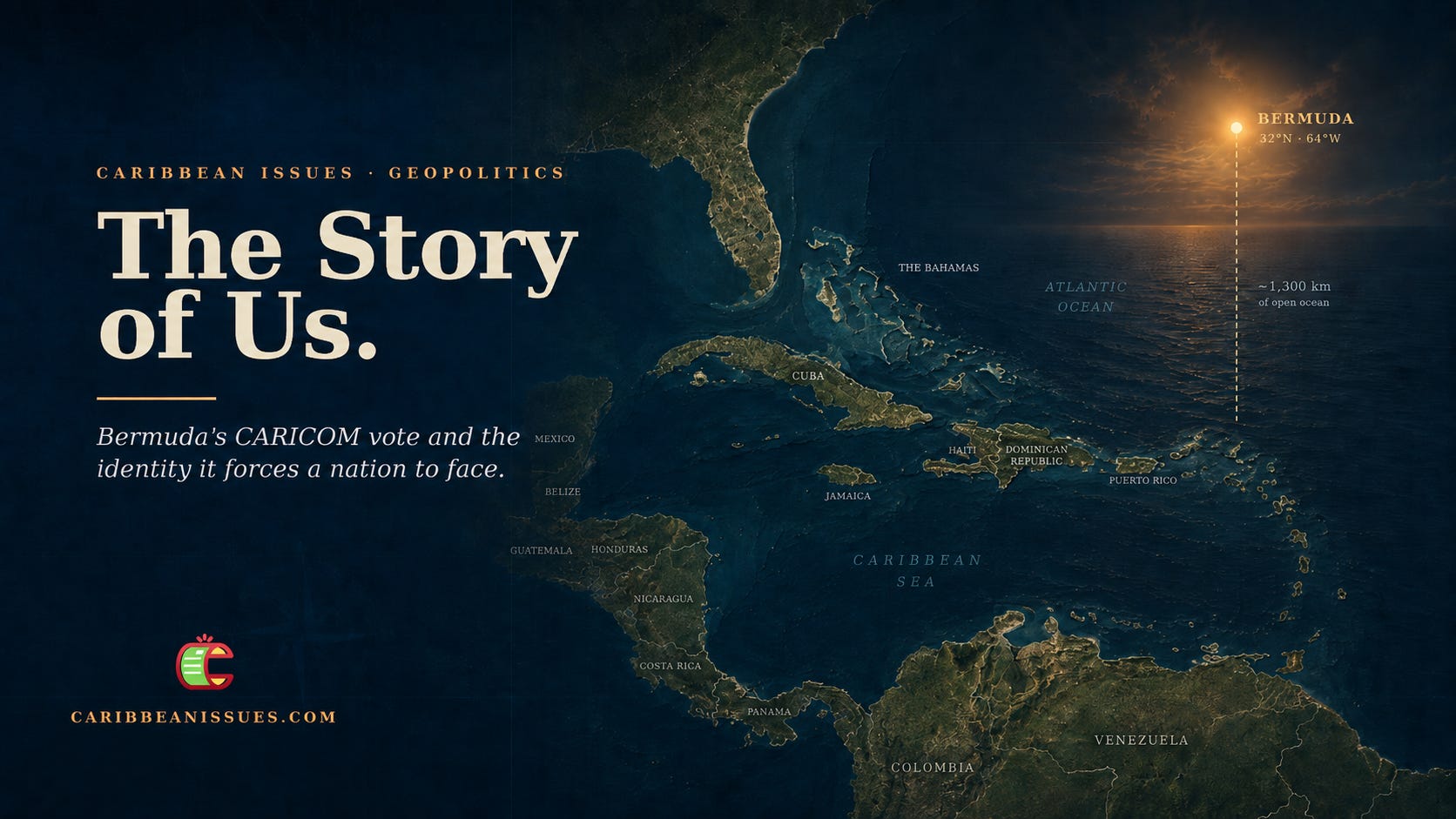
And in March 2026 , Home Affairs Minister Alexa Lightbourne tabled a Green Paper in the House of Assembly. Its title is not bureaucratic. It is, deliberately, The Story of Us .
The Green Paper, in one picture
The Green Paper, in one picture: Associate Member vs Full Member The proposal can be summarized very simply. As an Associate Member, Bermuda already participates in the cultural, sporting, and disaster-cooperation work of CARICOM. It does not vote. It does not access the Caribbean Single Market and Economy (CSME). It has no formal voice when CARICOM negotiates with the United States, the European Union, or the United Nations.
Full membership would change three things. It would give Bermuda a vote . It would unlock economic access — to regional supply chains, to food security initiatives, to workforce mobility programmes designed for Bermudian talent. And it would give Bermuda representation in the external negotiations that increasingly determine what small Atlantic and Caribbean states are allowed to be.
Three things would not change. Immigration control stays with Hamilton. As Lightbourne told the House, “Full membership does not grant CARICOM nationals the right to live or work here. The work permit system stays in place.” British citizenship stays. Bermuda would remain a British Overseas Territory. And Bermuda’s $4.5-billion-trade-surplus partner , the United States, would not be disturbed — the Bahamas has been a full member since 1983 and its relationship with Washington, in Lightbourne’s own words, “has never been stronger.”
There is one item in the proposal that is genuinely awkward, and the government has been less than fully forthcoming about it. As a British Overseas Territory, Bermuda would be required to abstain from CARICOM statements on external relations, defence, and security that conflict with UK positions, and the British government would retain a prior-approval right over any binding agreement Bermuda signed as a CARICOM member. The Shadow Home Affairs Minister, Michael Fahy of the One Bermuda Alliance, has been making this point in the Royal Gazette with increasing volume since March. He calls it an “artificial wedge” for an independence debate.
He may be right that it is a wedge. He is wrong that it is artificial.
The objections, taken seriously
The town hall in Somerset on May 14 was not, by most accounts, a happy room. The May 15 Royal Gazette report on a parallel forum captured the texture: one woman asked simply, “Is this the time to do this?” A former permanent secretary, Ellen-Kate Horton, said she could not support the extra spending while Bermudians went without health insurance and homes. “We’re going to spend an extra $2.8 million dollars a year so that you can have a seat at the table?” she asked, and the room agreed with her tone if not always with her numbers.
The opposition’s case rests on three load-bearing claims, and all three deserve to be addressed honestly:
One: that Bermuda gains nothing materially from full membership it does not already have. This is the strongest version of the argument, and it is not exactly wrong. Bermuda already trades with CARICOM countries. It already cooperates on disasters, on culture, on financial regulation. The Green Paper concedes this. Its rebuttal is that “access to a market is not the same as a seat at the table where the rules governing that market are written.” That is, in fact, an answer — but it is an answer for people who already accept that the rules being written in CARICOM rooms will matter to Bermuda. For people who do not believe that, the answer is unpersuasive.
Two: that $2.8 million a year is the wrong priority. Health insurance in Bermuda costs $439.55 per member per month, a figure that just rose by $39.24 this April because the Mutual Reinsurance Fund cannot cover its hospital obligations. Homelessness is visible on the streets of Hamilton. The educational system is, by the PLP government’s own admission, in need of “reform.” If you start the calculation from any of those facts, $2.8 million looks less like the price of a seat and more like the cost of an indulgence.
Three: that this is a stalking horse for independence. The OBA has been most explicit on this point. They note, correctly, that Premier David Burt has called his inability to lead Bermuda to sovereignty a “personal tragedy.” They note that the PLP’s founding constitution lists independence as the party’s ultimate goal. And they point to the awkward UK-prior-approval clause as a designed-in source of future friction — an “artificial wedge,” in Fahy’s phrasing, that will eventually produce a crisis that “forces” an independence vote.
There is no honest way to dismiss this concern. Burt has said what he has said. The PLP is what it is. The clause Fahy describes is real. The OBA is not inventing a conspiracy.
But there is a more accurate way to characterize what is happening, and it is this: Bermuda is being asked to take its own past seriously enough to make a present decision about it. Whether you call that “a wedge for independence” or “an honest accounting of who Bermuda is” depends mostly on which of those two outcomes you fear.
The room Bermuda isn’t in
The deepest case for full membership is the one the Green Paper makes least clearly, perhaps because making it would require the Government to be more candid about the world it is operating in.
The Caribbean is in the middle of the most volatile geopolitical reordering it has faced since the Cold War. The Strait of Hormuz is contested . Crude oil is moving through the Atlantic on routes that did not exist three years ago. Guyana is now South America’s second-largest oil producer . Trinidad is rebuilding its energy posture around regional cooperation. The United States is asserting an expansive Monroe Doctrine in the basin. China is investing across the region. CARICOM, after years of being treated as a polite irrelevance by larger powers, has suddenly become the venue where consequential decisions about Caribbean futures are being argued out.
On May 18 — yesterday — CARICOM issued a formal statement on the Strait of Hormuz, invoking the UN Convention on the Law of the Sea, defending the rights of small states to unimpeded transit passage, and warning of the “instability in global markets” already hitting Caribbean economies. The statement was signed by 15 member states. Bermuda was not in that room.
When the Caribbean Community speaks now, it speaks for itself in ways it has not since 1973. The communiques coming out of the 50th Heads of Government conference in Basseterre in February were, by regional standards, unusually direct: on Venezuela, on Haiti, on climate finance, on the proposed reparations framework. Bermuda, as Lightbourne put it, “was not in the room when those discussions took place.”
This is the structural argument that the cost-versus-benefit framing misses. $2.8 million per year is a real number. So is the cost of being a small Atlantic island whose interests are negotiated for it by people who do not have to live with the consequences.
The identity question, named plainly
There is one more layer to all of this, and it surfaced clearly in the comments under the Bernews announcement of tonight’s town hall. One reader’s note on the proposal cut to the bone:
“All CARICOM countries are classified as DEVELOPING countries… I highlighted Developing as Bermuda is developed. The PLP is trying to get you to accept that this is about race. It has nothing to do with race.”
It is worth sitting with what that comment is doing. The argument is that Bermuda — with its high GDP per capita, its insurance and reinsurance sector, its offshore finance industry — does not belong in a room full of developing nations. The argument is that membership is a kind of demotion. The argument is that the people pushing it are confusing race with economics, and economics with destiny.
You do not have to agree with that argument to recognise what it is asking. It is asking whether the Caribbean is a place defined by its hardships or by its history. It is asking whether “developed” and “Caribbean” are categories that can coexist. It is asking, at the deepest level, whether the wealth Bermuda has accumulated — through a particular pact with British capital, a particular history of segregated property ownership, a particular position in the offshore financial architecture — has earned Bermuda the right to define itself as something other than what its founding population came from.
Phil Perinchief, the former Attorney-General who spoke on the panel in April, gave the answer the PLP wants to give. “For me,” he said, “this is a unity — a renaissance. This is us going back to come forward.”
That sentence is what is on the ballot tonight, whether or not anyone in the room phrases it that way.
What to watch at Penno’s Wharf
There are three things worth watching specifically in the St. George’s meeting, for those following from outside Bermuda.
First: the East End texture. St. George’s was Bermuda’s first capital. It is whiter, older, and more associated with the UBP/OBA tradition than Hamilton or the West End. The previous town hall in Sandys (the West End) was already cool to the proposal. If Penno’s Wharf is significantly cooler, the consultation enters a different political phase — one where the government will have a harder time claiming a mandate.
Second: the question of “Why now?” This is the question that has surfaced at every previous meeting. The government’s answer — that the world has changed and the terms of Bermuda’s participation have not kept pace — is true but insufficient. The fuller answer is the one Lightbourne has been reluctant to give: that the geopolitical clock is moving, that CARICOM is becoming a more consequential actor, and that the window in which Bermuda can join on its own terms may be narrower than it looks. If she finds a way to say that tonight, the conversation changes.
Third: who shows up from the international business sector. The Bermuda Chamber of Commerce, the Association of Bermuda International Companies, the Association of Bermuda Insurers and Reinsurers, and the Bermuda Hotel Association have all reserved comment until after the Green Paper. Their consultation responses are due in the coming weeks. Their position, when it lands, will likely determine the trajectory of any subsequent White Paper. A senior figure from any of those organisations turning up at Penno’s Wharf would be a meaningful signal — in either direction.
The Caribbean Issues take
The Caribbean is having its sovereignty moment in fragments. Guyana is having it through oil. Trinidad is having it through gas. Jamaica is having it through reparations and the constitutional question. Bermuda’s version is quieter, more procedural, more wrapped in the language of consultation papers — but it is the same moment.
What is being asked of Bermudians tonight is not, finally, whether they want to spend $2.8 million on a seat. It is whether they are willing to name the relationship that already exists. The Bermuda that holds the Caribbean Financial Action Task Force chair is already part of the Caribbean. The Bermuda whose founding political party was built by West Indian immigrants is already part of the Caribbean. The Bermuda whose families call relatives in Jamaica, St. Lucia, and Trinidad every Sunday is already part of the Caribbean.
The Green Paper is called The Story of Us because the government has chosen to argue that the question is one of recognition, not creation. They are betting that if Bermudians read the document carefully, they will find their own history in it.
It is a serious bet. It might be the wrong one — Bermuda has, before, declined to ratify the obvious thing. But for a region that is going to have to navigate the next decade with more cohesion than the last five, a Bermuda that decides to come into the room would be a meaningful thing. And a Bermuda that decides to stay outside would be saying something worth listening to as well.
The meeting at Penno’s Wharf starts at 7:00 PM. We will be watching.
Sources and documentation
Sources are consolidated here so the investigation reads continuously while the record remains directly inspectable. Evidence roles describe how a source is used; they are not automatic truth scores.
Supports: Tonight at 7:00 PM, in the cruise ship terminal at Penno’s Wharf in St. George’s , a few dozen Bermudians will gather to discuss something that sounds technical and is not. The Government of Bermuda is asking the public whether the islan...
Currency: Date metadata is missing; recheck before relying on current conditions.
Supports: There is one item in the proposal that is genuinely awkward, and the government has been less than fully forthcoming about it. As a British Overseas Territory, Bermuda would be required to abstain from CARICOM statements on external rela...
Currency: Date metadata is missing; recheck before relying on current conditions.
Supports: On May 18 — yesterday — CARICOM issued a formal statement on the Strait of Hormuz, invoking the UN Convention on the Law of the Sea, defending the rights of small states to unimpeded transit passage, and warning of the “instability in gl...
Currency: Date metadata is missing; recheck before relying on current conditions.
Supports: • The Royal Gazette , “Forum attendees criticise plan for full Caricom membership” (May 15, 2026)
Currency: Date metadata is missing; recheck before relying on current conditions.
Supports: • The Royal Gazette , “Full Caricom membership Green Paper published” (March 9, 2026)
Currency: Date metadata is missing; recheck before relying on current conditions.
Supports: • Bernews , “Two Town Halls On CARICOM Membership” (May 6, 2026)
Currency: Date metadata is missing; recheck before relying on current conditions.
Supports: • House of Commons Library , UK–Bermuda relations and the visit of King Charles III 2026
Currency: Verification is older than 45 days; review before relying on current conditions.
Supports: • The Round Table , “Bermuda’s independence referendum – 30 years on” (September 2025)
Currency: Date metadata is missing; recheck before relying on current conditions.
Supports: The March 2026 launch, purpose and scope of Bermuda's Green Paper consultation on full CARICOM membership.
Currency: Verification is older than 45 days; review before relying on current conditions.
Supports: The consultation process and the Green Paper's stated economic, food-security, mobility and resilience considerations.
Currency: Verification is older than 45 days; review before relying on current conditions.
Editorial standards, corrections and AI-assistance policy · Privacy and data use
Caribbean Issues Reader Forum
What is your view?
Rate the usefulness of this analysis, respond to its evidence and add knowledge from the Caribbean or diaspora. Comments are reviewed before publication.
Was this analysis useful?
How would you describe it?
Reader discussion
Loading approved comments…