
The short answer
Caribbean education cannot be judged only by enrolment and examination results: the harder test is whether it develops applied capability, productive confidence, entrepreneurship and the power to build institutions suited to Caribbean needs.
Publication record
Transparent responsibility and verification details for this Caribbean Issues publication.
- Published
- Updated
- No later revision recorded
- Responsible byline
- Caribbean Issues
- Verification
- Editorially reviewed under our published method
- Sources listed
- 4 sources listed below
- Primary topic
- Caribbean History, Culture and Identity
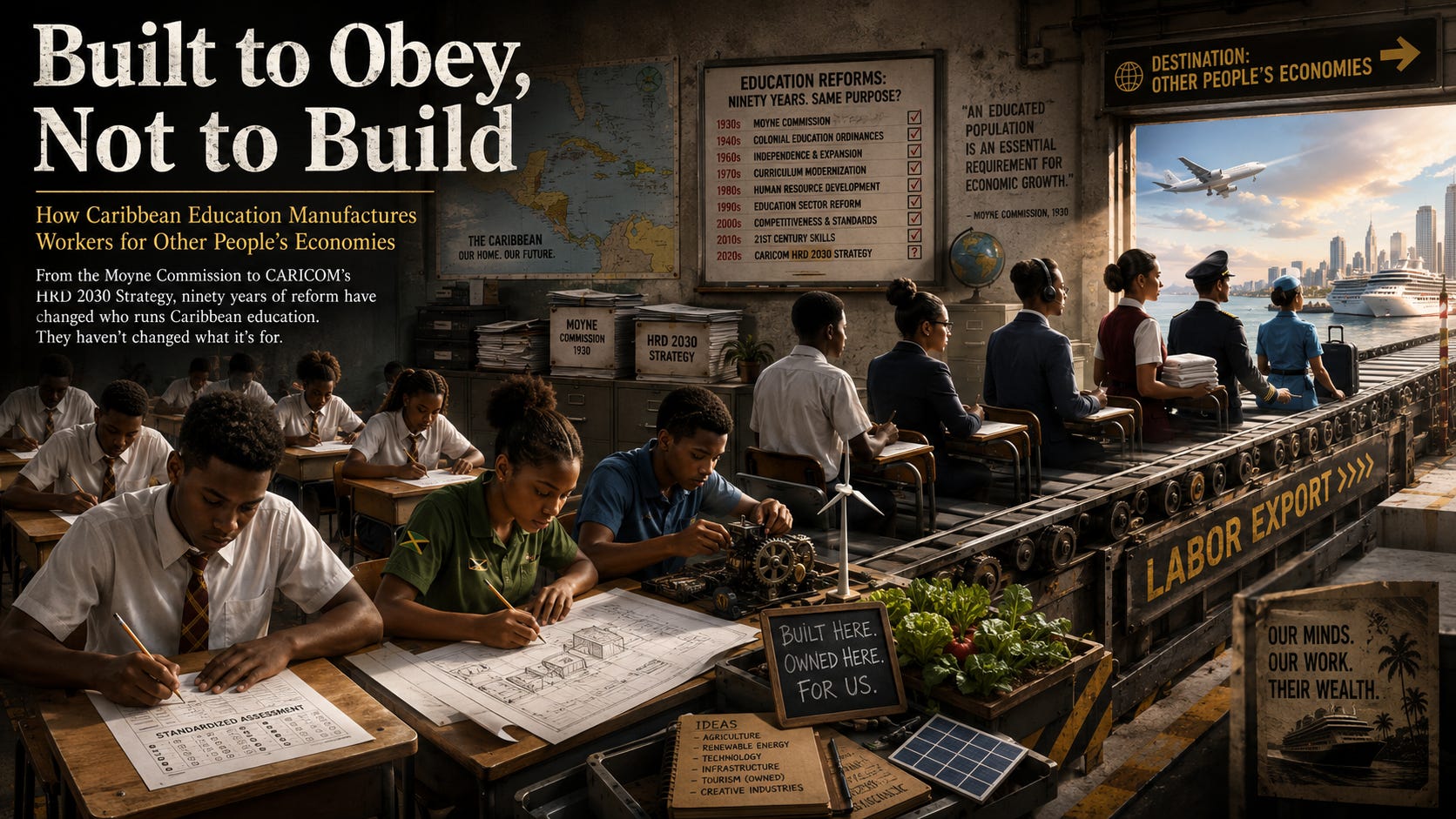
Built to Obey, Not to Build From the Moyne Commission to CARICOM’s HRD 2030 Strategy, ninety years of reform have changed who runs Caribbean education. They haven’t changed what it’s for.
The central argument
Every September, across fifteen CARICOM states, a new cohort of children walks into a system built on a foundation nobody in the region laid down. The uniforms are ours. The teachers are ours. The exam certificates carry a Caribbean name — CXC, CSEC, CAPE. But the architecture underneath — what gets tested, how success is defined, what a “good student” is trained to become — is a colonial inheritance that independence never actually replaced. It was renovated. It was never rebuilt.
That distinction is not academic. It shows up in the numbers every single year, and it is quietly determining whether Caribbean economies produce owners or exporters of their own best people.
This piece is, in a sense, the origin story behind an argument Caribbean Issues has already made once. In “Knowledge Is Not Power: Applied Knowledge Is The Real Revolution” , we argued that Caribbean power depends on a formula — Knowledge × Application × Organisation × Ownership — and that the region has never lacked the first term while chronically underbuilding the other three. What follows here is the answer to the question that piece left open: why. Why does a region this talented keep producing people who know without building, who diagnose without owning? Start at the schoolhouse.
Only 41% of CSEC candidates in 2024 passed five or more subjects including Mathematics and English.
A System Handed Down, Not Designed
Ask most Caribbean people whether their education system was built for the region, and the instinctive answer is yes — it has Caribbean history in the syllabus, Caribbean literature, Caribbean geography. But go back to how the modern system was actually assembled and a different picture emerges.
The current architecture is a direct descendant of the British colonial school system: age-graded classes, a fixed academic calendar, subject silos, and — most importantly — a battery of high-stakes exams whose entire purpose was originally to sort, not to develop. Trinidad’s Secondary Entrance Assessment, which decides at age eleven or twelve which secondary school a child will attend for the rest of their academic life, is a near-direct descendant of the old British-era College Exhibition Examination — a mechanism explicitly designed under colonial rule to limit access to quality schooling to a small, mostly elite cohort, not expand it. Barbados, Jamaica, and most of the English-speaking Caribbean run some version of the same sorting logic.
When political independence arrived in the 1960s and 70s, the region did move to reclaim educational sovereignty — CXC was created specifically to replace British-set colonial examinations with something designed and controlled regionally. That was a real and important act of nation-building. But researchers who have studied how that transition actually happened in places like Jamaica have found something uncomfortable: the state’s working assumption at the time was that the model itself was fundamentally sound, and only needed to be “Jamaicanized” — localized in content — and expanded to reach more people. Nobody seriously asked whether the underlying purpose of the machine needed to change, only who it should serve and what it should contain.
The result, one Caribbean education commentator has argued, is that the region gained political independence but never achieved educational independence. Students today are still moving through what is, structurally, a nineteenth-century industrial-age exam system — built originally to instill obedience and produce a disciplined workforce for factory floors and colonial administration. Those factory-floor jobs have all but vanished. The system built to feed them hasn’t.
SIDEBAR — The Moyne Commission and the Blueprint Nobody Revisited
To understand why “handed down, not designed” isn’t just a metaphor, it helps to go back to the actual document that shaped modern Caribbean social policy, including education.
In 1937 and 1938, labour uprisings swept the British West Indies — sugar workers in Jamaica, oilfield workers in Trinidad, cane cutters across the smaller islands, all rebelling against poverty wages and plantation-era conditions that had barely moved since emancipation. Alarmed, London dispatched a Royal Commission under Lord Moyne to investigate. Its report, completed in 1939 but suppressed by the British government until 1945 — officials feared Nazi Germany would use its findings on colonial neglect as propaganda — became the founding document of the modern West Indian welfare state.
The Moyne Commission’s education findings were damning: chronic shortages of qualified teachers, especially on the smaller islands, and schooling that had failed the population wholesale. Its central recommendation was not community-designed schooling — it was greater government control of the education system, funded through a new West Indian Welfare Fund that Britain would administer for the region. The commission also pushed import-substitution ideas well ahead of their time — building local manufacturing, milling cornmeal domestically, making the islands food self-sufficient rather than import-dependent — but historians studying the Commission’s actual implementation, particularly in Barbados, have described the resulting reforms as managed and muted by colonial administrators rather than handed to the people whose uprising provoked them in the first place. One historian’s assessment: the changes of the 1930s were, in substance, “pure shadow rather than substance” for the working people who forced the reckoning.
This is the seed of the pattern this piece keeps encountering ninety years later: crisis provokes a colonial-administered fix, the fix expands access without changing purpose, and the underlying architecture — who controls it, what it optimizes for — stays in outside hands even as the personnel running it eventually become Caribbean. Independence changed the second thing. It has never fully changed the first.
What the Numbers Say About What This Produces
The scale of the current crisis is not a matter of interpretation — it is heavily documented, and it is worse than most people outside the education sector realise.
• On the 2024 CSEC exams, the region-wide benchmark — five or more subjects including Mathematics and English — was met by just 41% of candidates, down sharply from 51.5% in 2023 (it recovered somewhat to 44% in 2025). The Mathematics pass rate alone sat at 36% regionally, and results varied widely by territory: Jamaica recorded just 18%, Trinidad and Tobago 45%.
• Regionally, on the 2022 PISA assessment — the first with meaningful Latin American and Caribbean participation — three in four 15-year-olds could not demonstrate foundational math skills, and roughly half could not meet basic reading benchmarks. The IDB and World Bank jointly called it one of the region’s worst education crises in a century.
• Pre-pandemic, roughly half the region’s ten-year-olds already could not read and understand a simple age-appropriate text — the World Bank’s definition of “learning poverty.” By 2021, that figure is estimated to have jumped from 51% to 62.5%, an additional 7.6 million children pushed into learning poverty across Latin America and the Caribbean.
• Trinidad and Tobago and Jamaica have both scored significantly below global averages on PISA, a gap the World Bank has flagged as underscoring the need for comprehensive reform, not incremental patching.
None of this reads as a system quietly underperforming. It reads as a system failing at its most basic stated function — teaching children to read, write, and calculate — at scale, year after year, regardless of which government or minister is in office. Reform initiatives come and go. The pass rates don’t move.
“Job Seekers, Not Job Creators” — The Quiet Admission Inside Caribbean Research
Here is the sentence that should be at the centre of any honest conversation about Caribbean education reform. Caribbean researchers Danns and Mentore, studying the region’s curriculum content directly, concluded that the current educational curriculum in the Caribbean is targeted at developing job seekers rather than job creators.
That is not a critique from an outside skeptic. That is a finding from inside Caribbean academia, describing the system’s actual design intent as reflected in what it teaches and how it evaluates success.
It shows up downstream in the data. Entrepreneurial intention research across Caribbean Small Island Developing States finds persistently weak conversion from potential to actual business ownership, tied closely to socio-cultural perceptions the education system itself helps shape — what counts as a respectable, “safe” outcome for a bright student. Regional entrepreneurship researchers have pointed out that most nascent Caribbean entrepreneurs are not driven into business by necessity, but the pipeline that could be turning capable young people into opportunity-driven founders remains thin, under-capitalized, and structurally an afterthought bolted onto an academic system built for something else entirely.
This is the throughline connecting the “workers, not producers” instinct to hard evidence: a system built to sort students toward passing standardized exams and securing a credential is, by design, optimizing for compliance and recall — the exact behaviours that make someone a good employee inside someone else’s enterprise, not the behaviours that make someone build, own, and scale an enterprise of their own.
Put in the terms of the earlier Caribbean Issues formula — Knowledge × Application × Organisation × Ownership = Power — this is where the equation starts breaking down. It doesn’t break down at Knowledge; the region has never lacked that term. It breaks down at Application, in the exact institution meant to build it. A curriculum organised around recall and sorting produces graduates well-stocked on the first variable and structurally undertrained on the other three. The multiplication collapses at the second step, in a school building, years before anyone reaches the labour market where the collapse eventually gets noticed.
The Reform That Isn’t Quite Reform
To be fair to the region’s policymakers: there is a live, funded, multi-country reform agenda underway, and it isn’t nothing.
CARICOM’s Human Resource Development (HRD) 2030 Strategy, approved in 2017, and the Regional TVET Strategy for Workforce Development and Economic Competitiveness, dating to 2014, are both explicitly framed around building “the critical skills needed to attract and sustain decent job-creation from foreign and domestic investments,” in the words of CARICOM’s Assistant Secretary General for Human and Social Development. In 2024–2025, this moved into a concrete digitalization pilot — the Digitalisation of TVET Delivery Project — running across institutions in Barbados, Grenada, Jamaica, and Trinidad and Tobago, backed by the EU, Germany’s GIZ, and Brazil’s SENAI, aiming to build a regional digital platform for skills training aligned with “the demands of today’s job market.”
This isn’t abstract for Grenada specifically. The New Life Organization is the country’s designated institution in that pilot — one of only four bodies across the entire fifteen-member Community selected to help build out the region’s digitalized TVET platform, alongside Barbados’s Samuel Jackman Prescod Institute of Technology, three HEART colleges in Jamaica, and Trinidad’s YTEPP. In August 2025, instructional designers from New Life joined counterparts from the other pilot territories in Goiânia, Brazil, training directly with SENAI to learn how to digitize vocational content for delivery back home. That puts Grenada in an unusually direct position: whatever version of “modernized TVET” gets built through this pilot, New Life is one of the institutions actually shaping what it looks like on the ground, not just receiving it after the fact from Kingston or Bridgetown.
That’s exactly why the purpose question in this piece matters most at the local level, not just the regional one. If New Life’s mandate stays anchored to the same framing driving the regional strategy — producing “portable” workers for the CSME labour market — Grenada gets a well-digitized version of the same job-seeker pipeline. If the mandate is deliberately widened even slightly, toward certifying people who can build something — a small agro-processing operation, a dive-tourism venture, a repair or fabrication business serving the local market — the same infrastructure investment produces a fundamentally different economic outcome for the same island. The platform being built right now doesn’t predetermine which of those two futures Grenada gets. The people setting the pilot’s local scope do.
This is real infrastructure, real money, real regional cooperation. It deserves credit.
But it’s worth reading the fine print on what this reform is actually optimizing for. One detailed academic critique of the HRD 2030 Strategy argues that since 2002, CARICOM’s human resource reforms have shifted away from broad-based mass education and toward TVET specifically to facilitate labour mobility for the Caribbean Single Market and Economy (CSME) — the free movement of certified workers across borders. The researcher frames this explicitly as a neoliberal reform logic: education repositioned as a supply mechanism for regional and global labour markets, rather than as a foundation for indigenous production and ownership.
Put plainly: the newest wave of Caribbean education reform is largely about making Caribbean labour more exportable and more certifiable, not about building a generation of Caribbean owners, builders, and producers. It is the same worker-not-producer pattern the colonial system encoded, now running under a modernization label, digitized rather than decolonized.
Why “Outdated” Undersells the Problem
It would be comforting to conclude that this is simply a pedagogy problem — old-fashioned rote teaching, chalk-and-talk instruction, an exam culture that needs modern classroom techniques. That’s part of it. A senior World Bank economist studying the region has pointed to outdated teaching methods and deep-rooted inequalities in access as the real drivers of underperformance — not any deficit in Caribbean students’ ability, which she is explicit is not the issue.
But several Caribbean researchers push further and argue the system isn’t malfunctioning — it’s functioning as it was built to. One study of West Indian education practice points out that the overwhelming majority of passes on regional exams sit at the lowest acceptable grade, and roughly 40% of students fail the English language exam annually despite twelve years of schooling. A system producing that outcome for decades, through repeated waves of “reform,” suggests the sorting function itself — who the system was built to select in, and who it was built to filter out — has never actually been touched. The syllabus got Caribbean content. The selection machine underneath kept running on its original settings.
This matters enormously for how reform gets designed going forward. If the diagnosis is “outdated methods,” the fix is new textbooks, teacher training, better classroom technology. If the diagnosis is “wrong purpose,” the fix is a fundamentally different theory of what the system is for — and no amount of digitizing the same job-seeker curriculum will touch that.
The Exit Ramp: Brain Drain as the System’s Actual Output
If you want to see what this architecture is actually optimized to produce, look at where its highest performers end up.
CARICOM’s 2024 Labour Market Report shows youth unemployment near 30% in Jamaica, Trinidad and Tobago, and Guyana — even as skilled professionals leave the region in significant numbers. Jamaica lost 60% of its nursing cohort to overseas recruitment in a single year, 2023. Older but still-relevant research found that some Caribbean countries have lost more than 70% of their labour force with twelve or more years of completed schooling — among the highest skilled-emigration rates anywhere in the world — driven by a combination of crime and instability, a persistent skills mismatch between what’s taught and what local economies actually need, and a shortage of both economic and social opportunity at home.
This is the quiet tragedy underneath the reform rhetoric: Caribbean taxpayers fund the education of their most capable citizens, and a very large share of the return on that investment is captured by Canada, the United States, and the United Kingdom instead. A system oriented around producing certified, mobile, exportable workers will, unsurprisingly, keep exporting its best output. The brain drain isn’t a leak in an otherwise sound system. It’s close to the system’s actual product.
The AI-Era Stakes
This is where the argument stops being historical and becomes urgent.
A system optimized for compliance, standardized recall, and exam performance is training people for precisely the category of cognitive labour that generative AI is fastest at automating — procedural knowledge, rote calculation, formulaic writing, pattern-matching against a known answer key. These are not hypothetical future job losses; they are already-visible pressures on the exact entry-level, process-driven roles that a job-seeker-oriented education system has spent generations funneling graduates toward.
A system oriented instead around producing — building things, owning enterprises, solving ambiguous local problems, working with judgment rather than recall — is training for the layer of the economy that AI augments rather than replaces. That is not an argument against technology in the classroom. CARICOM’s own digitalization push and voices within the University of the West Indies are already framing AI as a tool that, used well, can nurture critical thinking rather than just deliver content faster. But a digitized version of a job-seeker curriculum is still a job-seeker curriculum — just delivered on a screen instead of a chalkboard. The technology is not the reform. It’s a delivery mechanism for whatever the underlying design already is.
The small-state literature on this is candid about the fork in the road: the rise of ICT and rapid technological change genuinely open the possibility for small states to leapfrog straight past the old industrial model of schooling entirely. But there is an equally real risk that a new, commoditized global education paradigm simply locks small states — and the Caribbean specifically — into a more digitized version of the same peripheral role: certified, mobile, replaceable labour for someone else’s economy, rather than an economy that owns and builds its own value.
The Counter-Example: What Jamaica’s HEART Trust Gets Right — and Where It Still Falls Short
It would be dishonest to write this piece as if nothing in the region has worked. Jamaica’s HEART Trust/NSTA — the national TVET agency — is the closest thing the Caribbean has to a proof of concept that a different design is possible, and it’s worth being specific about why it works before being specific about its limits.
HEART runs on a competency-based model rather than an exam-recall model: trainees are certified against real occupational standards — performance observation, portfolio review, actual product inspection — not a written exam alone. The results are hard to argue with on their own terms. Certification rates exceed 90% across nearly all HEART programme categories, a startling contrast to CSEC’s single-digit five-subject pass rate. NVQ-J and CVQ certifications more than doubled in a five-year stretch in the 2000s, and the agency now partners with dozens of public and private sector organisations to keep training aligned with what employers actually need on the ground. The regional version of this credential, the Caribbean Vocational Qualification (CVQ), is CARICOM-endorsed and now offered inside secondary schools across multiple territories, letting students earn workplace-recognised competencies alongside — or sometimes instead of — the traditional academic track.
This is genuinely the right shape of reform: it replaced recall with demonstrated capability, and it replaced a single terminal exam with a portable, stackable credential. It also surfaced the depth of the underlying problem rather than hiding it — HEART’s own reporting has flagged that a majority of applicants arrive with weak basic education, with historical intake data showing roughly 60% failing a basic grade-nine diagnostic before vocational training even begins. That is itself a quiet indictment of everything upstream of HEART.
But look closely at how even this success story describes its own mission. The regional body governing the CVQ states its purpose plainly: to produce “highly skilled, portable, and industry-aligned workers” for local and regional economic development. Portable. Workers. Even the best-functioning, most genuinely reformed institution in Caribbean education still frames its ultimate product as better-credentialed labour for someone else’s payroll — Caribbean or foreign — rather than as owners standing up their own enterprises. HEART fixed the pedagogy problem. It did not touch the purpose problem. That is precisely the distinction this piece has been building toward: a system can modernize its methods completely and still be organised, at the root, around producing exportable workers instead of producers.
What a Producer-Oriented System Would Actually Look Like
If the diagnosis is right — that the system optimizes for job-seeking, not job-creating — then the fix isn’t a better version of the same machine. It’s a different machine, judged by different outcomes. In practice, that likely means:
1. Ownership as a graduation outcome, not an elective. Right now, entrepreneurship is bolted onto Caribbean tertiary education as an occasional module, often taught by lecturers with no founder experience of their own. A producer-oriented system would treat “can this student identify a local problem and build a viable venture around it” as seriously as CXC treats “can this student pass Mathematics” — assessed, resourced, and mentored by people who have actually built something, not just taught about building.
2. Capital and market access built into the curriculum, not left to chance afterward. The region’s own entrepreneurship researchers are consistent on this point: access to financing and start-up capital is one of the single biggest blockers converting entrepreneurial intention into actual Caribbean businesses. A system serious about producers, not workers, would treat seed capital, micro-financing pathways, and reduced start-up bureaucracy as part of the pipeline — not a separate policy conversation that happens after school ends.
3. Assessment built on demonstrated capability, region-wide — HEART’s model, generalized upward. HEART/CVQ proves competency-based assessment works at scale in the Caribbean. The question is why this logic stops at the vocational track instead of reorganizing CSEC and CAPE themselves around demonstrated capability rather than single-sitting exam recall.
4. Curriculum built around Caribbean problems with Caribbean-retained value — not global employability alone. Climate adaptation, food security, regional shipping and logistics, tourism-linked agro-processing, blue economy ventures — these are specific, high-value problems that only get solved by people trained to build inside the region, for the region, keeping the resulting value circulating in Caribbean hands. A curriculum organised around passing an internationally-benchmarked exam has no particular reason to orient toward any of this. A curriculum organised around producing owners does.
5. AI taught as a builder’s tool from an early stage, not bolted on as digital literacy. The danger flagged earlier — digitizing the same job-seeker curriculum — is avoidable, but only if AI is introduced as something students use to build and launch things (prototype a product, model a business, automate a small operation) rather than as a subject to be examined on in the abstract.
None of this requires abandoning CXC, HEART, or CARICOM’s existing reform architecture. It requires pointing the same institutional machinery at a different definition of success.
Where This Leaves the Region
Pulling the threads together:
6. Origin — Handed down, not designed. A British sorting-and-obedience architecture, built for factory-floor jobs and colonial administration under a model the Moyne Commission entrenched rather than reinvented, that got Caribbean content after independence but never a Caribbean purpose.
7. Function — Caribbean researchers themselves describe the resulting curriculum as built for job seekers, not job creators — and the entrepreneurial-intention and startup-conversion data bears that out.
8. Outcome — The system currently produces either underemployment at home (roughly 30% youth unemployment in several major economies) or export of the region’s best-educated citizens abroad. Brain drain isn’t the exception to the design. It’s close to the design’s result.
9. Current reform — Real, funded, and regional (HRD 2030, TVET digitalization, HEART/CVQ) — genuinely improving how skills are assessed, but still substantially organised around making Caribbean labour more mobile and certifiable for the CSME and international markets, which is a modernized version of the same worker-export logic, not a full break from it.
10. The AI moment — Raises the cost of getting this wrong. The skills the old system optimizes for are exactly the skills AI devalues fastest. The skills a producer-oriented system would build — ownership, building, ambiguous problem-solving, regionally-circulating value creation — are the ones that hold up.
The question the region has never squarely asked is not “how do we improve pass rates on an inherited exam system,” but “what would an education system look like if it had been designed, from the ground up, by people who intended for its graduates to own the Caribbean’s economy rather than staff someone else’s.”
A Maroon Economics Reading of the Problem
Maroon Economics starts from a simple discipline: value created by Caribbean people should circulate within the Caribbean before it leaves. Judged against that single standard, the education system’s core failure comes into focus immediately. A curriculum that trains its highest achievers for export, and its median students for a shrinking pool of low-value local jobs, is a system that structurally exports Caribbean-created value at its most concentrated point — human capital — before that value has a chance to compound at home.
The historical throughline traced here — Moyne Commission control without community design, CXC localization without architectural change, HRD 2030’s labour-mobility logic, even HEART’s “portable workers” framing — is the education-sector expression of the exact pattern Maroon Economics was built to name and interrupt: institutions repeatedly reformed by and for outside interests, with Caribbean people cycled through as the labour input rather than positioned as the owners of the output.
The traditions this framework draws on — Maroon self-provisioning in Grenada and the Windwards, Gayap in Trinidad, Koudmen across the French Creole islands — were never welfare programmes administered from outside. They were communal labour systems designed, controlled, and continually redesigned by the people using them, built around a shared and explicit goal: keep what we build among ourselves. That is the design principle absent from Caribbean education for nearly two centuries, through colonial rule and through independence alike.
Practically, that suggests where a Maroon Economics-aligned education agenda would start — not with another CARICOM strategy document, but with concrete, ownable pilots: a regional producer-track credential, sitting alongside CVQ, assessed on launched ventures rather than exam recall; seed-capital pools tied directly to secondary and tertiary institutions rather than external to them; and curriculum built explicitly around sectors where Caribbean-retained value is highest — climate adaptation, blue economy, agro-processing, regional logistics — rather than around whatever skills happen to be most exportable to Toronto, Miami, or London.
The system was handed down once. Redesigning it, this time, on Caribbean terms, is not a nostalgic project. It’s the next chapter of the same self-provisioning tradition this publication is named for.
Maroon Economics T-shirts - available at Caribbean Issues Store Related reading from Caribbean Issues:
“Knowledge Is Not Power: Applied Knowledge Is The Real Revolution” — the piece this investigation answers, on why Caribbean power depends on more than what the region already knows.
“Maroon Economics” — the region’s path to economic sovereignty
Questions readers are asking
What is the central problem identified in Caribbean education?
The article argues that access and certification have expanded without consistently aligning learning with applied capability, productive work, entrepreneurship and regional problem-solving. It treats this as a design and purpose problem, not a criticism of Caribbean students or teachers.
What does the evidence say about skills and employment?
World Bank and Caribbean Development Bank research identifies continuing weaknesses in foundational skills, labour-market relevance, education-to-employment pathways and skills matching. These findings support reform centred on learning outcomes and practical capability.
What does Jamaica's HEART/NSTA model demonstrate?
HEART/NSTA demonstrates the value of competency-based training, workplace learning, certification, job placement and entrepreneurship support. It is a useful Caribbean counter-example, although it does not by itself resolve every structural weakness in the wider education system.
Sources and documentation
Sources are consolidated here so the investigation reads continuously while the record remains directly inspectable. Evidence roles describe how a source is used; they are not automatic truth scores.
Supports: Evidence on education quality, foundational ICT, English and mathematics skills, labour-market relevance and long-term Caribbean growth.
Currency: Verification is older than 45 days; review before relying on current conditions.
- [2]Caribbean Development Bank — Formative Evaluation of Youth Policy and Operational StrategyIntergovernmental record
Supports: Regional evidence on youth exclusion, skills mismatch, demand-driven TVET, apprenticeships, entrepreneurship and education-to-employment pathways.
Currency: Verification is older than 45 days; review before relying on current conditions.
- [3]HEART/NSTA Trust — Jamaica's human-capital development and competency-based training modelOfficial record
Supports: HEART/NSTA's practical, competency-based, work-linked and entrepreneurship-support model as a Caribbean counter-example.
Currency: Verification is older than 45 days; review before relying on current conditions.
Supports: Programme evidence on TVET access, certification, decent-work placement, entrepreneurship support, digital skills and training infrastructure.
Currency: Verification is older than 45 days; review before relying on current conditions.
Editorial standards, corrections and AI-assistance policy · Privacy and data use
Songs from the Headlines
Now hear the story: Built To Obey, Not To Build
This article inspired a song on Caribbean Issues, Vol. 1 — Songs from the Headlines. Listen to the sample, then support independent Caribbean journalism by buying the complete Digital Album Edition directly from Caribbean Issues.
One-minute song sample
Caribbean Issues Reader Forum
What is your view?
Rate the usefulness of this analysis, respond to its evidence and add knowledge from the Caribbean or diaspora. Comments are reviewed before publication.
Was this analysis useful?
How would you describe it?
Reader discussion
Loading approved comments…