
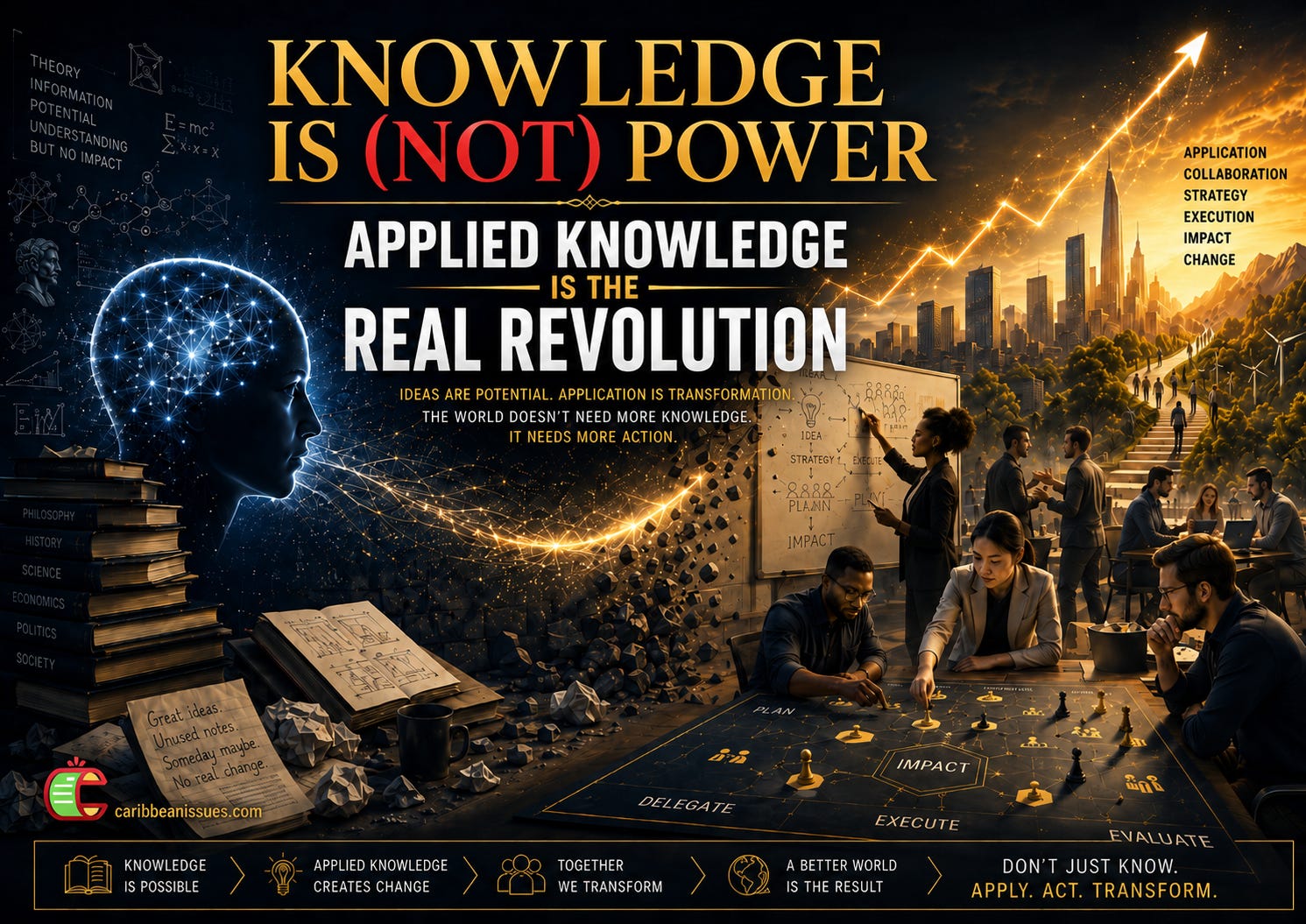
The short answer
Applied Knowledge, Organised People, and the Real Path to Caribbean Power.
Publication record
Transparent responsibility and verification details for this Caribbean Issues publication.
- Published
- Updated
- No later revision recorded
- Responsible byline
- Caribbean Issues
- Verification
- Editorially reviewed under our published method
- Sources listed
- 8 sources listed below
- Primary topic
- Caribbean History, Culture and Identity
Applied Knowledge, Organized People, and the Real Path to Caribbean Power.
The central argument
“Knowledge is power.”
It is one of the most repeated lines in the English language. It appears in classrooms, graduation speeches, motivational books, political slogans, and the back covers of self-help paperbacks. It sounds wise. It sounds complete.
It is not.
The saying is missing a word. The truth is closer to this: knowledge is potential power. It becomes real power only when something is done with it — when it is applied, when people are organised around it, when the systems it enables are built and owned. A book on a shelf is not power. A degree on a wall is not power. A government report that nobody acts on is not power. A brilliant idea that stays inside one person’s head is not power.
Power begins when knowledge moves.
And nowhere does that distinction matter more than in the Caribbean. We are a region that has never lacked intelligence. We do not lack memory, talent, or creativity. We have produced Nobel laureates, world-class musicians, world-class athletes, and a diaspora that quietly powers cities from Toronto to London. What we lack — what we have always struggled to build at scale — is the machinery that turns scattered Caribbean brilliance into collective Caribbean power.
This article is about that machinery. What it is. Why it matters. And why fixing it may be the most important sovereignty project of our generation.
The illusion of knowing
One of the dangers of the old saying is that it can create a false sense of achievement. It can make people believe that awareness is transformation . It is not.
A man may know his diet is killing him and continue to eat himself sick. A country may know it imports too much food and continue to neglect its own agriculture. A government may know its economy is brittle and continue to avoid the structural reform that would harden it. A young person may know that every skill they need is now available online and spend years consuming entertainment instead of building capacity.
The Complete Daily Strength System (CDSS) - 14 DAY FREE TRIAL In each case the knowledge exists. In each case, the world has not changed.
That is the gap. The world is not changed by what we know. It is changed by what we do with what we know. And in many post-colonial societies — including ours — we have been quietly trained to confuse certification with capability, information with intelligence, and discussion with development. We debate. We diagnose. We analyse. We complain. We explain. But do we build?
The honest answer, for too long, has been: not enough.
Knowledge as decoration
In nearly every Caribbean family I know, education is sacred. Parents sacrifice for it. Diplomas are framed. Titles are honoured. The phrase “get an education” has meant, for at least a hundred years, the path out of poverty and into dignity. None of that is wrong. Education matters. The Caribbean’s commitment to it remains one of the most beautiful things about us.
But education becomes thin when it produces people who can pass exams and not solve problems, who can quote theory and not start a business, who can identify colonial exploitation in elegant academic prose and not design the economic institution that would replace it. Knowledge that is not applied becomes decoration. It decorates résumés. It decorates offices. It decorates speeches. It decorates national five-year plans that get filed and forgotten.
Decoration is not power. Power feeds people. Power builds institutions. Power negotiates better contracts. Power protects national resources. Power organises capital. Power turns raw materials into industries and ideas into wealth.
That is what applied knowledge looks like. And it is the thing the region has, for the last sixty years of independence, found hardest to manufacture at scale.
The missing ingredient — organisation
There is another layer to all of this, and it is the one most easily overlooked.
Even applied knowledge is limited when it remains individual. A single person, however gifted, runs out of time, energy, and reach. Most meaningful success requires more than one capable person acting alone. It requires organisation — the ability to bring people, skills, money, tools, and information into alignment around a shared mission.
A person with deep technical knowledge may know how to solve a problem. A person with organisational ability knows how to gather the right people, assign roles, raise the funds, find the customers, and deliver the solution at scale. In the real world — in politics, in business, in community development — the organizer often produces more than the specialist. Not because the specialist’s knowledge is worth less, but because organisation is itself a form of knowledge: the rarest and most leveraged one.
The engineer understands the machine. The doctor understands the body. The farmer understands the soil. The economist understands the numbers. The lawyer understands the contract. The software developer understands the code. But the organizer understands how to bring all of them together — and that is, in practice, the skill that builds nations.
This is why networking, properly understood, can beat knowing.
Why networking can beat knowing
Networking is one of the most misunderstood concepts in Caribbean professional life. Many people, raised on the dignity of self-reliance, treat networking as something close to begging — chasing important people, collecting business cards, asking for favours. That is not real networking.
Real networking is the building of useful relationships based on trust, value, credibility, and mutual benefit. A person who knows how to network can access knowledge they do not personally possess. They do not need to be the accountant, the lawyer, the designer, the coder, the marketer, the logistics expert, and the manufacturer all at once. They need to know how to identify who is competent, communicate the mission, negotiate fairly, delegate responsibly, and coordinate execution.
Many of the world’s most successful business builders are not the best technicians in their own companies. They are not the best coders, designers, chefs, farmers, or scientists. Their genius is different. Their genius is in vision, coordination, hiring, raising capital, building systems, and moving people toward a goal. They may not know how to do every task. They know how to get the task done .
That is power. And it is teachable.
Delegation — the skill that multiplies
Delegation is one of the most powerful forms of applied knowledge, and one of the least taught. A person who cannot delegate is limited by what their own two hands can complete. Even if they are brilliant, they remain trapped inside personal capacity. A person who can delegate multiplies that capacity by every person they bring into the work.
But delegation is not laziness. It is judgement. To delegate well, you must know what needs to be done, who is capable of doing it, what standard is required, what resources the worker needs, when to follow up, when to correct, when to support, and when — sometimes — to replace. That is not less skilled than doing the task yourself. It is differently skilled, and at scale it is more valuable.
This is why someone with moderate specialized knowledge but excellent delegation skills can outperform someone with deep knowledge and poor leadership. The specialist may know more. The organiser produces more.
Two doors, one destination
There are, broadly, two paths to success in the modern economy. Both are real. Both have built Caribbean fortunes. Neither rewards laziness.
Two doors, one destination. The greatest success usually comes when both paths meet The first path is mastery. You choose one valuable skill, you master it through study and disciplined practice, and you become so good at it that the market — or the community, or the institution — rewards your competence. This is the doctor, the engineer, the lawyer, the farmer, the coder, the accountant. The specialist’s danger is that they can become trapped inside their excellence. The brilliant person who never learns to sell, negotiate, organise, or delegate stays underpaid and overworked their entire career. Even the specialist must, eventually, learn strategy.
The second path is mobilisation. You may not be the best technician in any single field, but you become excellent at identifying opportunity, connecting people, mobilising resources, and building systems that turn other people’s skills into outcomes. This is the entrepreneur, the producer, the platform builder, the community institution founder. The organizer’s danger is the inverse: they can become a fraud if they pretend to know what they do not, or if they exploit specialists rather than respect them. Even the organiser must learn enough to ask the right questions.
The highest form of success usually comes from combining both. The specialist who learns to organise becomes unstoppable. The organizer who learns enough specialist knowledge to judge competence becomes dangerous in the best sense. The professional who masters their craft and learns to build a business around it moves from employee to owner. The community leader who organises and understands economics moves from protest to institution-building.
In nearly every Caribbean economy, the most consequential figures of the last fifty years have been people who walked through both doors. The founders of GraceKennedy , of Massy , of ANSA McAL , of Sandals — every one of them started somewhere specific (a small grocery, a hardware store, a vegetable trade, a single hotel) and then organised their way upward into conglomerates that touch nearly every Caribbean household. Their knowledge was real. Their organising was relentless. And, crucially, their ownership was kept inside the region.
That last word — ownership — is where most of our quiet sovereignty crisis lives.
What we know, what we don’t own
It is worth saying out loud, because we have stopped saying it: the Caribbean produces extraordinary value, and a great deal of that value flows out of the region before any of us has the chance to spend it.
Our music has built record labels we do not own. Our culinary culture has built restaurant empires whose headquarters sit in cities we have never lived in. Our tourism revenue passes through booking platforms whose share price moves on stock exchanges where Caribbean equity is rarely listed.* Our natural resources — and here we have been writing about this regularly — are extracted under contracts whose terms were negotiated, in many cases, by people who knew vastly more about oil markets than the ministers across the table from them. In Guyana right now, a US$19.6 billion ExxonMobil cost audit has been sitting in a government drawer for over a year, awaiting release — a clear illustration of what happens when knowledge of a problem exists but the systems to act on it have not been built.
Even our money does not move freely. The region has lost an estimated 30%+ of its correspondent banking relationships over the last decade — Belize lost 83% in a two-year stretch — because the global compliance architecture was written, again, by people whose understanding of Caribbean financial risk did not match the lived reality. The de-risking story is the same story as the Stabroek audit, the same story as the music royalties, the same story as the tourism platforms: knowledge of the problem exists in abundance. The organisation that would convert that knowledge into negotiating power, into owned platforms, into systems that hold has been catastrophically thin.
This is not, to be clear, an indictment of any individual Caribbean professional. We have brilliant people in hospitals, universities, courts, banks, ministries, recording studios, fishing fleets, and cane fields. We have brilliant people in our diaspora, sending home roughly US$18 billion a year in remittances — money that arrives one transfer at a time and is, for the most part, consumed rather than invested. That last sentence is the entire problem. The capital exists. The relationships exist. The talent exists. The system that would turn US$18 billion in annual diaspora flows into Caribbean-owned enterprise has not been built.
A thousand talented people acting separately remain weak. A hundred organised people with a clear mission, shared resources, and disciplined execution can change an industry. The region’s quiet emergency is that we have too much of the first arrangement and too little of the second.
Highlight
Here are examples across all three categories — music, food, and tourism — with the mechanisms named and the numbers attached where they exist.
Music: The Label That Left Jamaica
Island Records is the sharpest example. It was founded in Jamaica in 1959 by Chris Blackwell, Graeme Goodall, and Leslie Kong. It built its global reputation entirely on Caribbean sound — ska, rocksteady, then reggae. Bob Marley, The Wailers, Toots and the Maytals, Jimmy Cliff. Blackwell relocated to England in May 1962 to garner greater levels of attention after the local Jamaican sound systems proved to be overwhelmingly successful. The label and its profits migrated with him. In 1989, Island Records was sold to PolyGram. PolyGram was later swallowed by Universal Music Group. Today, Island Records is a multinational record label owned by Universal Music Group — headquartered in London — and has nothing structurally Caribbean about it. The institution built on Jamaican music is now a line item in a French-Dutch conglomerate (Vivendi).
Bob Marley’s masters tell an even sharper story. Marley signed with Island in 1972. The agreements explicitly stated that the Sound Recordings were the absolute property of UMG — meaning that when Island was sold upward through PolyGram to Universal, the recordings went with it, not back to Jamaica. Universal Music Group has an 80% stake in the singer’s music, with Primary Wave Music Publishing, Island Records, and other companies owning the remaining percentage. The Marley family spent a decade fighting simply to retain his name, image, and publishing rights — the Jamaican government wanted to sell all his rights after he died without a will, and his family had no money, with everything frozen in legal fees. They held the line, but the master recordings themselves went north.
The streaming economics are punishing on top of all this. A Caribbean Export study found that artists signed with labels earned $0.00128 every time their music was streamed — and that was before the label took its share. In a traditional record deal, the label may take up to 80% of the revenue generated, leaving the remaining 20% to be split between the artist and any co-writers or producers. A Jamaican dancehall artist signed to a major sublabel generates streams that flow to a rights holder in Santa Monica or London.
Food: Caribbean Cuisine, Non-Caribbean Ownership
Bahama Breeze is the definitive case. It is an American restaurant chain owned by Darden Restaurants, specializing in Caribbean-inspired seafood, chicken, steaks, and tropical drinks. Founded in 1996 by Darden Restaurants, their first location was in Orlando, Florida. No Caribbean founder. No Caribbean ownership. Bahama Breeze is owned by Darden Restaurants Inc. (NYSE: DRI) — the same company behind Olive Garden and LongHorn Steakhouse. The reggae soundtrack, the jerk chicken, the rum punches are brand elements in an Orlando-headquartered corporation traded on the New York Stock Exchange. Bahama Breeze struggled last year, with systemwide sales down 7.7% to $246.7 million. That $246 million in annual sales from Caribbean aesthetic flowed to Darden’s Orlando headquarters and its NYSE shareholders.
Now compare Bahama Breeze to Golden Krust — the counterexample that proves the point by being the exception. Golden Krust Caribbean Bakery was founded in 1989 by Lowell Hawthorne and his siblings in the Bronx, New York, and is New York City’s largest locally owned restaurant chain, with over 100 locations. The Hawthornes are Jamaican immigrants; the ownership stayed in immigrant hands. Golden Krust is what it looks like when the diaspora keeps the equity. Bahama Breeze is what happens when American capital spots a cuisine and absorbs the concept without the people.
Tourism: The $60 Billion Question
The numbers here are the most disturbing — and they have only grown. The travel and tourism sector contributed more than $60 billion to Caribbean GDP in 2022. The Caribbean saw approximately 34.2 million international tourist arrivals in 2024, a 6.1% increase over 2023 and 6.9% above pre-pandemic levels — the second consecutive year the region has outperformed its 2019 benchmark. The sector is larger and more dominant than ever. The structural problem is too.
Tourism’s contribution to Jamaica’s GDP reached 33.6% in 2023, with projections indicating it will climb to 40.4% by 2034. Jamaica alone generated $4.38 billion in tourism revenue in 2023. An economy becoming more dependent on a sector where the majority of revenue exits the region is not recovering — it is deepening a structural trap.
The mechanisms remain unchanged:
All-inclusive resorts and cruise ships are designed to capture spending before it can circulate. Cruise passengers spend a mere $37 to $140 per onshore visit, while overnight visitors contribute approximately $1,600 per trip. The Caribbean cruise sector recorded 33.7 million cruise visits in 2024, a 10.3% increase over 2023 and 10.9% above pre-pandemic levels. That is the fastest-growing segment of Caribbean tourism — and the one that returns the least to Caribbean communities. A 2014 UNWTO report puts leakage at 80% in Caribbean countries due to factors including foreign-owned operators, airlines, hotels, and imported food. Tourism leakage remains a phenomenon in which Caribbean destinations lose their tourism revenue to foreign-owned businesses, with all-inclusive resorts and cruises funneling money into airlines, cruise lines, chain resorts, and other large, foreign-owned companies .
Online Travel Agencies extract a toll from every transaction regardless of who owns the hotel. OTA commissions represent pure leakage: 15–30% of booking value goes to platforms like Booking.com and Expedia rather than staying with properties and local economies. Booking.com is headquartered in Amsterdam. Expedia is in Seattle. Every room night booked through them by a tourist going to Barbados, St. Lucia, Grenada, etc. sends a commission abroad before the guest even boards the plane.
Import leakage compounds all of this at the property level. Resorts hire local workers but import a damaging percentage of supplies — Jamaica leaks 30% of its revenue in imports alone. Fruit grown in the Caribbean is frequently not the fruit in the buffet.
Sandals is the important counterexample — and a cautionary one. Gordon “Butch” Stewart was a Jamaican businessman who founded Sandals Resorts in 1981 and built it into what analysts estimate to be a $6–7 billion Caribbean-owned all-inclusive empire. It is the largest privately-held Caribbean hospitality company, retaining ownership within the Stewart family, headquartered in Montego Bay. But even Sandals — the best-case indigenous ownership story in Caribbean tourism — still operates on the all-inclusive model that suppresses local spending, imports significant supplies, and exists primarily as a destination for Northern visitors rather than a platform for regional wealth circulation. The United States remained the top source market for Caribbean tourism in 2024, with approximately 16.8 million arrivals — nearly half of all international tourist visits to the region. The Caribbean is, structurally, a service economy for American leisure. The question of who captures the economic architecture of that service remains almost entirely unanswered in the region’s favour.
The pattern across all three sectors is the same: the cultural product is Caribbean, the revenue architecture is not. The music is Jamaican but the masters are in London. The jerk chicken is selling $246 million worth of meals but the company is in Orlando. The beaches are generating $60 billion and 80 cents of every dollar makes the return journey to headquarters.
The new Caribbean power formula
If “knowledge is power” was the formula of the colonial-era classroom, the formula for the next fifty years has to be more honest.
Knowledge × Application × Organisation × Ownership = Power. Set any term to zero, and the whole equation collapses Knowledge × Application × Organisation × Ownership = Power.
Knowledge tells us what is possible. Application turns possibility into action. Organisation turns action into scale. Ownership turns scale into wealth that compounds inside Caribbean households instead of flowing out of them.
Note that it is multiplication, not addition. Set any term to zero and the whole equation collapses. A people with talent and drive but no map will burn through their energy and build nothing. A people with knowledge but no application will accumulate diplomas, theories, and reports that nobody acts on. A people with knowledge and application but no organisation will scatter their brilliance across a thousand individual careers without ever building the institutions that compound. And a people who reach all the way to scale without owning the platforms, the IP, or the customer relationship will do the work while someone else collects the cheque. That last one is the version of the Caribbean problem we have been living for sixty years, and the version this region cannot afford to live for another sixty.
What power actually means
It is worth pausing on the word power , because in our public conversation it has become tangled up with politics and posture. Power, for the purposes of this argument, is the ability to change outcomes.
Power is being able to feed your family. Power is owning a productive asset. Power is building an institution that survives beyond one leader, one election, or one personality. Power is creating jobs. Power is negotiating from strength. Power is controlling distribution rather than only producing. Power is using your culture without surrendering ownership of it. Power is turning a local problem into a local industry. Power is preparing the next generation to build and not only to complain .
When you measure the Caribbean by that definition, the picture is mixed. There are real institutions — UWI, regional conglomerates, sovereign wealth funds, central banks, CARICOM itself — that represent genuine accumulated power. There are also enormous holes where institutions should be: in regional payment infrastructure, in Caribbean-owned media, in diaspora investment vehicles, in trade negotiation capacity, in the supply-chain organisation that would let our farmers reach global markets without surrendering most of the margin to intermediaries.
Filling those holes is the work of the next generation, and it is more organisational than it is intellectual . The diagnosis is largely done. What is missing is the building.
From education to execution
A serious Caribbean education system would not only ask, what do students know? It would ask, can they solve a problem? Can they build something? Can they work in a team? Can they communicate clearly? Can they manage money? Can they read a contract? Can they use technology not just to consume but to produce? Can they start a small enterprise? Can they analyse their community’s needs? Can they turn local resources into value? Can they lead without waiting for permission?
This is not a rejection of academic depth — depth still matters. It is an insistence that depth without application becomes ornament, and ornament does not feed the region. A society full of credentialed people who cannot act will remain dependent. A society full of people who can learn, apply, organise, and build becomes difficult to dominate.
That is the educational and political project of the next quarter century. None of it is glamorous. All of it is winnable. We are not lacking the raw material. We have the talent. We have the diaspora. We have the cultural reach. We have, in our universities and ministries and trade unions, real organisational capacity that is currently underdeployed.
What we have not yet done — at scale, in a way that would change the regional balance of power within a generation — is decide that we are going to do it.
The Caribbean Issues take
Our recent articles have, in their own way, been an argument about applied knowledge.
The Bermuda Green Paper was about whether a small Atlantic island would convert its quiet membership of the Caribbean into a voting seat at the regional table. The Guyana investigation was about whether the largest oil audit in the country’s history would be acted on by the public, or filed in a drawer. The de-risking piece was about whether a region cut off from the global financial system would build the regulatory diplomacy and digital infrastructure to reconnect itself. The salt-wars piece was about whether Caribbean people would defend their own foodways with evidence, or accept imported guidelines without examining them.
All four are the same question. In each case the knowledge already exists. In each case what is being tested is whether the region can organise itself enough to do something with what it knows.
That is the long Caribbean argument of our lifetime, and it does not get settled by another conference or another diaspora forum or another university symposium. It gets settled the way every meaningful argument of this kind has ever been settled: by people who decide to build the thing they have been talking about, who recruit other people to help them build it, who keep ownership of what they build inside the region that needs it, and who treat the difference between knowing and doing not as a philosophical curiosity but as a daily personal discipline.
Knowledge alone may impress. Applied knowledge transforms. Organised knowledge multiplies. Owned knowledge liberates. The grandparents who fought for our independence understood that distinction with their blood, sweat, tears and bones. The job of our generation is to understand it again — not as a saying on a poster, but as the actual work in front of us.
The future will not belong to the Caribbean people who know the most. It will belong to the Caribbean people who can interpret reality, connect with others, organise resources, delegate responsibly, build institutions, and create value that stays.
That is the formula. The rest is up to us.
Appendix
Sources and documentation
Sources are consolidated here so the investigation reads continuously while the record remains directly inspectable. Evidence roles describe how a source is used; they are not automatic truth scores.
Supports: In nearly every Caribbean economy, the most consequential figures of the last fifty years have been people who walked through both doors. The founders of GraceKennedy , of Massy , of ANSA McAL , of Sandals — every one of them started som...
Currency: Date metadata is not recorded in the source ledger.
Supports: In nearly every Caribbean economy, the most consequential figures of the last fifty years have been people who walked through both doors. The founders of GraceKennedy , of Massy , of ANSA McAL , of Sandals — every one of them started som...
Currency: Verification is older than 45 days; review before relying on current conditions.
- [5]Caribbean Development Bank — Enhancing productivity and growth through a Caribbean knowledge economyIntergovernmental record
Supports: The regional importance of research, innovation, industrial clustering and knowledge-intensive labour for productivity and growth.
Currency: Verification is older than 45 days; review before relying on current conditions.
Supports: The region's uneven implementation of innovation policy and the need to turn research and shared knowledge into viable Caribbean business models.
Currency: Verification is older than 45 days; review before relying on current conditions.
Supports: The relationship between relevant, market-ready skills, education quality and long-term Caribbean economic growth.
Currency: Verification is older than 45 days; review before relying on current conditions.
Supports: CARICOM research, innovation and entrepreneurship capacity, including the need for systemic support for innovative firms.
Currency: Verification is older than 45 days; review before relying on current conditions.
Editorial standards, corrections and AI-assistance policy · Privacy and data use
Songs from the Headlines
Now hear the story: Knowledge Is A Seed
This article inspired a song on Caribbean Issues, Vol. 1 — Songs from the Headlines. Listen to the sample, then support independent Caribbean journalism by buying the complete Digital Album Edition directly from Caribbean Issues.
One-minute song sample
Caribbean Issues Reader Forum
What is your view?
Rate the usefulness of this analysis, respond to its evidence and add knowledge from the Caribbean or diaspora. Comments are reviewed before publication.
Was this analysis useful?
How would you describe it?
Reader discussion
Loading approved comments…