
The short answer
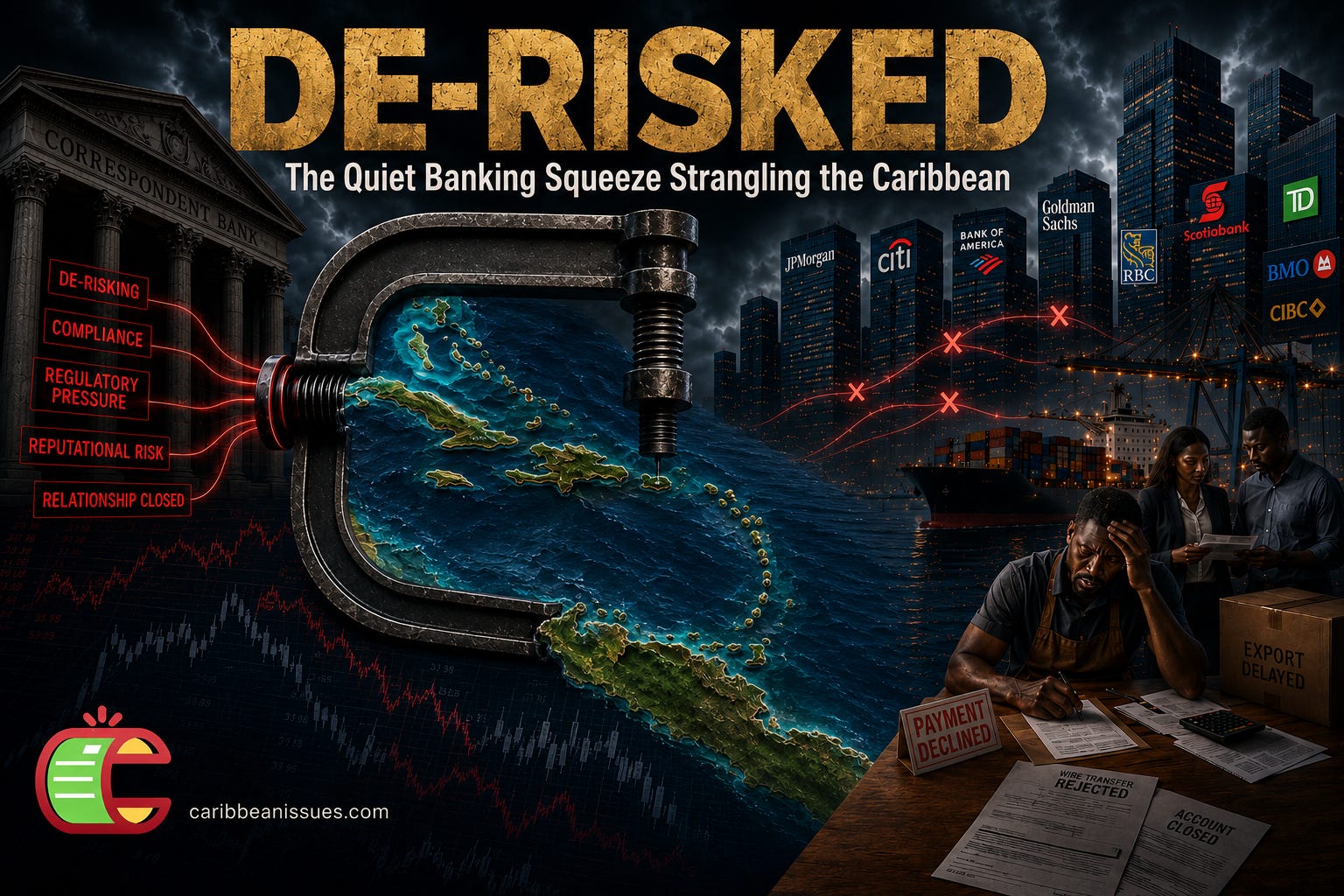
The Quiet Banking Squeeze Strangling the Caribbean
Publication record
Transparent responsibility and verification details for this Caribbean Issues publication.
- Published
- Updated
- No later revision recorded
- Responsible byline
- Caribbean Issues
- Verification
- Editorially reviewed under our published method
- Sources listed
- 9 sources listed below
- Primary topic
- Caribbean Economies and Economic Sovereignty
While the world argued about tariffs and strikes, a slower form of economic coercion has been cutting the Caribbean off from the global financial system — and the bill is being paid one remittance fee at a time.
The central argument
De-Risked:The Quiet Banking Squeeze Strangling the Caribbean In September 2022, the Prime Minister of Barbados did something no Caribbean leader had done in forty years: she stood in front of the United States Congress and testified. The committee was Financial Services. The hearing was called When Banks Leave . Mia Amor Mottley was given five minutes.
She used some of it to do arithmetic. CARICOM, she pointed out, is fifteen sovereign countries. Their combined gross domestic product is roughly US$82 billion — smaller, by a small margin, than the GDP of the state of Delaware. The kind of place that is, in the global economic conversation, a rounding error. And yet, she said, the region had spent the better part of a decade being treated as if it were a systemic risk to the international financial system. Treated, more specifically, as if it were so risky that the world’s correspondent banks would rather walk away from doing business with it altogether.
That walk-away has a name. It is called de-risking . It is the most consequential economic story in the Caribbean that almost nobody outside the region’s central banks is talking about. And the reason it matters is that it is, in its bureaucratic, technical, almost boring way, the most patient and effective form of economic coercion ever applied to the region. It does not require warships, sanctions, or extraterritorial arrests. It just requires a series of compliance officers, in offices in New York and London and Frankfurt, looking at the cost-benefit math of holding a Caribbean account on their books — and quietly clicking close .
What is being done, in one paragraph
A bank in Belize cannot, on its own, move a payment to a supplier in Germany. To do that, it needs a correspondent — usually a large international bank, almost always headquartered in the United States or Europe, that will hold an account on its behalf and clear the transaction on the global plumbing. This is called a Correspondent Banking Relationship, or CBR. Without one, a national bank is effectively a closed-system credit union. It can take deposits and lend locally. It cannot import, export, send remittances, settle a tourism credit-card charge, or pay a foreign invoice. It is, in the modern global economy, a bank in name only.
Since roughly 2014, the world’s big correspondent banks have been steadily closing those accounts.
A decade of withdrawal
A decade of withdrawal: countries and stats from IMF, CAB, and CSIS surveys of correspondent-banking loss The pattern is consistent and well-documented. The Caribbean Association of Banks, which represents the indigenous banks of the region, has surveyed its members repeatedly: by its own and CSIS’s estimates, about 60% of CAB members have suffered a loss of correspondent banking services. The International Monetary Fund’s earlier surveys identified more than a dozen affected countries — Bahamas, Belize, Guyana, Jamaica, Suriname, Trinidad and Tobago, and the entire Eastern Caribbean Currency Union among them. The IMF count was 16 banks in five countries; the lived reality across the region is considerably broader. Prime Minister Mottley’s own figure — more than 30 percent of CBRs lost across “almost every country” except two or three — has held up across multiple subsequent surveys.
The most extreme case, the one that should have made this a global story and did not, is Belize. In 2015 and 2016 alone, the country lost 83% of its correspondent banking relationships. By August 2016, only one bank in Belize still had a correspondent partner, and even that bank could clear only cheques. A national financial sector that, by the IMF’s accounting, accounts for roughly 80% of Belize’s financial assets had been functionally cut out of the global system in eighteen months.
What is striking about that two-year cliff is what was not in it. There was no scandal, no major prosecution, no terrorist financing case, no specific allegation that a Belizean bank had done anything criminal. There was simply a recalculation, on the part of large global banks, that the regulatory exposure of holding a Belize account exceeded the profit margin of running it. The mechanism is bureaucratic and almost amoral: the world’s anti-money-laundering rules became more demanding, the cost of complying with them rose, and a Caribbean account that yielded modest fees was no longer worth the compliance overhead. The bank in New York did not need to find fault. It needed only to do the math.
Multiply that decision by hundreds of banks and thousands of accounts and you have the regional pattern.
The argument that nobody in Washington wants to repeat
The defence of the architecture is straightforward. The international financial system has obligations under anti-money-laundering and counter-terrorist-financing law. Caribbean jurisdictions have small populations, less mature regulatory infrastructure, and — in some cases — citizenship-by-investment programmes that the United States considers genuine due-diligence risks. The Financial Action Task Force exists to set standards. Countries that fail to meet those standards land on lists. Banks see those lists and act accordingly. None of that is irrational, and none of it is, on its surface, racial or colonial.
The trouble is the asymmetry.
Mottley’s argument before Congress was made with the kind of clarity small countries develop because they have to. The banks of the world, she pointed out, were not running away from the actual centres of laundered money, which are — as anyone who has read the leaked-document journalism of the last decade can confirm — overwhelmingly in the world’s largest financial capitals. “Russia didn’t choose the Caribbean to hide its money. They chose the metropoles. They chose London and New York, Switzerland and Luxembourg.” The opaque shell companies that have moved actual oligarch capital around the planet are, in the public record, registered in places like Delaware and Wyoming — jurisdictions where a person can open a corporate bank account in a matter of hours and disclose effectively nothing. Those jurisdictions do not appear on the FATF watch lists. The Eastern Caribbean states do.
The lists, Mottley noted carefully, share a quality. “Look at the list of countries who are listed and you will see they are all former colonies and people of colour.” She was not arguing that compliance regimes are an act of racial malice. She was arguing — far more damagingly — that they are an act of structural inattention. The world’s compliance architecture pays exquisite attention to certain kinds of risk in certain kinds of jurisdictions, and looks past structurally equivalent risk in jurisdictions where the banks are larger and the lobbying budgets bigger. That is not racism. It is something quieter and harder to fight: the assumption, baked into compliance software, that risk lives elsewhere.
The result, she said, is that the FATF’s lists “are perhaps well intentioned, but are focused on process and form, and are not focused on substantive prosecution.” A Caribbean country can spend tens of millions of dollars upgrading its AML regime, prosecute money launderers, satisfy the technical evaluation — and still find that the global banks have already moved on, because the list is what matters, not the work.
It is, in the most precise sense of the word, a Catch-22. The countries doing the most to comply are the countries that lose the most from the assumption that they cannot.
The remittance squeeze, by the numbers
The hemisphere’s most expensive remittance corridor — and the proposed U.S. tax that would push it past 10% of every dollar sent While the institutional damage piles up on bank balance sheets, the household-level damage shows up where most Caribbean families experience the international financial system in the first place: in the cost of sending money home.
In 2024, roughly US$18.4 billion in remittances flowed to the Caribbean, per the Inter-American Development Bank. That figure represents around 10% of regional GDP . For some economies it is more: Jamaica’s $3.13 billion is roughly 18% of GDP, Haiti’s $4.9 billion is among the highest dependency ratios on Earth, and 62.8% of Haiti’s remittance flows come from the United States alone. The Dominican Republic — not a CARICOM member but a Caribbean economy — pulls in roughly $11.9 billion, more than half the regional total. Remittances are not a nice-to-have for the Caribbean; they are, for tens of millions of households, the floor under daily life.
That money does not move freely. In the first quarter of 2025, the average cost of sending $200 to the Caribbean was 7.1% of the amount sent. That made the Caribbean the most expensive remittance corridor in the Western Hemisphere — more expensive than South America (6.4%), substantially more expensive than Central America (4.8%), and well over twice the United Nations Sustainable Development Goal target of 3%. A diaspora worker in Brooklyn sending $200 to Kingston pays, on the way, roughly $14 in fees that a comparable worker sending $200 to Guatemala City would not.
That gap — the Caribbean premium , you could call it — is the household-level fingerprint of de-risking. When fewer correspondent banks compete for the business, and the ones that remain charge more to absorb the compliance cost, the difference lands somewhere. It lands on the kitchen table.
And the squeeze is about to get tighter. Bills currently moving through the United States Congress would impose a 3.5% tax on remittances sent abroad by non-U.S. citizens — a tax that, layered on top of the existing 7.1% transfer cost, would push the total cost of a Caribbean remittance toward 10.6% of every dollar sent. The diaspora worker in Brooklyn would pay closer to $21 to send the same $200. Multiply that by the volume — billions of dollars across millions of households — and you have, in a single legislative provision, a transfer of wealth from Caribbean families to the United States Treasury that would dwarf most aid programmes ever directed in the opposite direction.
The escapes that didn’t escape
The Caribbean did not sit still. Faced with the patient withdrawal of the global banks, three central banks tried something genuinely radical: they built their own digital currencies.
The Bahamas launched the Sand Dollar in October 2020 — among the first central bank digital currencies in the world. The Eastern Caribbean Central Bank followed with DCash in 2021, deployed across Antigua and Barbuda, Grenada, St. Kitts and Nevis, and Saint Lucia. The Bank of Jamaica launched JAM-DEX in 2022. Each was, in part, an effort to reduce the region’s structural dependence on cash, on slow cheque clearing, and — most importantly — on the foreign correspondent banks that controlled the rails.
It is honest to report that none of the three has worked as designed. The Federal Reserve Bank of Kansas City’s review of the Caribbean rCBDCs found that none has yet achieved widespread adoption . The reasons are familiar to anyone who has watched a new payment system try to displace cash: people use what their neighbours use, merchants are cautious, the network effects are slow. The ECCB is preparing a DCash 2.0 — described as more user-friendly — and the central banks remain committed. But the structural relief from de-risking that the CBDCs were partly designed to provide has not yet materialized.
That leaves the diplomatic track. Here the Caribbean has had narrow, hard-won wins. In 2021, Section 6215 of the U.S. National Defense Authorization Act introduced de-risking guidelines — the result of years of work by Antigua and Barbuda’s Prime Minister Gaston Browne and Ambassador Sir Ronald Sanders, who had spent the back half of 2019 lobbying the House Financial Services Committee one meeting at a time. In December 2025, Congresswoman Maxine Waters secured a further provision in the FY2026 NDAA requiring the State Department’s annual narcotics-control report to explicitly note remedial actions and AML progress made by Caribbean countries, rather than only the deficiencies. That sounds technical. It is. It is also the most useful piece of pro-Caribbean financial legislation Washington has produced in years, because it directly attacks the information asymmetry that drives bank-side de-risking decisions in the first place.
Whether any of this is enough — diplomatic wins, CBDC pilots, regulatory upgrades — is the open question of 2026.
Why this is the next sovereignty story
Over the last weeks, Caribbean Issues has been writing about regional sovereignty as a thing that can be lost in dramatic ways: a sitting president seized in Caracas ; warships and boat strikes in Caribbean waters ; an audit worth nineteen billion dollars sitting hidden in a Georgetown drawer . Those are real and they matter.
De-risking is the quiet sibling of those stories, and it may, in the long run, be the most consequential of them. A country that cannot reliably move money cannot trade. It cannot run tourism revenue through international card networks at reasonable cost. It cannot receive its diaspora’s remittances without taxing the love out of them. It cannot attract foreign direct investment at competitive terms. It cannot, in any meaningful sense, exercise the financial independence its political sovereignty supposedly guarantees. The right to have a flag at the United Nations is not, all by itself, the right to send a wire to Frankfurt.
The maddening part of the de-risking story is that it does not have a face. There is no general giving an order, no executive signing a sanctions package. There is only an aggregate effect of millions of small, defensible, individually rational decisions by private institutions, made under the pressure of a regulatory architecture written largely without Caribbean input. The damage is real. The villain is structural. And the response — diplomatic, technological, regulatory — has had to be slow and careful because the small states involved cannot afford to be wrong, or strident, or impatient.
But there is also a version of this story that ends differently. It ends with the Waters provisions being fully implemented and CARICOM AML progress being honestly reflected in the lists that drive bank decisions. It ends with DCash 2.0 and JAM-DEX 2.0 and Sand Dollar 2.0 finally hitting the merchant adoption curve. It ends with a regional payment infrastructure — built in the Caribbean, governed in the Caribbean, settled in the Caribbean — that does not need a friendly compliance officer in New York to function. It ends with a remittance cost that bends toward, rather than away from, the UN’s three-percent target.
The Caribbean Issues take
The Caribbean spent the last century arguing about independence in terms of constitutions, flags, anthems, and head-of-state titles. The next sovereignty argument is about plumbing. It is about whether the region can send and receive money on its own rails, on its own terms, at its own cost. It is, ironically, the most technical and the most fundamental sovereignty question the region has faced — and the one most easily lost while we are watching for the warships.
Mottley’s 2022 testimony was titled When Banks Leave . The question the region has not yet finished answering is what to do once they have. The honest reading of the last four years is that we have learned a lot, won some narrow legislative ground, built ambitious CBDCs that have not yet found their public, and accumulated a useful body of evidence that the international compliance regime is not, in any practical sense, calibrated for the small states it most affects.
The dishonest reading would be that nothing can be done. Plenty can be done. Some of it is being done. None of it is being done loudly enough.
The wire goes through, or it doesn’t. The diaspora’s $200 arrives intact, or it doesn’t. The Belize importer pays its German supplier, or it doesn’t. The Jamaican hotel clears its credit-card receipts at a competitive rate, or it doesn’t. The decisions that determine those answers are being made every day, in offices the Caribbean has never been allowed inside. That is the form modern sovereignty takes. And it is past time we treated the loss of it with the urgency we reserve for the louder kinds.
Sources and documentation
Sources are consolidated here so the investigation reads continuously while the record remains directly inspectable. Evidence roles describe how a source is used; they are not automatic truth scores.
Supports: • Mia Amor Mottley , Testimony before the U.S. House Financial Services Committee, “When Banks Leave: The Impacts of De-Risking on the Caribbean” (Sept 14, 2022)
Currency: Date metadata is not recorded in the source ledger.
Supports: • Wendy Delmar / Caribbean Association of Banks , Written testimony to U.S. House Financial Services Committee (Sept 2022)
Currency: Date metadata is not recorded in the source ledger.
- [3]“Ranking Member Waters Secures Key Provision in Defense Bill to Strengthen Financial Access for Caribbean Nations”Official record
Supports: • U.S. House Financial Services Committee , “Ranking Member Waters Secures Key Provision in Defense Bill to Strengthen Financial Access for Caribbean Nations” (Dec 2025)
Currency: Date metadata is not recorded in the source ledger.
Supports: • Americas Quarterly , “Are Caribbean Banks Held to a Double Standard?”
Currency: Date metadata is not recorded in the source ledger.
- [5]“Assessing the Impact of De-risking on Remittances and Trade Finance in Belize”Intergovernmental record
Supports: • Inter-American Development Bank , “Assessing the Impact of De-risking on Remittances and Trade Finance in Belize”
Currency: Verification is older than 45 days; review before relying on current conditions.
Supports: • Inter-American Dialogue , “The State of the Remittance Industry and an Outlook for 2025”
Currency: Date metadata is not recorded in the source ledger.
Supports: • RemitSCOPE Latin America & Caribbean , Remittance pricing and access data
Currency: Date metadata is not recorded in the source ledger.
Supports: • Federal Reserve Bank of Kansas City , “Observations from the Retail CBDCs of the Caribbean”
Currency: Date metadata is not recorded in the source ledger.
Supports: • CSIS , “Caribbean Collateral Damage of U.S. National Security Policy”
Currency: Date metadata is not recorded in the source ledger.
Editorial standards, corrections and AI-assistance policy · Privacy and data use
Caribbean Issues Reader Forum
What is your view?
Rate the usefulness of this analysis, respond to its evidence and add knowledge from the Caribbean or diaspora. Comments are reviewed before publication.
Was this analysis useful?
How would you describe it?
Reader discussion
Loading approved comments…