
The short answer
A global shock can reach Caribbean households long after prices move. Governments can buy time with targeted relief, alternate suppliers and payment systems that still work when the main system fails.
Publication record
Transparent responsibility and verification details for this Caribbean Issues publication.
- Published
- Updated
- No later revision recorded
- Responsible byline
- Caribbean Issues
- Verification
- Editorially reviewed under our published method
- Sources listed
- 18 sources listed below
- Primary topic
- Caribbean Economies and Economic Sovereignty
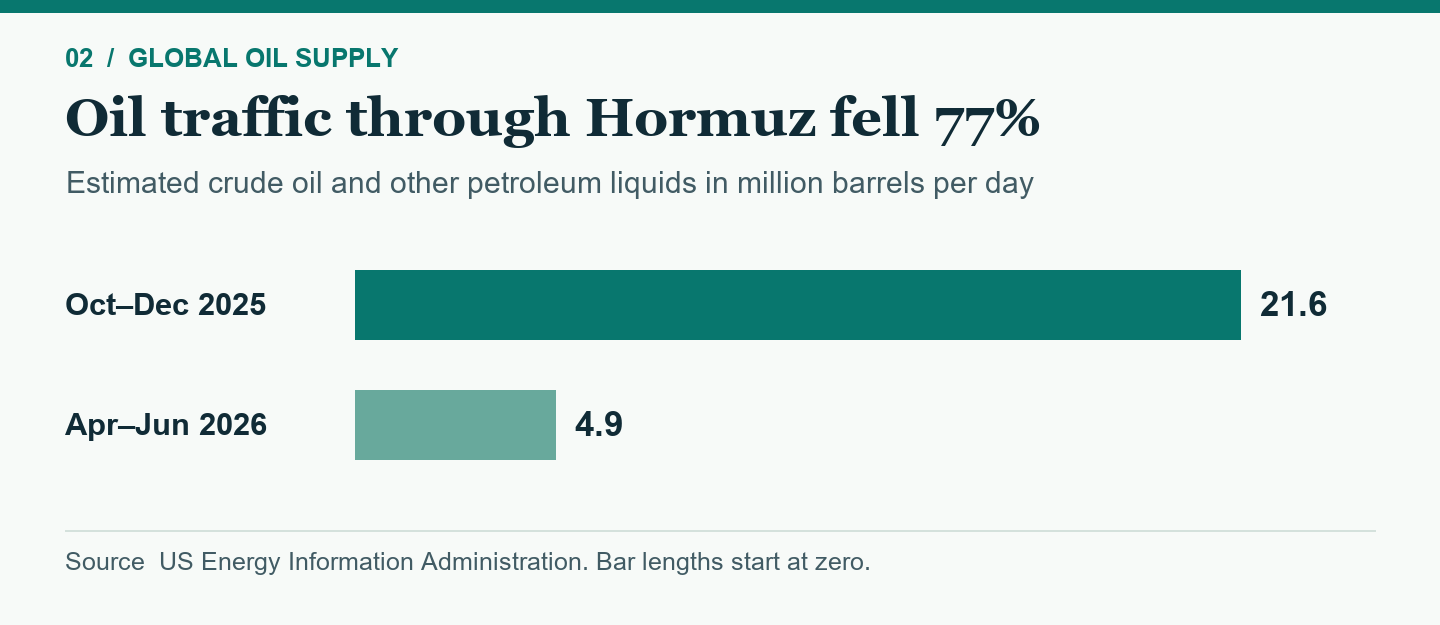
Use the same amount of electricity in March and July and still owe about EC$40 more. That was the arithmetic for a Grenadian household using 150 kilowatt-hours a month in 2026. The fuel charge went from just over 50 cents a unit to 77 cents. Then the government cut a charge on imported diesel. Grenlec told customers they would see the benefit as the utility used up the fuel it already had. Relief had to wait its turn in the tanks.
What the next bill tells us
In Turks and Caicos, a different kind of emergency left officials figuring out how to pay people by hand. A December 2024 ransomware attack disrupted government services. Cabinet put welfare, healthcare and utility payments among the urgent transactions staff would process manually.
Put those two events side by side and a familiar promise gets harder to make. A government can announce help the day a crisis hits. Getting it to a household may depend on an oil shipment, a billing cycle or a payment system that is itself in trouble.
The oil price can fall before your bill does
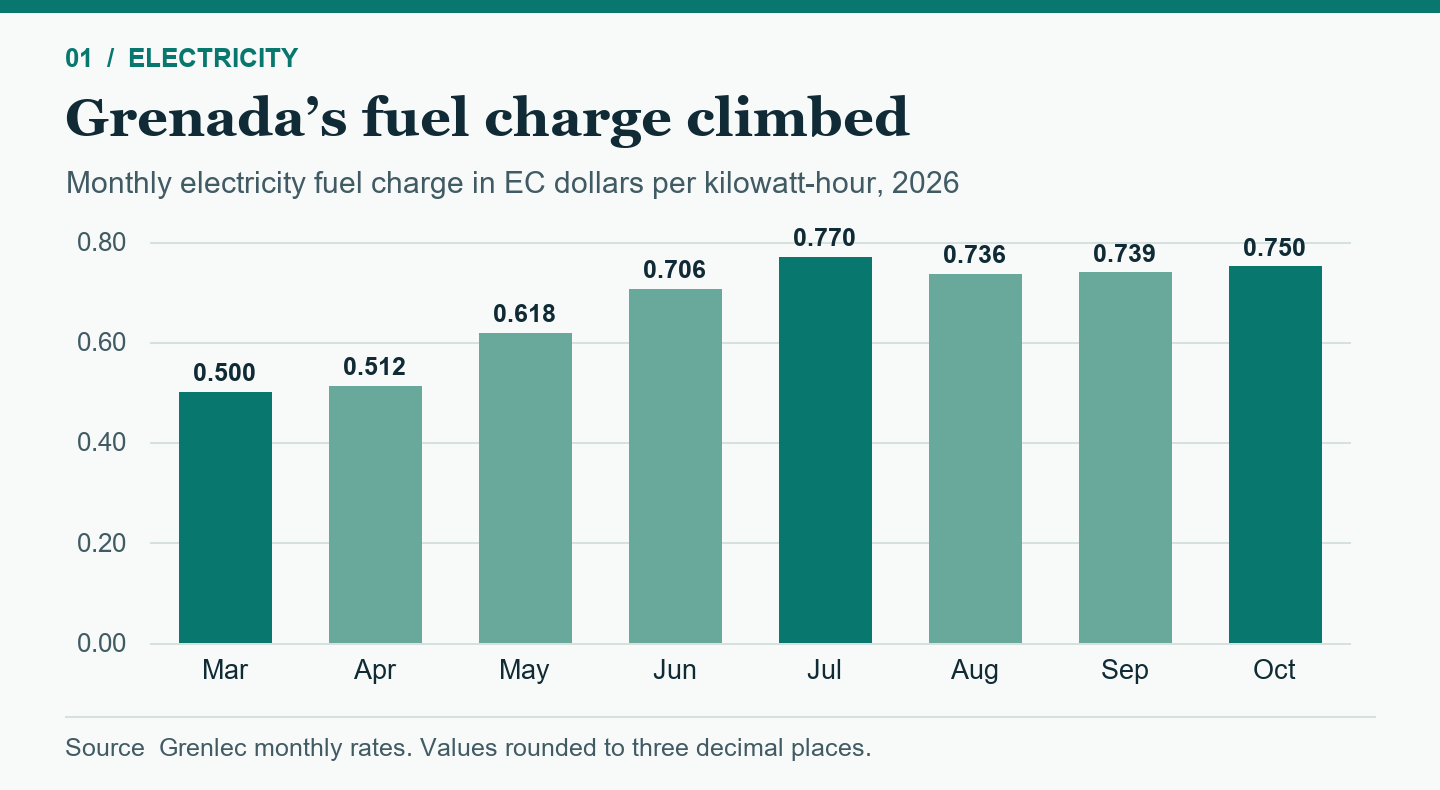
The Strait of Hormuz carried an estimated 21.6 million barrels a day of crude oil and other petroleum liquids in the last quarter of 2025. In the second quarter of 2026, after the conflict began, that fell to 4.9 million, a decline of about 77 percent. Some oil moved by other routes, so the fall in traffic through the strait does not measure the loss of global supply. Those alternatives had vulnerabilities of their own. In September, attacks temporarily interrupted Saudi Arabia’s East–West pipeline, a major bypass. The US Energy Information Administration put average Brent spot crude at US$114 a barrel that month, up from US$91 in August.
A supplier can be thousands of miles from the fighting and still charge more. Its other customers are bidding for replacement barrels too. By the time fuel reaches a Caribbean port, refining, freight, exchange rates and contract terms have all shaped the landed cost. The oil ticker tells you what the market is paying now. Your electricity bill may be telling you what the utility paid a shipment ago.
The Energy Chamber of Trinidad and Tobago found that retail gasoline prices rose in seven of the eleven CARICOM markets it compared between July 2025 and May 2026. Its sample average rose about 7 percent, compared with about 22 percent for the global average in its dataset. That comparison measures gasoline at the pump across two dates. It cannot establish the change in regional diesel or electricity costs, or separate the effect of the war from taxes, exchange rates and local pricing decisions. Grenada’s utility data answer a narrower question with a clearer denominator. The monthly fuel component rose by roughly 54 percent from March to July and was still about 50 percent above its March level in October.
Who gets relief before the next bill comes due
The pressure is visible in household reports. In July, UN Trade and Development analysed World Food Programme and CARICOM survey data covering 13,686 people in ten Caribbean countries. The share reporting higher electricity prices rose from 41 to 55 percent, and the share reporting higher gas prices rose from 38 to 57 percent. The share reporting insufficient food edged from 22.1 to 22.9 percent. These are changes in what respondents reported, rather than measured price inflation or estimates of how many people the war pushed into hunger. They show where pressure was surfacing while the changes in food access were still relatively small.
Grenada and the Cayman Islands illustrate different ways of buying time. Grenada combined a subsidy for eligible electricity customers with relief on the non-fuel portion of bills and the customs charge on diesel for generation. Cayman extended a full import-duty waiver on gasoline, diesel and propane and continued residential electricity fuel-charge assistance through December 2026. Cayman’s cabinet approved a further CI$3 million for the electricity assistance programme. That appropriation makes one part of the cost visible. The duty waiver operates through revenue the government gives up.
A duty cut can get relief out quickly, including to the people who buy the most fuel. Sending money directly can reach people with greater need, provided the government can find and pay them in time. An IMF review of Antigua and Barbuda and Grenada found limits on how quickly their safety nets could expand. That matters to the family missing from a register. Someone needs to be able to add them, hear an appeal and release the money before the next bill comes due.
When a waiver is about to expire, publish the numbers that will decide whether it stays. What are people actually paying? How much expensive fuel is still in storage? How many households can the transfer system reach before the next billing cycle? An expiry date gives ministers a day to decide. Those numbers give them a reason for the decision.
What happens when the food boat misses a sailing
CARICOM says the region imports more than 60 percent of the food it consumes. Its initiative to reduce the food import bill by 25 percent was extended from 2025 to 2030 and broadened to address resilience and other goals. In October, CARICOM also reported that regional food production grew by about 24 percent between 2022 and 2024. Those figures measure different things. More production can improve security even when a rising world price keeps the import bill high. A lower import bill can also reflect households buying less because they cannot afford it.
Picture a school kitchen on the morning a supplier calls to say the boat is late. A nearby farmer is only an alternative if the produce is ready, someone can collect it and the kitchen can afford it. If it has to sit in cold storage, the warehouse needs power. For some foods, a second shipping route may be the quickest protection. For others, steady contracts with regional growers can give them a reason to plant enough to supply a buyer when it matters.
That is a test CARICOM can make public before 2030. Pick a basket of foods people rely on. Show how much can be sourced within the region, how many suppliers can step in and how long it takes to switch. Then ask a school or public purchasing agency to assemble that basket at an affordable price after a missed sailing. The result would tell us something the annual import total cannot.
When the treasury has to pay by hand
On 18 December 2024, ransomware disrupted services run by the Turks and Caicos Islands Government. By the end of the month, Cabinet said staff were preparing to process urgent payments manually, including welfare, healthcare, utilities and payroll. Some systems, including customs clearance, remained operational. The official account shows what a cyber incident looks like from the finance ministry. It has to decide who can be paid first, who can authorise a payment and how to keep financial controls intact while systems are being restored.
Almost two years later, Bill Gates told CNN, “The front that we will probably see most dramatically in the next year is cyberattacks”. On Decoder that October, he added, “you will see a lot of attacks different in terms of scale than anything we’ve seen in the past.” In Turks and Caicos, the people waiting for welfare or utility payments had already seen how far an attack could reach beyond the computer network.
The business behind the attack method is well documented. Chainalysis traced more than US$820 million in ransomware payments on blockchains globally in 2025, roughly 8 percent less than its revised 2024 estimate. Over the same period, a separate dataset it cited showed a 50 percent rise in victims claimed by attackers. Payment estimates and criminal claims have different coverage and neither measures Caribbean incident prevalence. Together they show why falling ransom receipts tell us little about the operational risk. Organisations can lose access to records, interrupt services and incur recovery costs even when no payment is made.
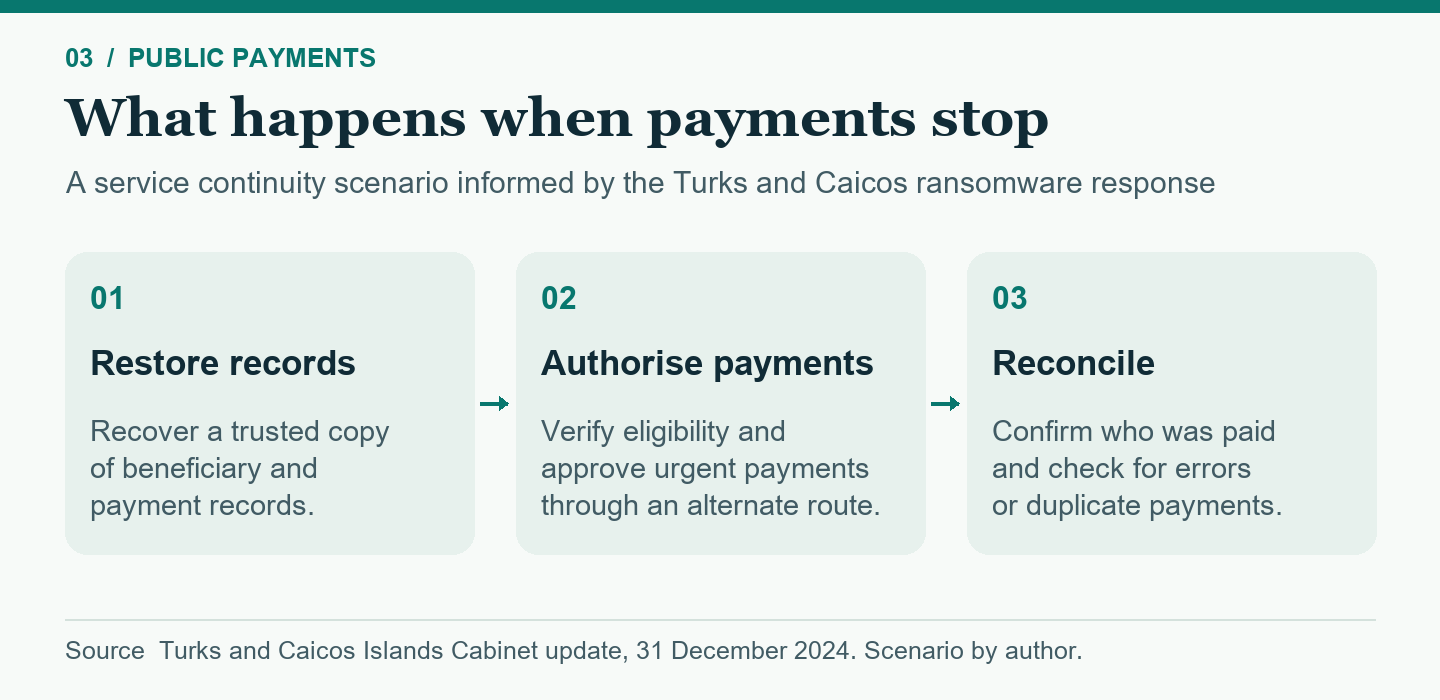
Now put an electricity relief payment on that list. The main system is down and the money is due. Staff need a trusted copy of the beneficiary list, a way to verify who qualifies and a route for approving the payment that still leaves a record. Afterwards, they have to check who got paid and who was missed. The exercise ends when the money reaches people and the books balance.
CARICOM IMPACS already has a Cyber Fusion Unit whose mandate includes technical assistance, information sharing and mutual aid. Give it and the national agencies a concrete exercise. Take the main system out of play in a drill and give the finance team an urgent welfare payment to deliver. Time the restoration, the authorisation and the reconciliation. A backup can pass a technical check while staff still cannot get a payment out.
How much time can the region buy
Finance ministries can arrange liquidity before an emergency and decide what releases it. Jamaica’s response to Hurricane Melissa shows the value of arranging several sources in advance. The World Bank reports that Jamaica had reserves, parametric insurance and contingent credit available. The lesson for an import-price shock is to specify the trigger and permitted use ahead of time. Insurance tied to a hurricane threshold cannot be assumed to cover a rise in landed fuel prices. A budget reserve or a credit line explicitly designed for a sustained import shock would have different costs and conditions, which should be published before it is needed.
Fox News reported that Pentagon planners wanted major bases in the continental United States to sustain essential operations for 90 days without outside support. In the Caribbean, a useful version of that test starts with an interruption that could happen next week. Take one fuel delivery off the schedule and see which public service runs out of time first.
Start with the places where an interruption quickly becomes everybody’s problem. How long can a clinic run on its backup power? What happens to the water pumping station if its next delivery is late? Can a cold store keep food safe through the outage? An operator should know the answers from a test under load. A generator on an inventory sheet tells you very little about how long the service can hold.
Disaster agencies can extend familiar storm communications to longer power, payment and supply interruptions. People need to know where to find verified updates, which services will stay open and how to get assistance if mobile data or card payments fail. A World Bank study of household preparedness for natural hazards found a clear income gradient in access to emergency supplies. Applying that finding to other disruptions calls for care, but it points to a practical design choice. Pair public guidance with ways to reach households that cannot afford to keep much in reserve.
Maroon Economics gives that problem a regional answer. A small jurisdiction may struggle to keep a recovery team or an extra supply route on standby all year. Neighbours can agree who will send a team, which ports or suppliers can take extra orders and how they will share the cost. The time to find out whether those commitments work is during an exercise, while the lights are still on.
At the next budget hearing, ask two questions. How many days can the water utility run if its next fuel shipment misses port? How soon can the treasury pay urgent benefits if its main system goes dark? Put the answers on the public record. The next shock will put both numbers to the test.
Questions readers are asking
Why can Caribbean electricity bills stay high after oil prices fall?
Utilities can still be burning fuel bought earlier at a higher price. Delivery schedules, inventories and billing formulas determine when the lower cost reaches households.
What changed in CARICOM’s food import reduction initiative?
CARICOM extended its goal of reducing the regional food import bill by 25 percent from 2025 to 2030 and broadened the programme to address resilience.
How can governments keep emergency payments flowing after ransomware?
Finance teams can test restoring trusted beneficiary records, authorising urgent payments through an alternate route and reconciling the transactions afterwards.
Sources and documentation
Sources are consolidated here so the investigation reads continuously while the record remains directly inspectable. Evidence roles describe how a source is used; they are not automatic truth scores.
Supports: Grenada monthly fuel rates and the March to July change
Currency: Verified within the last 45 days.
Supports: Timing and terms of Grenada electricity relief
Currency: Verified within the last 45 days.
Supports: Volume of oil moving through Hormuz before and during the shock
Currency: Verified within the last 45 days.
Supports: September 2026 Brent price and Saudi pipeline disruption
Currency: Verified within the last 45 days.
Supports: Gasoline price changes in eleven CARICOM markets
Currency: Verified within the last 45 days.
- [6]IMF technical assistance report on fuel pricing in Antigua and Barbuda and GrenadaIntergovernmental record
Supports: Limits on scaling targeted relief in Antigua and Barbuda and Grenada
Currency: Verified within the last 45 days.
Supports: Household survey on electricity, gas and food pressure
Currency: Verified within the last 45 days.
Supports: Cayman electricity relief funding and extended duty waiver
Currency: Verified within the last 45 days.
Supports: Food import dependence and regional production growth
Currency: Verified within the last 45 days.
Supports: CARICOM extension of its food import initiative to 2030
Currency: Verified within the last 45 days.
Supports: Turks and Caicos emergency manual payment arrangements
Currency: Historical baseline; assess relevance rather than recency.
Supports: Global ransomware payments and separate victim-claim count
Currency: Verified within the last 45 days.
Supports: Regional Cyber Fusion Unit remit
Currency: Verified within the last 45 days.
Supports: Income gradient in household emergency supplies
Currency: Verified within the last 45 days.
- [15]World Bank account of Jamaica’s disaster financing after Hurricane MelissaIntergovernmental record
Supports: Jamaica disaster financing arrangements
Currency: Verified within the last 45 days.
Supports: Gates remarks on expected scale of attacks
Currency: Verified within the last 45 days.
Supports: Gates remarks on near-term cyberattacks
Currency: Verified within the last 45 days.
Supports: Reported 90-day planning target for major US bases
Currency: Verified within the last 45 days.
Editorial standards, corrections and AI-assistance policy · Privacy and data use
Caribbean Issues Reader Forum
What is your view?
Rate the usefulness of this analysis, respond to its evidence and add knowledge from the Caribbean or diaspora. Comments are reviewed before publication.
Was this analysis useful?
How would you describe it?
Reader discussion
Loading approved comments…