
The short answer
Caribbean governments have meaningful diaspora policies, units, databases and programmes, but they operate unevenly and without a common regional standard. The result is fragmented communication, incompatible data and limited public accountability.
Publication record
Transparent responsibility and verification details for this Caribbean Issues publication.
- Published
- Updated
- Responsible byline
- Caribbean Issues
- Verification
- Editorially reviewed under our published method
- Sources listed
- 23 sources listed below
- Primary topic
- Caribbean Diaspora
A 15-member CARICOM scorecard examines the policies, data, communication, investment pathways and accountability needed for diaspora engagement.
Why the region cannot fully mobilise its people, skills and investment abroad
The Caribbean does not suffer from a shortage of people abroad who care about home. It suffers from a shortage of durable public infrastructure for turning that connection into accountable, two-way development.
Governments regularly call on the diaspora to invest, return, volunteer, advocate, send supplies or share expertise. Diaspora communities regularly answer—through family remittances, school and hospital support, business investment, professional networks, disaster relief and political advocacy. Yet the region still cannot produce one current, comparable public account of where its diaspora lives, what skills and resources it holds, how people want to participate, which institutions are responsible for responding, and what happened after participation began.
That is the Caribbean diaspora data gap. It is not merely a statistical inconvenience. It is a development constraint.
The short answer
Caribbean governments have meaningful diaspora policies, units, databases and programmes, but they operate unevenly and are not organised around a common regional standard. The result is fragmented communication, incompatible data and limited public accountability for whether diaspora skills, investment and participation produce lasting outcomes.
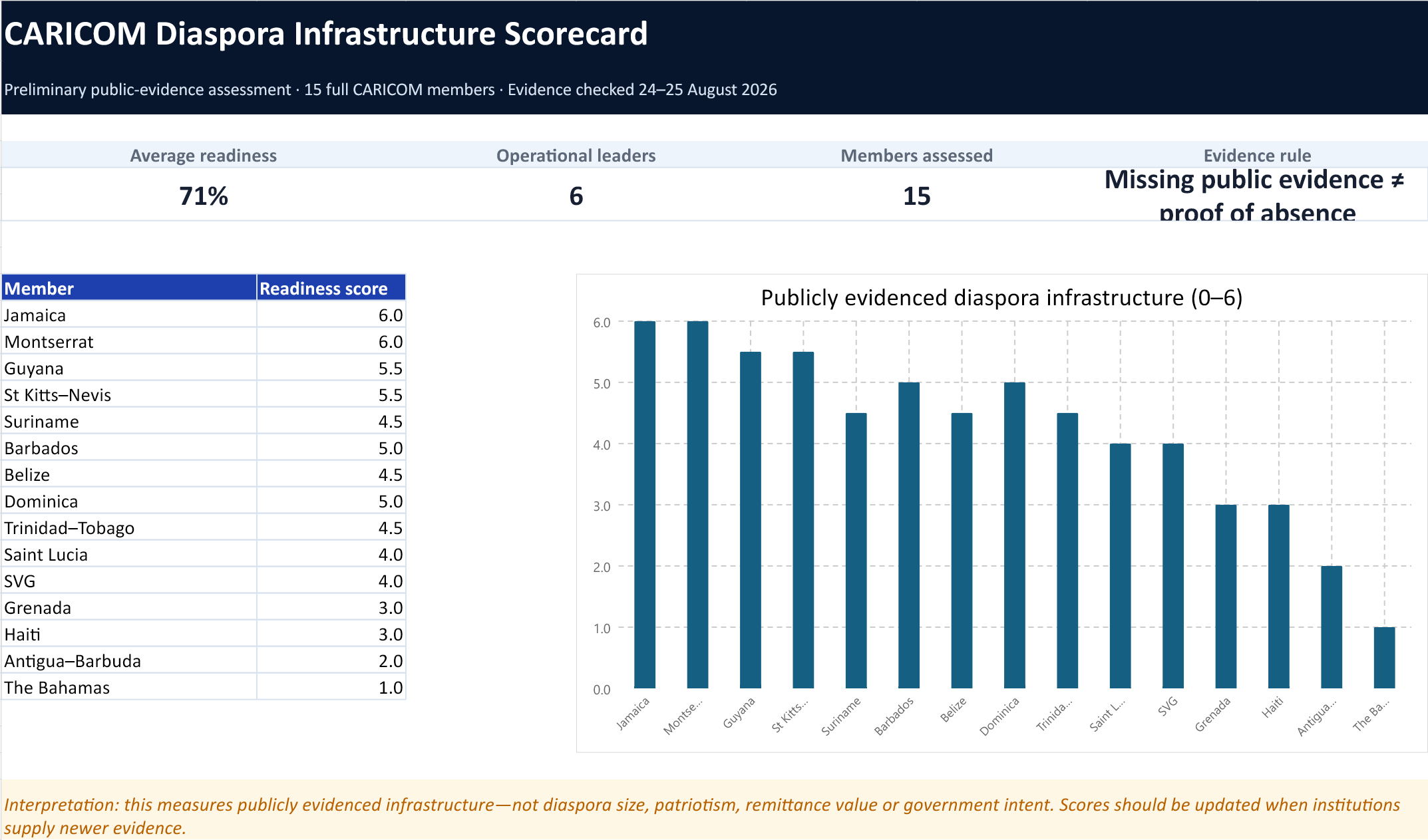
Caribbean Issues reviewed publicly available official and intergovernmental evidence for all 15 full members of the Caribbean Community. The preliminary scorecard assessed six forms of infrastructure: dedicated responsibility, policy or strategy, mapping or databases, two-way communication, investment or return pathways, and public reporting of results.
The average publicly evidenced readiness score was 71 per cent. Six members met the scorecard’s operational threshold, seven were developing, and two remained foundational based on evidence that could be verified on 24–25 August 2026.
Those numbers need discipline. They are not a verdict on patriotism, government intent or diaspora commitment. They do not prove that an unverified programme does not exist. They measure what a citizen, investor, researcher or diaspora organisation can currently verify from public institutional evidence.
The region is not starting from zero
Any honest account must begin by rejecting a convenient exaggeration: Caribbean governments are not all ignoring their diasporas.
Jamaica has a National Diaspora Policy and digital platforms designed to map communities, facilitate communication and connect people with investment and philanthropic opportunities. Guyana’s Diaspora Affairs Unit has an explicit mandate to maintain a database, act as a communication bridge and provide a one-stop shop for investment, trade, philanthropy and remigration. Barbados maintains a diaspora database, associations network and the Barbados Network Programme for returning nationals.
Montserrat’s official diaspora initiative is unusually specific. It calls for a database incorporating a registry and skills bank, networks for structured dialogue, cross-border business and knowledge partnerships, and financial vehicles for diaspora direct investment. Its 2026–27 budget reports progress on the database, a United Kingdom business directory and a diaspora leadership conference.
Saint Kitts and Nevis has a published Diaspora Policy, a Regional Integration and Diaspora Unit, recurring public engagement and defined investment commitments. Belize has a Diaspora Relations Unit and 2026–27 priorities covering a summit, a returnee incentive programme, investment, entrepreneurship and knowledge exchange. Trinidad and Tobago has an active diaspora registration mechanism, and its Ministry of Foreign and CARICOM Affairs describes that registration as a first step toward launching and implementing a draft National Diaspora Policy for 2025–2030.
These are not symbolic details. They prove that workable pieces of a regional system already exist.
The problem is that the pieces do not yet form a system.
What the scorecard found
The strongest public evidence was concentrated in the first layer of engagement: assigning responsibility.
Fourteen of the 15 members showed at least partial evidence of a ministry, department, unit, institute or official portfolio with responsibility for diaspora affairs. That is important institutional progress. A person abroad needs to know where to begin.
The weakest layers were mapping and public reporting.
Many official documents speak about registries, databases, skills banks, conferences, consultations, volunteer programmes or investment interest. Far fewer tell the public:
A database can exist and still be unusable. A conference can attract hundreds of people and still produce no durable mechanism. An investment announcement can generate headlines and still leave potential participants unable to verify ownership, risk, fees, approvals or project performance.
This is why public outcomes matter. Engagement should be measured by completed and independently verifiable results—not only registrations, attendance, promises or expressions of interest.
- Action. how many people or organisations are currently registered;
- Action. when the data were last updated;
- Action. which countries, professions, generations and communities are underrepresented;
- Action. how consent and privacy are protected;
- Action. how many skills matches became completed assignments;
- Action. how many announced investments reached financial close;
- Action. how many projects delivered their promised benefits;
- Action. what complaints were received and resolved; or
- Action. which initiatives failed and why.
Why the diaspora cannot simply be “counted”
Even defining the population is more complicated than political speeches suggest.
The United States Census Bureau collects ancestry information through the American Community Survey. Statistics Canada publishes ethnic or cultural origins, as well as separate birthplace and immigration variables. The Office for National Statistics in England and Wales publishes self-identified ethnic-group data, including detailed classifications and write-in responses.
These categories do not measure the same thing.
A person can be born in the Caribbean and identify through several ancestries. Another can be born abroad to Caribbean parents or grandparents. Some people identify by a particular island or country; others use West Indian, Caribbean, African Caribbean, Indo-Caribbean, Black British, mixed or another identity. Citizenship adds another layer. So does return migration.
Adding incompatible census categories to produce a single dramatic “global Caribbean diaspora” number would create precision without accuracy.
The more useful approach is to build fit-for-purpose measures. A healthcare skills programme needs profession, licensing, availability and country of practice. An investment platform needs sector interest, risk tolerance, jurisdiction and due-diligence requirements. A cultural programme may need ancestry, language, generation and organisational affiliation. Emergency communication may require current location and consent to be contacted.
The question is not simply, “How many are there?” It is, “What are we trying to accomplish, what information is legitimately necessary, and who is trusted to hold it?”
The remittance trap
The Caribbean’s relationship with its diaspora is too often reduced to money sent home.
IOM’s 2025 data mapping for the English- and Dutch-speaking Caribbean reported 2.52 million emigrants globally from the covered region and USD 18.4 billion in remittances to the Caribbean in 2024. OECD and IDB analysis describes remittances as an important stabilizer that supports consumption and helps households pay for education, housing and health.
But remittances are primarily private family transfers. They should not be treated as a permanent substitute for productive domestic economies, functioning public services or trustworthy investment systems.
The same OECD–IDB report found an average Caribbean emigration rate of 18.7 per cent in 2024 and warned that the departure of skilled workers can reduce the stock of human capital. Money sent home does not automatically replace the nurse absent from a ward, the engineer unavailable for a project, the teacher who left a classroom or the experienced manager missing from a growing enterprise.
Nor should remittance totals be treated as evidence that households have surplus capital available for government projects. Supporting relatives and investing in infrastructure are different financial decisions with different risks.
The diaspora relationship must therefore move from extraction to exchange: not “What can people abroad send us?” but “What can institutions at home and communities abroad build together, under rules both can trust?”
Communication without accountability is not engagement
The Caribbean is rich in diaspora events. Conferences, town halls, independence celebrations, webinars, homecoming programmes and investment forums create useful points of contact. They can renew identity and surface ideas.
But an event is not an institution.
Meaningful two-way engagement requires a visible response cycle:
1. A government or community identifies a specific problem. 2. Residents and diaspora participants can review the evidence and propose support. 3. Responsible institutions respond publicly within a defined period. 4. Selected projects disclose ownership, costs, safeguards and milestones. 5. Participants can track implementation and raise complaints. 6. Results—including failures—are reported.
Without that cycle, consultation can become another request for free expertise, political endorsement or capital without adequate influence over decisions.
Trust is not created by adding a registration form. It is created by demonstrating that information is accurate, participation has consequences, public money is traceable and people can safely challenge the process.
A Caribbean Diaspora Observatory and Exchange
The region does not need one compulsory master list of everyone with Caribbean roots. That would create serious privacy, security and political risks.
It needs a consent-based Caribbean Diaspora Observatory and Exchange: a regional standard and interoperable public-interest infrastructure that allows countries to maintain national ownership while making selected information comparable.
1. The observatory
The observatory would publish aggregate, non-identifying indicators on diaspora location, generations, occupations, organisations, engagement preferences, remittance context, return patterns and completed initiatives.
It would establish a common data dictionary so that a “registered professional,” “diaspora organisation,” “investment commitment,” “completed project” and “returning national” mean the same thing across reports—or are clearly marked when they do not.
2. The exchange
The exchange would let individuals and organisations opt into verified professional, business, research, cultural and community networks.
Caribbean institutions could post specific problems: a hospital seeking a short-term specialist, a school requiring curriculum support, an exporter needing regulatory expertise, a municipality preparing a climate-resilience project, or a cooperative seeking a qualified board adviser.
The exchange should show the local project owner, scope, required qualifications, time commitment, decision process, funding, conflicts of interest and outcome measures.
3. The investment trust layer
Diaspora investment requires more than a list of opportunities. Each promoted project should disclose:
The platform should not guarantee investment performance. It should make due diligence possible and prevent official promotion from being mistaken for an investment guarantee.
4. Public accountability
Every participating institution should publish annual results using the same basic measures: registrations, active participants, completed skills matches, investment projects reaching close, funds actually deployed, jobs or services delivered, complaints, corrections and data breaches.
Independent privacy and audit oversight must be built in from the beginning. People should be able to see their information, correct it, withdraw consent and know which institution accessed it.
- Action. legal ownership and beneficial owners;
- Action. regulator and approval status;
- Action. use of funds;
- Action. fees and commissions;
- Action. financial statements or feasibility evidence;
- Action. material risks;
- Action. procurement arrangements;
- Action. exit or repayment terms; and
- Action. complaint and enforcement mechanisms.
What governments can do now
A regional platform will take time. National improvements do not have to wait.
Every CARICOM government can publish a one-page diaspora infrastructure statement answering seven questions:
1. Which institution is responsible? 2. What policy governs its work? 3. How can people register, update or remove their information? 4. How are skills and organisations classified? 5. Which verified investment, return or volunteer pathways are active? 6. What happened in the last reporting year? 7. How can a person complain or correct public information?
Governments should also publish machine-readable aggregate data and establish service standards for responding to diaspora inquiries. Overseas missions should use the same core system instead of maintaining disconnected lists that become outdated when staff change.
What diaspora organisations should demand
Diaspora organisations also have responsibilities. Representation should not be assumed simply because an organisation is established, well connected or repeatedly invited to official events.
Members should ask:
The diaspora should not have to choose between affection for home and rigorous scrutiny. Scrutiny is part of commitment.
- Action. Who selected the organisation’s representatives?
- Action. Which countries, generations, professions and communities are missing?
- Action. Are conflicts of interest disclosed?
- Action. Can members see how funds and endorsements are used?
- Action. Are investment promotions independently checked?
- Action. Are local Caribbean organisations equal partners or merely beneficiaries?
- Action. What changed because the organisation participated?
The deeper Caribbean issue
For generations, Caribbean societies have absorbed the departure of people as a normal feature of survival. Families became transnational institutions long before governments developed diaspora policies. Money, care, goods, ideas and obligations moved through informal networks because formal systems were weak or absent.
Those networks remain powerful. They are also unequal. Participation often depends on personal contacts, political access, professional status, spare time and the ability to absorb risk. Smaller organisations and younger generations can remain outside official conversations. People who ask difficult questions may be treated as disloyal. Residents may see diaspora participants as distant critics; diaspora participants may see local systems as opaque or unresponsive.
Better data will not solve those tensions by itself.
But common standards, visible decisions and accountable institutions can turn a relationship built mainly on private sacrifice into one capable of sustained public cooperation.
The Caribbean does not need to discover whether its diaspora cares. The evidence of care is everywhere.
It needs to prove that participation will be respected, protected, matched to real needs and converted into results that both sides can see.
Methodology
Caribbean Issues reviewed publicly available official government and intergovernmental evidence for the 15 full CARICOM members on 24–25 August 2026.
Each member received 0, 0.5 or 1 point across six pillars. Zero means current public evidence was not verified; it does not prove no internal initiative exists. Half a point indicates draft, planned, historical, mission-specific or incomplete evidence. One point indicates current public evidence of an operating mechanism or reported implementation.
The scorecard is a baseline for reporting and correction, not a final performance audit.
Questions readers are asking
Does CARICOM have a complete database of the Caribbean diaspora?
No single current, comparable public CARICOM database covering diaspora location, skills, organisations, investment interests and engagement outcomes was identified in this review. National databases and registration initiatives exist, but their scope and definitions differ.
Which Caribbean countries have diaspora programmes?
Many do. Public evidence shows policies, units, databases, conferences, return programmes or investment initiatives across most full CARICOM members. The scorecard distinguishes current operational mechanisms from draft, planned, historical or partially evidenced ones.
Why can’t US, Canadian and UK diaspora figures simply be added together?
They measure different concepts, including ancestry, ethnic or cultural origin, ethnicity, birthplace, immigration status and citizenship. Adding them without harmonization would risk double counting and misleading comparisons.
Are remittances the same as diaspora investment?
No. Remittances are mainly private transfers supporting households. Investment involves different expectations, risks, legal rights, due diligence and potential returns.
What would improve Caribbean–diaspora engagement?
Comparable aggregate data, consent-based skills networks, defined service standards, independently verifiable investment information, published results and meaningful two-way participation would make engagement more useful and trustworthy.
Sources and documentation
Sources are consolidated here so the investigation reads continuously while the record remains directly inspectable. Evidence roles describe how a source is used; they are not automatic truth scores.
- Migration data categoryPrimary record
Supports: Evidence used in: The short answer; What the scorecard found; Methodology.
Currency: Date metadata is missing; recheck before relying on current conditions.
- Migration Governance in the CaribbeanIntergovernmental record
Supports: Evidence used in: The short answer; Methodology.
Currency: Date metadata is missing; recheck before relying on current conditions.
- Data Mapping for the English and Dutch Speaking CaribbeanIntergovernmental record
Supports: Evidence used in: The remittance trap; Methodology.
Currency: Date metadata is missing; recheck before relying on current conditions.
- Diaspora Mapping ToolkitIntergovernmental record
Supports: Evidence used in: Methodology.
Currency: Date metadata is missing; recheck before relying on current conditions.
- Contributions and Counting: Guidance on Measuring the Economic Impact of Your Diaspora Beyond RemittancesIntergovernmental record
Supports: Evidence used in: The remittance trap.
Currency: Date metadata is missing; recheck before relying on current conditions.
- Caribbean Development Dynamics 2026Intergovernmental record
Supports: Evidence used in: The remittance trap.
Currency: Date metadata is missing; recheck before relying on current conditions.
- National Diaspora PolicyPrimary record
Supports: Evidence used in: The short answer; The region is not starting from zero; What the scorecard found; Methodology.
Currency: Date metadata is missing; recheck before relying on current conditions.
Supports: Evidence used in: The region is not starting from zero.
Currency: Date metadata is missing; recheck before relying on current conditions.
- Diaspora Affairs UnitPrimary record
Supports: Evidence used in: The short answer; The region is not starting from zero; What the scorecard found; Methodology.
Currency: Date metadata is missing; recheck before relying on current conditions.
- Diaspora RelationsPrimary record
Supports: Evidence used in: The short answer; The region is not starting from zero; What the scorecard found; Methodology.
Currency: Date metadata is missing; recheck before relying on current conditions.
- Barbados Network ProgrammePrimary record
Supports: Evidence used in: The region is not starting from zero.
Currency: Date metadata is missing; recheck before relying on current conditions.
- Montserrat Diaspora Database InitiativePrimary record
Supports: Evidence used in: The short answer; The region is not starting from zero; What the scorecard found; Methodology.
Currency: Verified within the last 45 days.
- Budget Speech 2026–2027Primary record
Supports: Evidence used in: The region is not starting from zero.
Currency: Verified within the last 45 days.
- Diaspora PolicyPrimary record
Supports: Evidence used in: The short answer; The region is not starting from zero; What the scorecard found; Methodology.
Currency: Date metadata is missing; recheck before relying on current conditions.
- Diaspora Relations UnitPrimary record
Supports: Evidence used in: The short answer; The region is not starting from zero; What the scorecard found; Methodology.
Currency: Date metadata is missing; recheck before relying on current conditions.
- Strategic Priorities 2026–2027Primary record
Supports: Evidence used in: The region is not starting from zero.
Currency: Verified within the last 45 days.
- Non-Resident Services and Office of Diaspora AffairsPrimary record
Supports: Evidence used in: The short answer; What the scorecard found; Methodology.
Currency: Date metadata is missing; recheck before relying on current conditions.
- 2026 Budget EstimatesPrimary record
Supports: Evidence used in: What the scorecard found.
Currency: Date metadata is missing; recheck before relying on current conditions.
- Ministry directory and Diaspora InstitutePrimary record
Supports: Evidence used in: What the scorecard found.
Currency: Date metadata is missing; recheck before relying on current conditions.
- Diaspora RegistrationPrimary record
Supports: Evidence used in: The short answer; The region is not starting from zero; What the scorecard found; Methodology.
Currency: Date metadata is missing; recheck before relying on current conditions.
- Ancestry in the American Community SurveyIntergovernmental record
Supports: General context; no claim- or section-level mapping is recorded.
Currency: Date metadata is missing; recheck before relying on current conditions.
- Caribbean origins reported in the 2021 CensusPrimary record
Supports: General context; no claim- or section-level mapping is recorded.
Currency: Date metadata is missing; recheck before relying on current conditions.
- Ethnic group, England and Wales: Census 2021Primary record
Supports: General context; no claim- or section-level mapping is recorded.
Currency: Date metadata is missing; recheck before relying on current conditions.
Caribbean Issues Reader Forum
What is your view?
Rate the usefulness of this analysis, respond to its evidence and add knowledge from the Caribbean or diaspora. Comments are reviewed before publication.
Was this analysis useful?
How would you describe it?
Reader discussion
Loading approved comments…