
The short answer
The Caribbean has credible investment needs and investable projects, but a promising sector is not the same as a suitable investment. Investors should verify the legal entity, regulatory status, financing structure, climate exposure, local-development value and realistic route to repayment or exit before committing money.
Publication record
Transparent responsibility and verification details for this Caribbean Issues publication.
- Published
- Updated
- No later revision recorded
- Responsible byline
- Caribbean Issues
- Verification
- Editorially reviewed under our published method
- Sources listed
- 9 sources listed below
- Primary topic
- Caribbean Economies and Economic Sovereignty
People searching for Caribbean investment opportunities are usually shown promotion before they are shown a method. The useful question is not simply where money can be placed. It is which projects can survive legal, commercial, climate and public-interest scrutiny—and which ones allow Caribbean people to retain more of the value their economies create.
The short answer
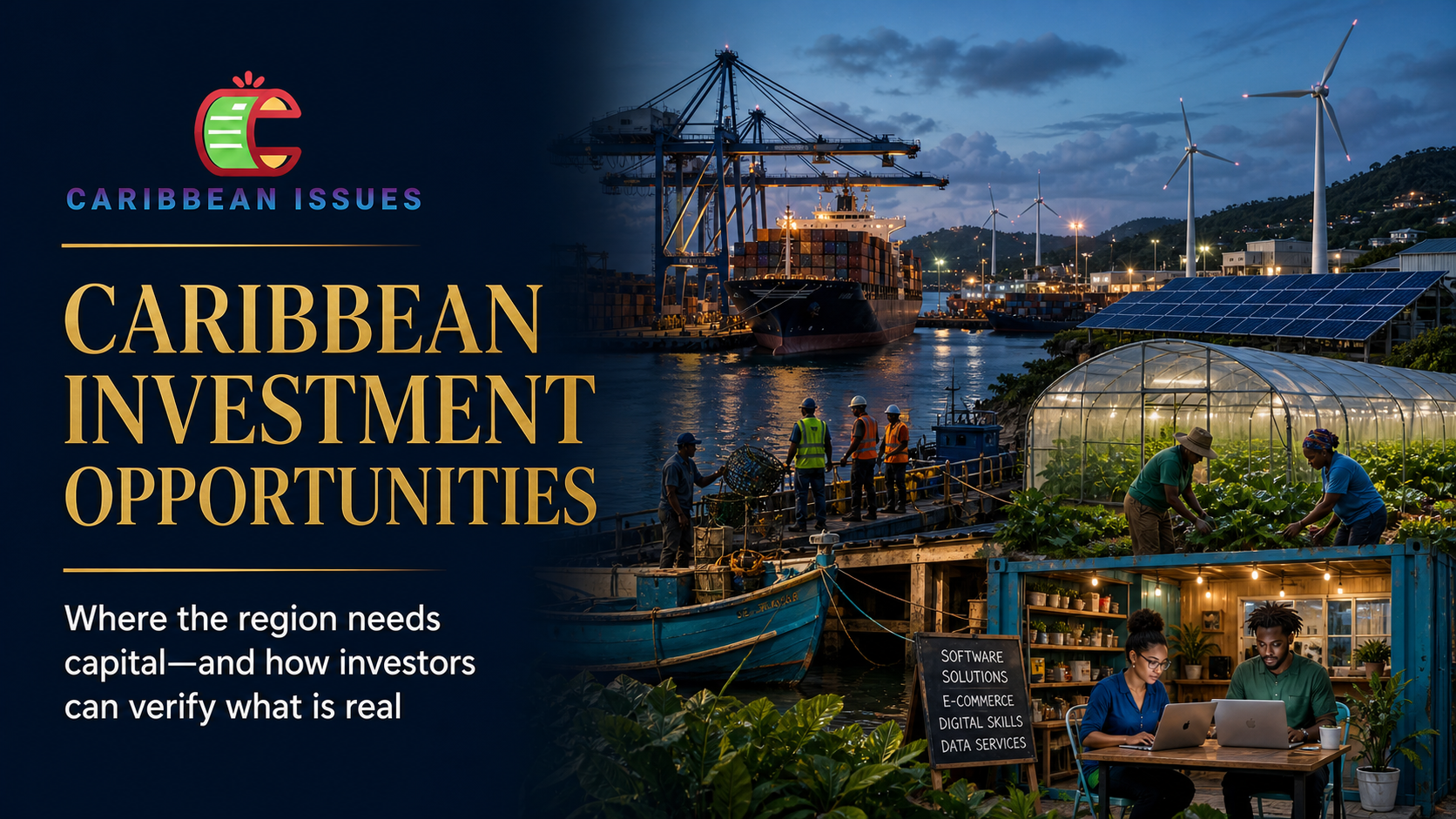
Current regional evidence points to renewable energy, sustainable agriculture and food systems, logistics and transport, digital transformation, the blue economy, resilient infrastructure, the circular economy, creative industries and more locally connected tourism as areas where investment can support Caribbean development.
That is a map of needs and productive potential, not a promise of returns. A sector can be strategically important while a particular project remains poorly governed, undercapitalised, overpriced, illiquid or exposed to unacceptable climate, currency or regulatory risk.
The strongest opportunity is therefore not the project with the most dramatic presentation. It is the one whose ownership, permissions, costs, customers, financing, safeguards and route to repayment can be independently checked—and whose success leaves useful capacity, jobs, knowledge, infrastructure or ownership in the Caribbean.
Why the Caribbean needs an investment guide rather than another promotion
The region is often marketed through extremes. One version presents a tropical frontier in which tourism, property, citizenship programmes and offshore services appear to offer effortless upside. Another presents small markets, debt, hurricanes and bureaucracy as reasons to avoid the region entirely. Neither is a useful basis for a decision.
The OECD and IDB’s 2026 regional assessment argues that investment must be judged by both quantity and quality. Caribbean economies face modest potential growth, low productivity, high public debt in several jurisdictions, infrastructure gaps and severe exposure to environmental shocks. Large projects can also have outsized effects in small economies, which makes design and governance unusually consequential.
Caribbean Export’s 2025 investment catalogue presented a pipeline across sustainable agriculture, digital transformation, green transition, logistics and transport. It is evidence that regional agencies are assembling projects and seeking capital. It is not a substitute for legal, financial or technical due diligence on any listed venture.
Caribbean Issues does not rank individual investments or guarantee their suitability. This guide provides the questions needed before promotion becomes commitment.
Where the productive opportunities are
The strongest regional case is built around problems Caribbean households and firms already pay to manage: expensive and vulnerable energy systems, imported food, fragmented logistics, uneven digital infrastructure, water stress, climate exposure and limited access to growth capital.
Renewable energy and resilient grids can reduce imported-fuel exposure, but projects need bankable offtake arrangements, grid capacity, land and environmental approvals, maintenance plans and protection against extreme weather. In 2025 the World Bank approved a regional facility for Grenada, Saint Lucia and Saint Vincent and the Grenadines designed to aggregate renewable-energy projects, strengthen grids and use guarantees to mobilise commercial credit. That structure illustrates why scale, preparation and risk-sharing matter.
Sustainable agriculture and food systems can replace selected imports, add value through processing and link farmers to hotels, retailers and export markets. The opportunity is not established by the size of the food-import bill alone. Investors must verify production capacity, water, land tenure, disease controls, cold storage, logistics, buyer agreements and price competitiveness.
Logistics, ports, inter-island transport and digital services can help small markets function as a connected regional economy. Blue-economy and circular-economy projects can create value from marine assets and waste streams, but they need enforceable environmental limits rather than a green label attached to extraction.
Tourism remains investable, but the development test should include local procurement, ownership, wages, infrastructure burdens and how much revenue remains in the host economy. More rooms do not automatically mean more retained Caribbean value.
The region is one story but not one jurisdiction
CARICOM’s Single Market and Economy is intended to support the movement of goods, capital, services, eligible nationals and business establishment. It creates a regional direction, but it does not erase national company law, licensing, tax, land, securities, exchange-control, planning or sector-specific rules.
The Bahamas does not participate in the CSME. Haiti cannot participate in all regimes, and Montserrat participates in elements without having acceded to the Revised Treaty and related agreements. Investors should not assume that a right, incentive, approval or corporate structure available in one territory carries automatically into another.
A regional project may therefore require several legal entities, licences, contracts, currencies and regulators. That fragmentation can be a cost, but it can also create a case for regional aggregation, common standards and shared project preparation.
A Caribbean due-diligence framework
Before considering projected returns, establish what the investor would actually own, who is allowed to sell it and what enforceable rights exist if the proposal fails. The same discipline applies whether the invitation comes through a government forum, a respected community figure, a diaspora network, a glossy online campaign or a personal introduction.
The following six tests do not replace advice from appropriately licensed legal, tax, accounting, engineering or investment professionals. They identify the evidence those professionals should be able to inspect.
- Identity and authority. Verify the registered entity, beneficial ownership where lawfully available, directors, physical presence, regulator, licences and the legal authority to offer the investment.
- Commercial reality. Identify the paying customer, signed contracts, realistic demand, competitors, pricing, operating costs, debt obligations and assumptions behind every forecast.
- Capital structure. Determine whether the money is equity, debt, a deposit, a pre-purchase, a membership or something else; identify priority, security, dilution, fees, related-party payments and use of funds.
- Climate and infrastructure. Test hurricane, flood, heat, drought, sea-level, insurance, grid, water, transport, data and supply-chain exposure—including the cost of recovery and business interruption.
- Local value. Measure Caribbean ownership, jobs, training, procurement, tax contribution, environmental effects, community consent and whether knowledge and productive capacity remain after outside capital exits.
- Repayment and exit. Identify the lawful route to dividends, interest, redemption or sale; test currency conversion, transfer restrictions, liquidity, valuation and what happens when no buyer appears.
What diaspora investors should ask that outside investors may miss
Diaspora investors often bring relationships, cultural knowledge, professional expertise and a longer time horizon. They may also face pressure to treat trust, identity or patriotism as a substitute for documentation.
A project can be emotionally important and commercially weak. It can also be commercially sound but socially extractive. Separating those questions protects both the investor and the community.
Diaspora capital should not be invited only after a project has been designed by others. Earlier participation can improve market knowledge, governance, professional standards and connections to export customers. But influence should be documented through voting rights, board representation, reporting obligations or contracts—not assumed from goodwill.
Remittances, philanthropy and investment also serve different purposes. Money sent to support a household should not be described as available risk capital. A donation does not create an ownership claim. An investment should not be marketed as charity when repayment depends on commercial performance.
A 30-minute first screen before paying for professional advice
A first screen cannot prove that an investment is safe, but it can identify proposals that are not ready for deeper work. Stop and seek independent advice when basic records cannot be produced, when urgency replaces evidence or when projected returns are presented without operating assumptions.
- Minutes 1–5. Write down the exact legal entity, jurisdiction, registration number, website, named directors and regulator.
- Minutes 6–10. Locate the official corporate or regulatory record independently rather than following only links supplied by the promoter.
- Minutes 11–15. State in one sentence what you would own, what creates revenue and who is contractually required to pay.
- Minutes 16–20. List the approvals, land rights, insurance, infrastructure and financing still required before operation.
- Minutes 21–25. Check whether financial statements, material contracts, fees, conflicts and downside scenarios are available.
- Minutes 26–30. Record how money could be recovered, transferred or sold—and what happens if the project is late, smaller than planned or unsuccessful.
What Caribbean governments and promotion agencies should publish
The region will attract better capital when investors can compare projects without relying on private introductions or political access. Promotion agencies can improve credibility by publishing standardised project records that can be updated.
Each promoted project should identify the sponsor and beneficial ownership where lawful; project stage; permits granted and outstanding; land status; total capital required; financing already committed; audited or independently reviewed financial information where appropriate; material public support; procurement expectations; climate and environmental assessment; local-development targets; named contact; and the date the record was last verified.
Agencies should also report what happened after an investment forum: which projects entered due diligence, reached financial close, began construction, became operational, delivered jobs and procurement, or failed. A catalogue measures presentation. A completion record measures institutional performance.
Regional templates would reduce duplication and make smaller projects easier to aggregate. That is especially valuable in renewable energy, food logistics, digital infrastructure and climate adaptation, where individual island markets may be too small to absorb preparation costs efficiently.
The Caribbean Issues investment test
A Caribbean investment opportunity should pass two tests at the same time.
The first is commercial: a lawful structure, credible management, real customers, defensible costs, adequate capital, proportionate risk and an intelligible route to repayment or exit.
The second is developmental: more resilient infrastructure, productive capacity, local ownership, useful skills, better regional connections, environmental protection or stronger community wealth.
Passing the development test does not guarantee a financial return. Passing the commercial test does not guarantee that the Caribbean benefits. The region needs projects capable of passing both—and public institutions willing to show the evidence.
Important boundary
This publication is general editorial information, not personal financial, legal, tax or investment advice and not an offer or recommendation to buy or sell an asset. Laws, licences, incentives, exchange controls, tax treatment and project status vary by jurisdiction and can change. Verify current records with the relevant national authorities and obtain independent professional advice appropriate to the proposed transaction and your circumstances.
Questions readers are asking
What are the main Caribbean investment opportunities?
Regional evidence identifies renewable energy, resilient infrastructure, sustainable agriculture and food systems, logistics, digital transformation, the blue economy, circular-economy activity, creative industries and locally connected tourism as sectors with productive potential. Each individual project still requires legal, financial, technical and climate due diligence.
Is investing in the Caribbean safe?
There is no single Caribbean risk level. Safety depends on the jurisdiction, asset, promoter, legal rights, financing, climate exposure, currency, liquidity and the investor's circumstances. A regional label or government presentation does not replace project-level verification.
How can diaspora investors verify a Caribbean opportunity?
Confirm the legal entity and regulator independently, identify what is being purchased, inspect financial statements and material contracts, verify permits and land rights, test climate and currency exposure, document governance rights and obtain independent professional advice before transferring money.
Does CARICOM make the Caribbean one investment jurisdiction?
No. The CSME supports regional economic integration and includes movement of capital and business establishment among participating members, but national company, tax, securities, land, licensing and sector rules still apply, and not every CARICOM member participates in the same way.
What are warning signs in a Caribbean investment offer?
Warning signs include unclear ownership, pressure to act quickly, unverifiable licences, guaranteed or unexplained returns, missing financial statements, dependence on permits or financing not yet secured, undisclosed fees or conflicts, and no credible route to repayment or sale.
What makes an investment good for Caribbean development?
Development value can include resilient infrastructure, Caribbean ownership, decent jobs, skills transfer, local procurement, regional supply chains, environmental protection, tax contribution and useful capacity that remains in the region. These benefits should be measured rather than assumed.
Sources and documentation
Sources are consolidated here so the investigation reads continuously while the record remains directly inspectable. Evidence roles describe how a source is used; they are not automatic truth scores.
Supports: Evidence used in: The short answer; Why the Caribbean needs an investment guide rather than another promotion; Where the productive opportunities are; The Caribbean Issues investment test.
Currency: Verification is older than 45 days; review before relying on current conditions.
Supports: Evidence used in: The short answer; Why the Caribbean needs an investment guide rather than another promotion; What Caribbean governments and promotion agencies should publish.
Currency: Verification is older than 45 days; review before relying on current conditions.
- [3]World Bank — Caribbean Resilient Renewable Energy Infrastructure Investment FacilityIntergovernmental record
Supports: Evidence used in: Where the productive opportunities are; What Caribbean governments and promotion agencies should publish.
Currency: Verification is older than 45 days; review before relying on current conditions.
Supports: Evidence used in: The region is one story but not one jurisdiction.
Currency: Verification is older than 45 days; review before relying on current conditions.
Supports: Evidence used in: The region is one story but not one jurisdiction.
Currency: Historical baseline; assess relevance rather than recency.
Supports: Evidence used in: Where the productive opportunities are; The Caribbean Issues investment test.
Currency: Verification is older than 45 days; review before relying on current conditions.
Supports: Evidence used in: What Caribbean governments and promotion agencies should publish.
Currency: Verification is older than 45 days; review before relying on current conditions.
Supports: Evidence used in: What diaspora investors should ask that outside investors may miss.
Currency: Verification is older than 45 days; review before relying on current conditions.
Supports: Evidence used in: What diaspora investors should ask that outside investors may miss.
Currency: Verification is older than 45 days; review before relying on current conditions.
Editorial standards, corrections and AI-assistance policy · Privacy and data use
Songs from the Headlines
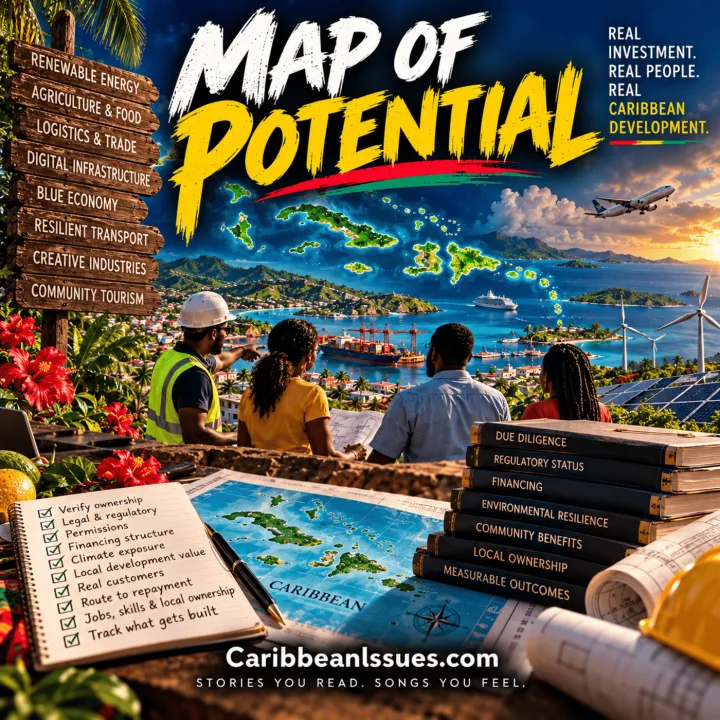
Now hear the story: Map of Potential
This article inspired a song on Caribbean Issues, Vol. 1 — Songs from the Headlines. Listen to the sample, then support independent Caribbean journalism by buying the complete Digital Album Edition directly from Caribbean Issues.
One-minute song sample
Caribbean Issues Reader Forum
What is your view?
Rate the usefulness of this analysis, respond to its evidence and add knowledge from the Caribbean or diaspora. Comments are reviewed before publication.
Was this analysis useful?
How would you describe it?
Reader discussion
Loading approved comments…