
The short answer
Guyana's accountability collapse and the watchdog press that died before it could tell you
Publication record
Transparent responsibility and verification details for this Caribbean Issues publication.
- Published
- Updated
- No later revision recorded
- Responsible byline
- Caribbean Issues
- Verification
- Editorially reviewed under our published method
- Sources listed
- 12 sources listed below
- Primary topic
- Caribbean Economies and Economic Sovereignty
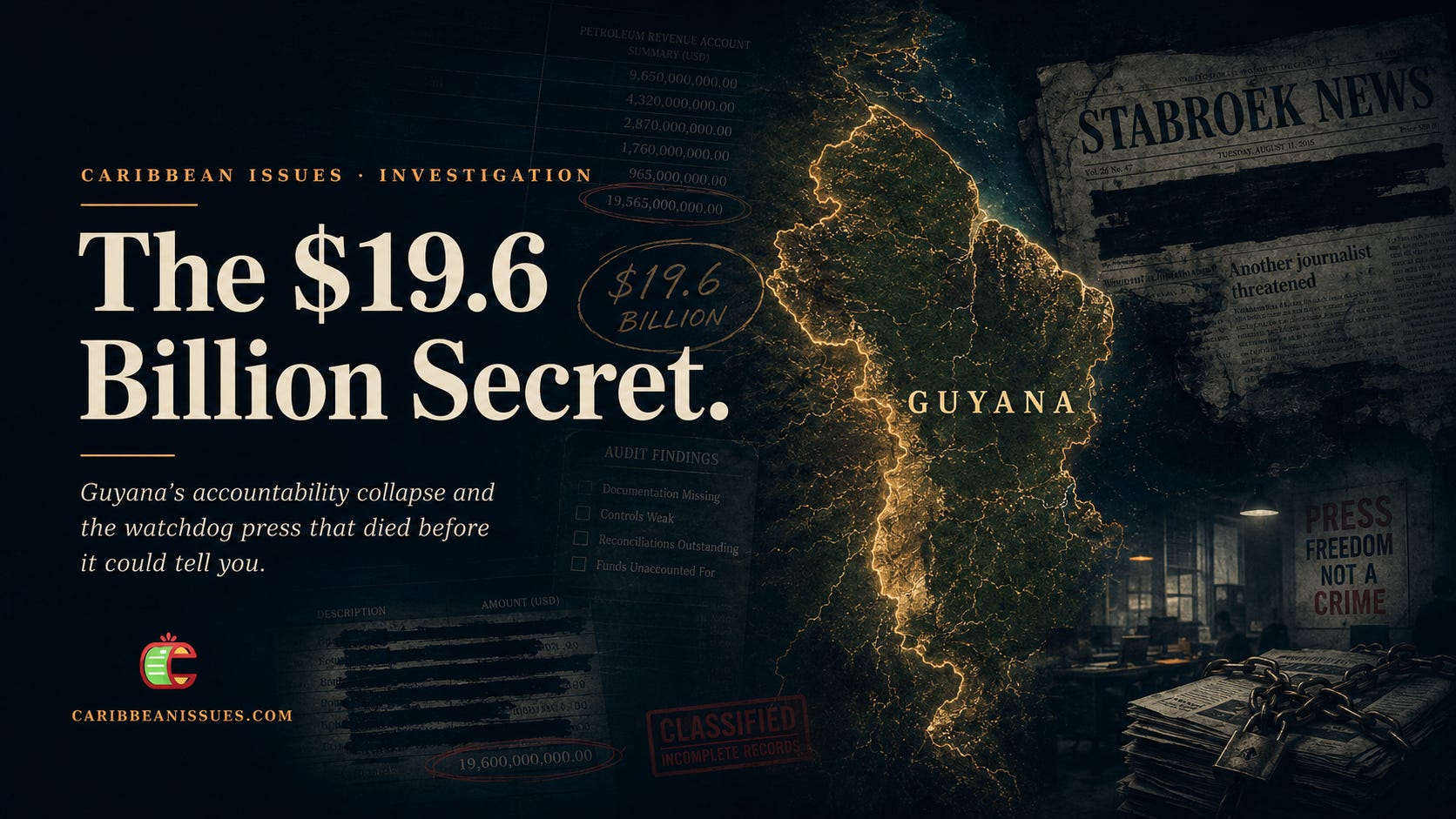
In the world’s fastest-growing economy, an oil audit larger than the entire national budget sits hidden from the public — and the independent newspapers that would have pried it loose are dying. They are the same story.
The central argument
In October 2025, Guyana opened a bridge. The Bharrat Jagdeo Demerara River crossing cost US$260.8 million and was paid for, in full, with oil money — a clean steel arc over brown water, named for the vice president, and as good a monument as any to what has happened to this country. Five years ago, more than half of Guyana’s population lived in poverty. Today its GDP per capita, measured at purchasing power, sits in the same band as Norway and Switzerland. Its economy has grown by an average of roughly 47% a year since 2022 — the fastest on Earth, by a distance no other nation comes close to.
And somewhere in a government building in Georgetown, there is a document worth more than two years of that bridge-building, that nobody outside a small circle of officials is allowed to read.
It is an audit. It examines US$19.6 billion in costs that ExxonMobil and its partners have charged against Guyana’s oil. It was completed and handed to the government in May 2025 . A full year later, it has not been released. We do not know what it found. We are not allowed to know.
This is the story of that secret — and of why, in the same eighteen months, the journalists who would have forced it into the open have been switching off the lights one newsroom at a time.
Visit Our Store
Follow the barrel
To understand why a hidden audit is not a technicality but a theft-shaped hole, you have to understand the contract.
Guyana’s oil comes out of the Stabroek Block, operated by ExxonMobil (45%) alongside Chevron (30%, acquired with Hess) and China’s CNOOC (25%). The terms are set by a Production Sharing Agreement signed in 2016 — a contract so generous to the companies that the International Institute for Energy Economics and Financial Analysis has spent years documenting how thin Guyana’s slice really is.
Here is the mechanic that matters. Under the PSA, before any profit is split, the companies first recover their costs — up to 75% of revenue in any period can be claimed as “cost oil.” Only what remains is divided, fifty-fifty, with a 2% royalty on top. Which means the single most consequential number in the entire arrangement is the cost figure. Inflate the costs, and the pool left to share shrinks. Every dollar Exxon books as a recoverable expense is a dollar Guyana does not split.
The audits exist to check that number. There have been three.
The first , covering 1999 to 2017, was conducted by the British firm IHS Markit. It reviewed roughly US$1.7 billion in expenses and flagged US$214 million as questionable — a portion ineligible, a large portion simply undocumented. That was over five years ago. As of this month, the dispute remains unresolved; the “sole expert” the contract requires to settle it has, by the Natural Resources Ministry’s own account, still not been seated.
The second , covering 2018 to 2020, examined some US$7.2 billion and found a further US$65 million wrongly charged to Guyana. Whether the full report was ever published remains, charitably, unclear.
The third is the one that should stop you. Conducted by a local team, it covers a staggering US$19.6 billion in claimed costs — the largest audit in the country’s history by a wide margin. The government received it in May 2025. It has refused to make it public. The findings — whatever they are, however many hundreds of millions they may flag — sit redacted from the only people with a real stake in them: the Guyanese.
The government’s defenders will say, fairly, that the PSA provides a dispute process, that the Guyana Revenue Authority reviews these matters, that audits are technical and adversarial by nature and take time. All true. But none of it explains the central fact. A finished audit of nearly twenty billion dollars in charges against the national patrimony has existed for a year, and the public has not been permitted to see a single page.
The machinery of not-knowing
What makes this more than a paperwork delay is the pattern. Reports arrive and disappear. Disputes open and never close. The Oil and Gas Governance Network has separately flagged that the Natural Resource Fund — Guyana’s sovereign wealth vehicle, which closed 2025 at about US$3.25 billion — appears, on the available figures, to be short by some US$27 million it cannot fully reconcile against the companies’ own statements. A court has already ruled that the government broke the law by granting Exxon a 20-year environmental permit when the statute allowed only five.
None of these are, on their own, proof of corruption. Taken together, they describe something more corrosive than any single scandal: a machinery of not-knowing. The numbers are too big to picture, the contracts too technical to follow, the disputes too slow to track — and the result is a public that has been maneuvered, gently and bureaucratically, into being unable to verify what is happening to the largest fortune in its history.
This is the thing about resource wealth that the celebratory coverage misses. A sovereign wealth fund is not a vault; it is a promise, and a promise is only as good as the public’s ability to audit it. Norway — the model Guyana’s leaders invoke constantly — does not have a clean oil fund because Norwegians are more virtuous. It has a clean fund because Norwegian institutions, Norwegian courts, and the Norwegian press make hiding a $19.6 billion audit for a year politically impossible.
Guyana wants the Norway outcome. The question this piece is really about is whether it is building the Norway machinery — or quietly dismantling the part of it that bites.
The watchdogs go dark
Because here is what else happened while the audit sat in its drawer.
As the money rose, the watchdogs went dark
In July 2025, the regional outlet Loop News shut down. In January 2026, Trinidad and Tobago’s Newsday — 32 years old, independently owned, a real newsroom with real reporters — stopped publishing. Its print advertising had fallen 75% over a decade; its managing director called the end a “perfect storm.” And in March 2026, Guyana’s Stabroek News printed its final edition after 39 years.
That last one deserves a moment, because Stabroek News was not just any paper. It was founded in 1986, when its creator reportedly had to ask the sitting president whether the country would even tolerate an independent newspaper — at a time when Guyana was still years away from its first free and fair elections in nearly three decades. For four decades it was, with the fiercely combative Kaieteur News , one of the two papers that actually scrutinized power in Guyana. It covered the corruption, the contracts, the disputes. It was exactly the institution you would want alive and funded during an oil boom.
It died, in part, owing money — to the government. By its owners’ account, the state had run up an advertising debt of around GY$90 million (something north of US$320,000) and had cleared “a mere” fraction of it. The paper was careful to say that the unpaid bills were not the main reason for its closure; like papers everywhere, it had lost readers to the phone in their hands. That is honest, and it is true. But it is impossible to read the sequence — a watchdog paper, owed money by the government it watched, folding in the middle of an oil boom thick with unanswered questions — without feeling the chill of it.
One reader, in a letter mourning the closure, said it plainly: the loss landed hardest “during this period of Guyana’s history, where allegations of massive public corruption are rife,” with the nation’s oil and gold “either corruptly exploited or used as personal political bargaining chips.” The president of the Media Institute of the Caribbean noted that the closures hit so hard precisely because these were independent owners — voices not easily leaned on by advertisers or power.
When Stabroek’s editor-in-chief was asked why they were leaving now, his answer was almost unbearably pointed. They were going, he said, while they could still make sure their independence was “not on the line.”
Why these are one story
It would be easy to file these as two separate items: an oil-transparency problem in column A, a media-economics problem in column B. The first looks like politics; the second looks like the inevitable global death of print. Treat them separately and each becomes manageable, even boring.
They are not separate. They are the same story, and the connection is the entire point.
A hidden audit only stays hidden if no one with reach is asking where it is. A disputed $214 million only sits unresolved for five years if the cost of leaving it unresolved — in headlines, in editorials, in dogged follow-up questions at every press conference — is close to zero. The Natural Resource Fund only goes unreconciled if the people who could explain the gap to a million citizens have been quietly removed from the board.
The press is not a nice-to-have ornament on a democracy. In a petrostate, it is load-bearing infrastructure — the only enforcement mechanism that operates between elections. Strip it out, and the formal institutions remain standing while their function quietly fails: the audits still get commissioned, the fund still gets reported, the dispute mechanisms still technically exist. They just stop mattering, because nothing follows from what they find.
Guyana is not there yet. Kaieteur News still publishes, still swings hard at Exxon and at the government, still puts the $19.6 billion question in print. The civil-society groups — the governance networks, the financial analysts — still do the arithmetic. But the trend line is unmistakable, and it runs exactly the wrong way. The money is going vertical. The watchdogs are going dark. The two lines cross somewhere just ahead of us, and on the far side of that crossing is a country with Norway’s bank balance and none of Norway’s accountability.
The Caribbean Issues take
We have spent the last weeks writing about Caribbean sovereignty as a thing that happens to the region from the outside — Venezuela’s claim on Essequibo, Washington’s warships, the strikes in Caribbean waters. Those are real. But there is a quieter sovereignty question, and Guyana is where it is being decided: whether a people actually control the wealth that is nominally theirs.
A nation does not lose control of its patrimony in a single dramatic act. It loses it in increments — a contract signed in haste, an audit left in a drawer, a dispute that never resolves, a newspaper that folds owed money by the state, a public gradually trained not to expect answers. Each step is defensible on its own. The sum is a country that is spectacularly rich and cannot tell you, with confidence, where its money went.
The $19.6 billion audit should be published. Not leaked, not summarized, not “addressed through the appropriate process” — published, in full, the way Norway would publish it. Guyana’s leaders ask to be measured against the Norway model. This is the test. A government with nothing to hide releases the audit. A free country keeps its newspapers alive. And a people who intend to stay sovereign over their own oil insist, loudly and continuously, on both.
The bridge over the Demerara is real and it is paid for. The question is whether anyone will still be allowed to check the receipts.
Sources and documentation
Sources are consolidated here so the investigation reads continuously while the record remains directly inspectable. Evidence roles describe how a source is used; they are not automatic truth scores.
Supports: • Kaieteur News , “Five years later Govt. still to settle US$214M audit dispute with Exxon” (May 5, 2026)
Currency: Date metadata is not recorded in the source ledger.
Supports: • IEEFA , “ExxonMobil contract leaves Guyana exposed to financial and environmental risks”
Currency: Verification is older than 45 days; review before relying on current conditions.
Supports: • Oil & Gas Governance Network , “Natural Resource Fund Appears to Be Missing US$27M”
Currency: Date metadata is not recorded in the source ledger.
Supports: • Associated Press , “A blow to Caribbean democracy as Stabroek News and Newsday papers fold” (March 2026)
Currency: Date metadata is not recorded in the source ledger.
Supports: • LatAm Journalism Review (Knight Center) , “Closures of Stabroek News and Newsday signal deepening crisis”
Currency: Date metadata is not recorded in the source ledger.
Supports: • International Monetary Fund , Guyana economic outlook and Natural Resource Fund data
Currency: Verification is older than 45 days; review before relying on current conditions.
Supports: • Council on Foreign Relations , “How Guyana’s Oil Boom Will Reshape Energy Security” (February 2026)
Currency: Date metadata is not recorded in the source ledger.
- [8]Government of Guyana Petroleum Management Programme — IHS Markit final cost-recovery auditOfficial record
Supports: The audited 1999–2017 Stabroek Block cost claims and the US$214.4 million in costs the report found reasonable grounds to dispute.
Currency: Verification is older than 45 days; review before relying on current conditions.
- [9]Guyana Ministry of Natural Resources — Media release on first and second petroleum auditsOfficial record
Supports: The government's stated position on the US$214,411,994 cost-bank adjustment and the dispute process.
Currency: Verification is older than 45 days; review before relying on current conditions.
Supports: The scope and status of the first three Stabroek Block cost-recovery audits and amounts not accepted by government.
Currency: Verification is older than 45 days; review before relying on current conditions.
Supports: The Fund's statutory reporting basis, activities and financial position through December 2025.
Currency: Verification is older than 45 days; review before relying on current conditions.
Supports: The legal framework governing the Natural Resource Fund, including transparency and reporting obligations.
Currency: Verification is older than 45 days; review before relying on current conditions.
Editorial standards, corrections and AI-assistance policy · Privacy and data use
Caribbean Issues Reader Forum
What is your view?
Rate the usefulness of this analysis, respond to its evidence and add knowledge from the Caribbean or diaspora. Comments are reviewed before publication.
Was this analysis useful?
How would you describe it?
Reader discussion
Loading approved comments…