
The short answer
The disclosed lobbying relationship is not merely a Washington story: it shows how a small Caribbean state tried to manage pressure surrounding a strategically sensitive hospital project while navigating unequal access to competing sources of finance and influence.
Publication record
Transparent responsibility and verification details for this Caribbean Issues publication.
- Published
- Updated
- No later revision recorded
- Responsible byline
- Caribbean Issues
- Verification
- Editorially reviewed under our published method
- Sources listed
- 3 sources listed below
- Primary topic
- Caribbean Security and Global Power
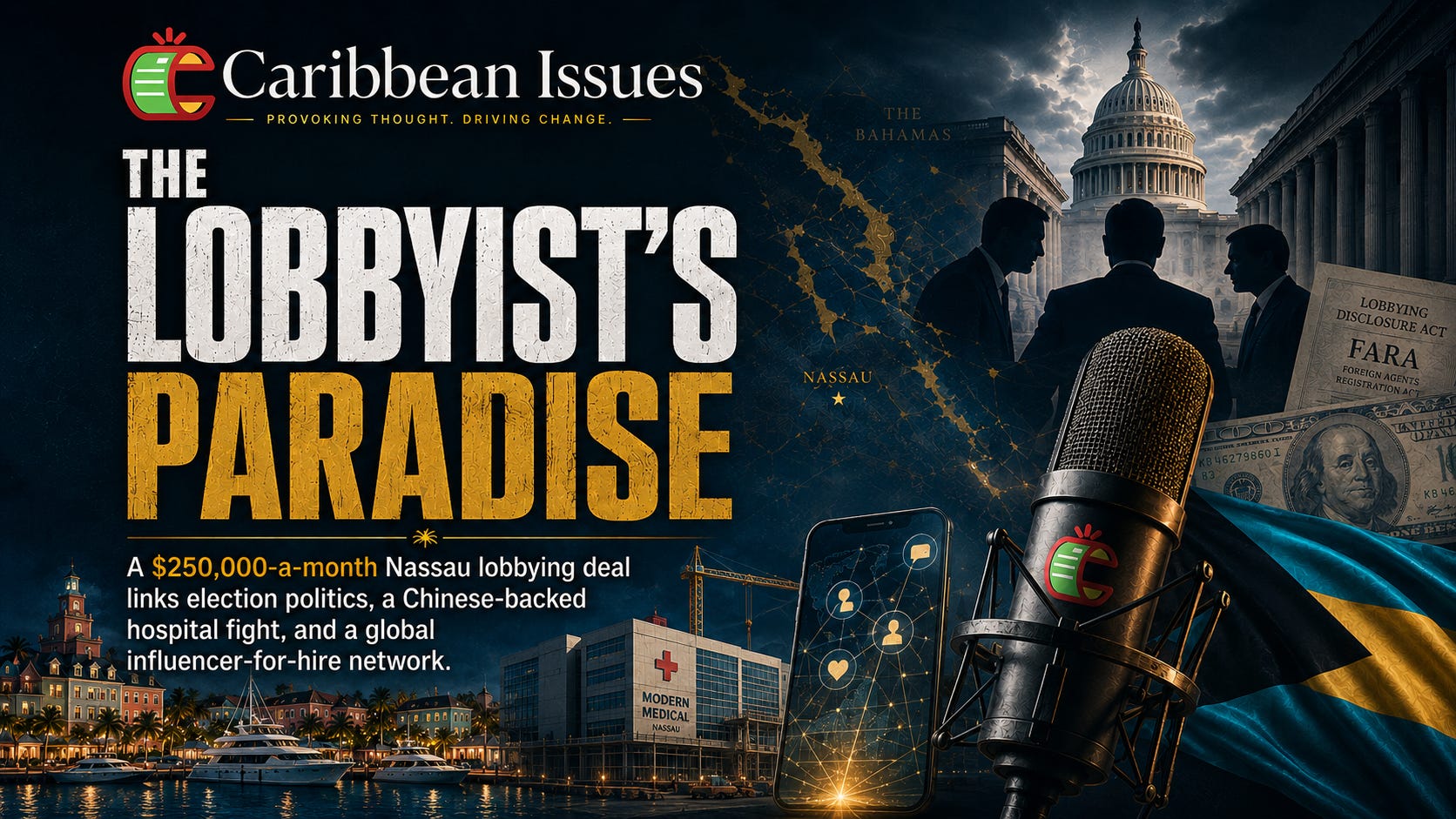
A Washington firm whose 2026 client list also includes Myanmar’s military junta signed a five-month, $250,000-a-month contract with Nassau — weeks before an election, in the middle of a fight over a Chinese-financed hospital, and as the same influencer-for-hire model spreads from the Caribbean to Israel, Qatar, and Kenya.
The central argument
The Lobbyist’s Paradise: Inside The Bahamas’ $1.25 Million Bet on Trump World This piece is the companion feature to *The Lobbyist’s Paradise*, a five-part investigative podcast series. Listen Episode 1 as it drops Tomorrow, August 5th, 2026 .
On March 24, 2026, Cresswell Sturrup, Permanent Secretary in the Office of the Prime Minister of The Bahamas, signed a five-month, $1.25 million contract with a Washington public affairs firm most Bahamians had never heard of. The FARA filings that followed named Roger Stone, CJ Pearson, and a third operative most coverage has missed entirely — and put Nassau inside a global pattern that now stretches from Myanmar to Israel.
The Filing
Cresswell Sturrup signed for the government. Justin Peterson, a managing partner at DCI Group AZ, L.L.C., signed for the firm. The engagement was for five months, running from March 24 through August 18, 2026, at a flat rate of $250,000 a month — $1.25 million in total. [1][2]
The contract language itself is boilerplate: DCI would provide “communications and government-affairs services” and help The Bahamas “build stronger relations with the United States.” [3] What turned a routine engagement into international news was the paperwork DCI filed with the U.S. Department of Justice the following day under the Foreign Agents Registration Act — the 1938 law that requires anyone working on behalf of a foreign government to disclose who they are, what they’re paid, and what they’re doing.
Three names appear in those filings as the people actually doing the work:
Roger Stone, 73 — the longest-serving political adviser in Donald Trump’s orbit, with a relationship that traces back more than four decades to when Trump was the first client of a firm Stone co-founded. [4] Stone’s career runs through the Nixon administration, the 2016 Trump campaign, a 2019 conviction on seven felony counts (lying to Congress, witness tampering, obstruction of an official proceeding), and a full pardon from Trump in December 2020. His initial FARA filing listed his fee at $125,000 a month; an amendment filed minutes later, on March 25, cut it to $100,000. [1][5] Neither Stone nor DCI has explained the change. Contacted by the Miami Herald, Stone declined to comment. [5]
Coreco “CJ” Pearson, 23 — a MAGA social media personality who first drew national attention at age 12 with a viral video attacking then-President Barack Obama’s leadership. [6] Pearson’s short-form registration, filed roughly five weeks after Stone’s, lists his compensation at $20,000 a month and describes his role as helping “the Commonwealth of The Bahamas in its communications efforts to build stronger relations with the United States.” [5]
Doug Davenport — a former attorney in the first Trump administration, now a senior adviser at DCI, registered alongside Stone and Pearson but almost entirely absent from the public conversation about the deal. [5][7]
Stone and Pearson’s individual retainers — $500,000 and $100,000 respectively over the five-month contract term — account for less than half of the $1.25 million DCI is being paid in total. The remainder covers Davenport, DCI’s internal staffing, and the firm’s own margin. For a country of roughly 400,000 people, that is a serious line item under any accounting. [7]
Who DCI Group Actually Is
The Bahamas’ lobbyists are not a boutique shop specializing in Caribbean affairs. DCI Group was founded in 1996 and has been described by ABC News as a Republican public relations powerhouse and by O’Dwyer’s as a conservative public affairs firm, though its client list has spanned both partisan and bipartisan work over three decades. [8]
In the same year it signed The Bahamas, DCI also registered under FARA to represent Myanmar’s ruling military junta, agreeing to a one-year, $3 million contract aimed at rebuilding the regime’s relationship with Washington following years of sanctions since the 2021 coup — the largest lobbying agreement the junta has signed since seizing power. [9] The firm’s client history also includes the government of Azerbaijan and EN+ Group, a Russian aluminum conglomerate that spent years under U.S. sanctions. [10] DCI came under FBI investigation over a hacking-and-leaking operation — internally nicknamed “Fox Hunt” — that it ran on behalf of ExxonMobil, compiling target lists of environmental activists and researchers preparing litigation against the company, whose emails were then hacked by an outside contractor. [11]
None of this makes DCI’s work for Nassau illegitimate on its own — FARA exists precisely so this kind of representation happens in the open, and DCI is far from the only Washington firm whose books mix democracies, monarchies, and juntas. But it does mean that when the Bahamian government describes this as ordinary professional communications support, it hired the same firm that, in the same calendar year, was doing comparable work for a military government facing allegations of atrocities against its own population.
The Hospital That Started It
To understand why Nassau felt it needed a six-figure-a-month relationship manager in Washington, start with a hospital.
The New Providence Specialty Hospital is a 200-bed facility under construction to relieve pressure on the overcrowded Princess Margaret Hospital, the country’s main public healthcare facility and, for years, the only real option for Bahamians who couldn’t afford to fly to Miami for cardiac or cancer care. The project’s total financing needs come to $278 million; a loan from the China Export-Import Bank covers $195 million of that — 72.8%, or nearly three-quarters of the total. [12] Reporting by Tribune Business established that the EXIM Bank loan places the financing under Chinese law and jurisdiction rather than Bahamian law — the detail that became the entire fight. [12][13]
U.S. Ambassador Herschel Walker — the former NFL running back and 2022 Georgia Senate candidate, installed in Nassau in 2025 — raised the issue publicly as early as February 6, 2026, arguing the terms weren’t “in the best interests” of The Bahamas and that submitting to Chinese law and labour standards on Bahamian soil wasn’t advisable, and pledging that the Trump administration would help secure a better deal. [13] The Bahamian Ministry of Health and Wellness responded that, before finalizing the China agreement, the government had engaged “at the highest levels” with Washington, including talks with the U.S. Export-Import Bank, but received no American financing proposal that matched “the scale, timing, and certainty required to advance this critical national project.” [14]
The dispute became a formal diplomatic incident when the government proceeded to a groundbreaking ceremony on April 17. Two days later, the U.S. Embassy issued a statement quoting Walker directly:
We are disappointed to see this project move forward so quickly when fundamental concerns about the terms of the deal remain unaddressed. I question the decision to rush forward with a deal that places the hospital financing under Chinese law and jurisdiction on Bahamian soil. — U.S. Embassy Nassau, quoting Ambassador Herschel Walker [15][16]
The Bahamian Ministry of Foreign Affairs called the intervention “unusual” and said it was seeking “urgent clarification,” while maintaining that every document tied to the financing agreement had already been tabled in Parliament — there was, in its account, nothing hidden about the deal. [16] The Chinese Embassy in Nassau, responding separately, described the project as a “livelihood project” advanced through “friendly consultation and mutual respect,” and a Chinese Embassy spokesperson said Beijing believes the Bahamian government has the sovereign right to choose its own development partners based on its own national priorities. [13][17]
The Timing
The detail that has gotten the least attention so far, and arguably matters most, is the calendar. The DCI Group contract was signed March 24 — in the middle of the hospital dispute, after Walker’s February criticism but before the April groundbreaking fight — and roughly seven weeks before Prime Minister Philip Davis called a snap general election.
Davis dissolved Parliament on April 8, and writs of election went out the next day, setting the vote for May 12 under newly redrawn boundaries that expanded the House of Assembly from 39 to 41 seats. [18][19] The stated reason was to avoid campaigning through hurricane season — but the sequence is hard to ignore: a public fight with the U.S. ambassador over sovereignty and a Chinese-financed hospital, a six-figure-a-month contract with a Trump-aligned lobbying firm signed in the middle of that fight, and a national election seven weeks later.
It worked out for the government, at least electorally. The PLP won 33 of the House of Assembly’s 41 seats on May 12; the FNM, under Pintard, took eight. [19][20] It was the first time a Bahamian party had won consecutive terms since 1997, and Davis was sworn in for his second term on May 14. [19][21] Pintard conceded within four hours of polls closing. [19] Whether the DCI contract insulated the government from the hospital controversy, whether voters weighted it lightly against other issues, or whether the PLP’s broader record simply carried the day is not something the public record can settle. What the record does show is that Stone, Pearson, and Davenport were still on retainer, doing whatever it is they do, on the day Bahamians voted.
The Reaction in Nassau
The arrangement became public through U.S. reporting rather than Bahamian government disclosure — the Miami Herald and Bloomberg Government both worked the FARA filings in late April and early May, weeks after the contract was signed and days before the election. [5][6]
Free National Movement leader Michael Pintard raised the issue on the campaign’s final stretch, arguing that the disclosed figures likely understated the real cost — “that’s only the amount that you know,” he said — while pointing out that communities across The Bahamas still lacked functioning fire trucks and ambulances. [22] The Nassau Guardian’s editorial board was harsher still, writing that Pearson’s engagement and its cost were “outright offensive” and challenging the government to explain what practical usefulness a 23-year-old influencer offered the country, when thousands of other commentators occupy the same media ecosystem. [7]
The Office of the Prime Minister held its ground publicly, framing the U.S. relationship as central to nearly every part of Bahamian life — tourism, financial services, border security — and describing professional representation in Washington as ordinary statecraft rather than scandal. Separate commentary defending the arrangement pointed to the scale of what’s actually at stake: roughly 85% of the 11.2 million visitors who came to The Bahamas in 2024 were American, tourism accounts for close to 70% of GDP, and the relationship had been tested over the previous fifteen months not just by the hospital dispute but by a 10% U.S. reciprocal tariff on Bahamian exports and a Southern District of New York federal indictment naming senior Royal Bahamas Police Force and Defence Force officers. [7] That framing — that a serious, sustained relationship-management problem justified a serious price tag — is the strongest case the arrangement’s defenders have made publicly. It is also, notably, an argument made in opinion commentary rather than in an on-the-record government accounting of what, specifically, the $1.25 million bought.
Not an Isolated Case — and Not Just the Caribbean
The Bahamas’ bet on Trump-aligned representation fits a pattern that extends well beyond one island nation, and beyond the Caribbean altogether.
Within the region, Continental Strategy — founded by Carlos Trujillo, Trump’s first-term ambassador to the Organization of American States — has built a substantial book of government clients since Trump’s return to office. The firm signed a $600,000 annual contract with Guyana, whose government wanted assurance that Washington would back it if Venezuela moved against disputed territory. [23] It signed a separate $35,000-a-month, one-year agreement with Haiti’s transitional government aimed at improving the country’s standing in Washington amid its security and governance crisis. [23] By August 2025, Continental had added two Dominican Republic government clients, including the country’s Industry and Trade ministry, in contracts aimed explicitly at blunting new U.S. tariffs and positioning the DR as a nearshoring alternative to Mexico and China. [24] The Tribune’s own reporting on the Bahamas deal named Haiti, Guyana, the Dominican Republic, and Grenada as Caribbean governments that have hired lobbyists with close Republican and Trump-administration ties amid mounting U.S. pressure over ties to Cuba, use of Cuban medical missions, and demands to accept deportees — though independent reporting located for this piece could confirm the specifics only for Haiti, Guyana, and the Dominican Republic; a Grenada contract, if one exists, was not independently verifiable in public FARA filings at time of writing. [6]
Outside the hemisphere, the same firm signed Kenya to a $175,000-a-month retainer, prompting a senior Kenyan official to describe the arrangement as standard, legitimate practice for governments worldwide. [25]
And the influencer-specific version of this trend — paying MAGA-aligned social media figures directly, rather than registered lobbyists — is considerably larger than the Bahamas deal suggests on its own. The Wall Street Journal reported in January 2026 that a growing number of countries were paying influencers from Trump’s “America First” movement, often people with no diplomatic background at all, to advance their interests with the American public, naming Israel and Qatar specifically. [6][26] By mid-2026, reporting from the Journal, TIME, and Axios detailed a far larger version of the same model: Israel’s campaign built around Brad Parscale, Trump’s former campaign manager, which filings showed growing from roughly $6 million to $9 million by December 2025, with the Journal later describing total spending including subcontractors in the $45–$50 million range — dramatically larger than what Trump-aligned consultants have typically been paid to represent other foreign governments such as Saudi Arabia, India, or Qatar, which the Journal said generally pay in the tens of thousands of dollars a month. [26][27] Qatar has taken a more informal version of the same approach, flying MAGA-aligned influencers to Doha for luxury trips that included meetings with Qatari officials. [28]
Seen against that backdrop, The Bahamas’ $250,000-a-month contract is neither the largest nor the strangest example of this model — it’s a mid-sized, disclosed, comparatively conventional version of a strategy that stretches from a Caribbean archipelago of 400,000 people to a $700 million-a-year Israeli global influence budget. [27] What ties all of it together is the same underlying calculation: in an administration where access runs through personal relationships rather than institutions, a retainer with the right person looks like a more reliable investment than a State Department relationship that might not survive the next reshuffling of who has the president’s ear.
Visit caribbeanissues.com What the Filings Don’t Tell You It’s worth being precise about the limits of the public record, because the temptation with a story like this is to treat the existence of the retainer as proof of influence purchased.
The filings establish who is being paid and how much. They do not establish what, specifically, Stone, Pearson, or Davenport has done on Nassau’s behalf, or whether any of it has moved a single U.S. policy decision. There is no public evidence connecting DCI’s work to a change in the administration’s posture on the hospital, on Cuba-linked medical missions, or on deportation cooperation — the three pressure points most often cited as driving this wave of Caribbean lobbying contracts. [6] It is entirely possible the retainer functions exactly as its defenders describe: professional representation, no different in kind from what dozens of foreign governments maintain in Washington at any given time. It is equally possible it functions as insurance against a bad outcome that hasn’t happened yet — money spent to avoid a crisis rather than to produce a specific, measurable win, which would make its value nearly impossible to assess from the outside no matter how transparent the underlying filings are.
That ambiguity is, in the end, the real subject of this story. A sovereign nation of 400,000 people, squeezed between a superpower demanding loyalty on Cuba and migration and a rival superpower offering hospital financing terms nobody else would match, decided that the most reliable investment available to it wasn’t a diplomatic cable or a policy paper — it was a retainer with a Washington firm whose other 2026 clients include a military junta.
Under Maroon Economics, the test for any transaction is simple: does the value created stay in the region, or does it leave before it ever really arrives? By that measure, $1.25 million over five months is $1.25 million that will never touch a Family Island fire station, a Princess Margaret Hospital ward, or a Bahamian communications firm capable of doing comparable work at home. Whether that is a fair price for insurance against a genuinely hostile geopolitical moment, or the down payment on a habit the next government won’t be able to break, is a question voters — not lobbyists — will eventually have to settle. They already answered it once, on May 12, with the information they had. What they didn’t have, at the time, was most of what is in this article.
Maroon Economics T-Shirts available on caribbeanissues.com
Questions readers are asking
What do the United States FARA records establish about DCI Group and The Bahamas?
The Justice Department's public register records DCI Group AZ, LLC as representing The Commonwealth of The Bahamas from March 25, 2026. The filing establishes the disclosed relationship; assessments of its political purpose remain analysis and should not be confused with the filing itself.
Why is the New Providence hospital central to this investigation?
The hospital placed an essential public-health project inside a wider financing and diplomatic contest. Bahamian government records document the project and its financing case, while the article examines why that context made external political representation valuable.
What should Caribbean governments disclose when hiring foreign lobbyists?
At minimum, the principal, contract value, duration, scope, public purpose, decision authority and measurable results should be published in a form citizens can inspect alongside any legally required foreign-agent filing.
Sources and documentation
Sources are consolidated here so the investigation reads continuously while the record remains directly inspectable. Evidence roles describe how a source is used; they are not automatic truth scores.
- [1]U.S. Department of Justice FARA — DCI Group filings for The Commonwealth of The BahamasOfficial record
Supports: The public filing history for DCI Group AZ, LLC, including its March 25, 2026 registration materials for The Commonwealth of The Bahamas.
Currency: Verification is older than 45 days; review before relying on current conditions.
- [2]U.S. Department of Justice FARA — Active registrants representing Bahamian principalsOfficial record
Supports: The official register identifying DCI Group as an active registrant for The Commonwealth of The Bahamas and placing it among other agents for Bahamian principals.
Currency: Verification is older than 45 days; review before relying on current conditions.
- [3]Office of the Prime Minister, The Bahamas — Special Resolution on the New Providence hospital projectOfficial record
Supports: The government's stated financing, public-interest case and policy context for the New Providence hospital project.
Currency: Verification is older than 45 days; review before relying on current conditions.
Editorial standards, corrections and AI-assistance policy · Privacy and data use
Listen to The Lobbyist’s Paradise series
Follow the complete five-part investigation from the original protection contract through the wider global influence market.
Caribbean Issues Reader Forum
What is your view?
Rate the usefulness of this analysis, respond to its evidence and add knowledge from the Caribbean or diaspora. Comments are reviewed before publication.
Was this analysis useful?
How would you describe it?
Reader discussion
Loading approved comments…