
The short answer
The contradiction is not that every Caribbean government follows one deportation rule. It is that no transparent regional rule exists, even as CARICOM advances a common moral case against forced displacement through reparatory justice.
Publication record
Transparent responsibility and verification details for this Caribbean Issues publication.
- Published
- Updated
- Responsible byline
- Caribbean Issues
- Verification
- Editorially reviewed under our published method
- Sources listed
- 19 sources listed below
- Primary topic
- Caribbean Security and Global Power
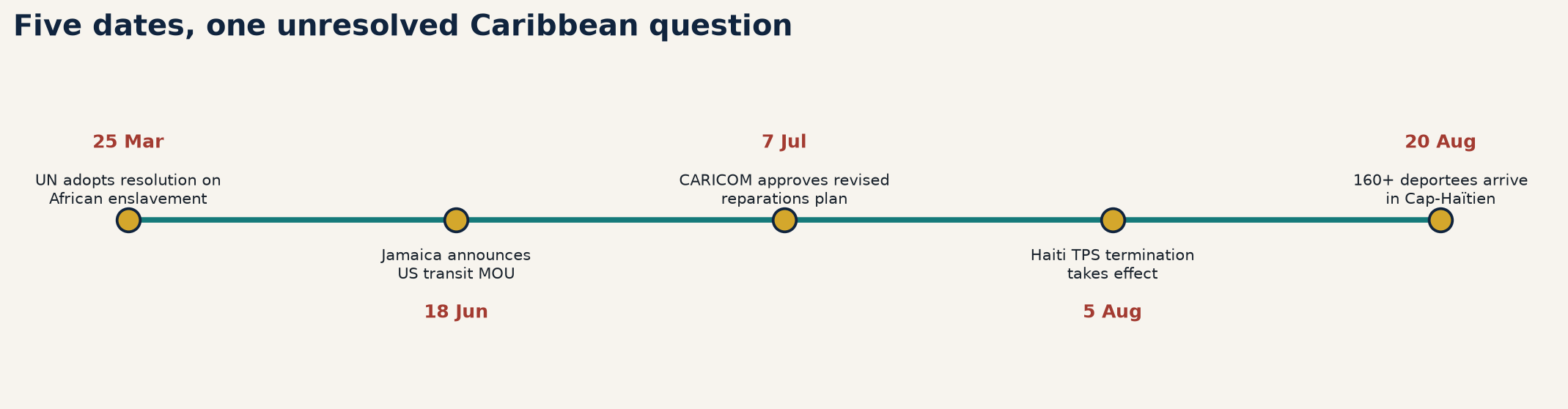
On 20 August, a deportation flight carrying more than 160 people landed in Cap-Haïtien. It did not land in Port-au-Prince. The capital’s main airport was considered too dangerous.
A flight to the place Americans are warned not to visit
That detail should stop the argument before it becomes another dispute about labels. The United States was prepared to put Haitians on an aircraft and remove them to Haiti, but not to land that aircraft at the country’s principal airport. Its own State Department was simultaneously telling American citizens not to travel to Haiti for any reason because of crime, kidnapping, terrorism, unrest and limited health care.
An FAA notice restricted specified US civil flight operations below 10,000 feet in a defined area near Port-au-Prince because of risks associated with ongoing instability, while allowing government-authorised exceptions. The honest question is therefore narrower—and harder—than the slogan: what standard of safety is being applied, to whom, and for whose benefit?
What changed for Haitian TPS holders?
Temporary Protected Status does not confer permanent residence. It is a statutory protection that allows eligible nationals of a designated country to remain and work in the United States when conditions make return unsafe or impracticable. Haiti’s designation grew out of the devastation following the 2010 earthquake and was later extended and redesignated as political, humanitarian and security conditions deteriorated.
In June 2026, the US Supreme Court ruled 6–3 in Mullin v. Doe that the statute generally bars judicial review of the Homeland Security secretary’s TPS determinations. A lower court subsequently lifted the order preventing Haiti’s termination from taking effect. Roughly 350,000 Haitians lost TPS protection. That did not mean all were immediately subject to removal, because individual immigration histories and other claims differ. It did mean that TPS itself no longer supplied lawful status and work authorisation.
The 20 August flight was the first large removal flight after that legal shift. Haitian migration officials said the passengers included former TPS holders as well as people who had completed prison sentences. Those are not interchangeable categories, and collapsing them into the word ‘deportees’ conceals more than it explains.
The reparations case—and the present-tense test
On 25 March, all CARICOM member states supported a Ghana-led United Nations resolution declaring the trafficking and racialised chattel enslavement of Africans the gravest crime against humanity because of its scale, duration, systemic nature, brutality and enduring consequences. The resolution passed 123–3, with 52 abstentions. Sir Hilary Beckles, chair of the CARICOM Reparations Commission, called it a historic landmark.
In July, CARICOM heads approved a revised Ten-Point Plan for Reparations: A Manifesto for the Coming Enlightenment. The region’s reparations campaign is not performative theatre. It is one of the Caribbean’s most sustained exercises in coalition-building, historical documentation and international legal strategy.
That seriousness creates a present-tense obligation. A region asking Europe to account for the forced movement of African people cannot treat contemporary forced movement as a collection of minor bilateral favours. It must explain the rules, publish the agreements, protect due process and defend a common regional principle.
There is no single Caribbean deportation deal
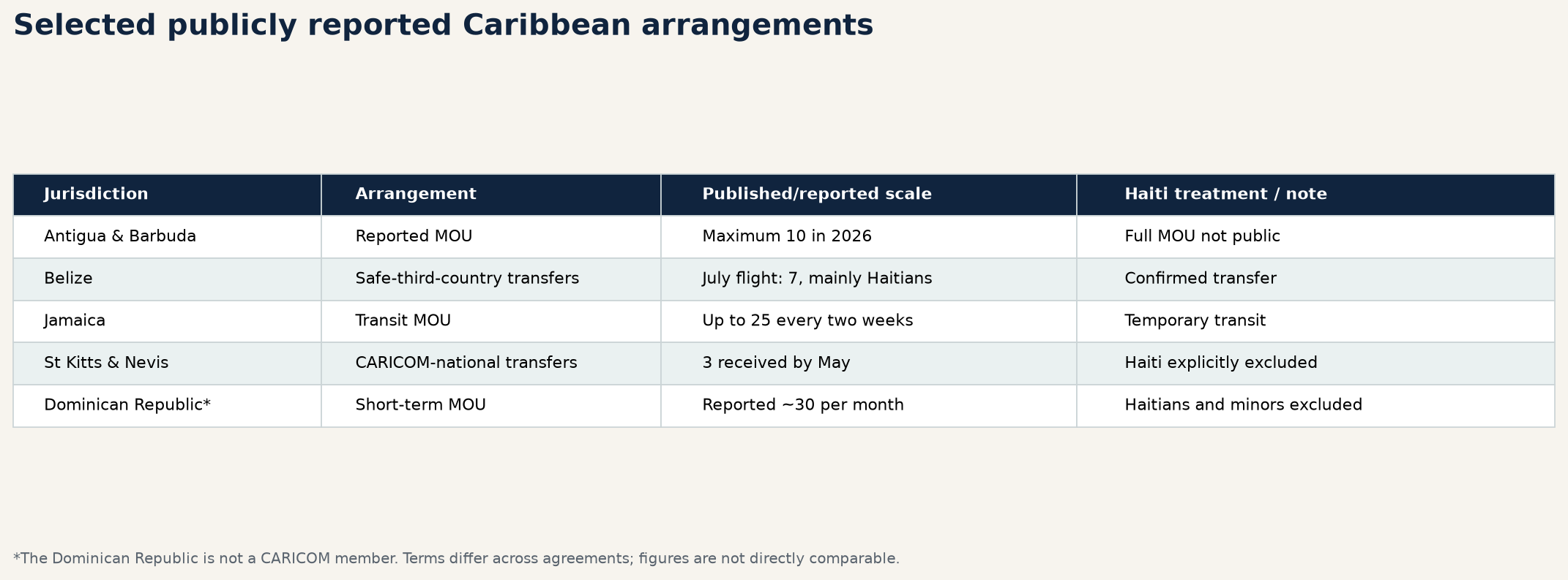
The available evidence does not support the claim that every reported Caribbean arrangement excluded Haitian nationals. St Kitts and Nevis explicitly excluded Haitians on security grounds, and the Dominican Republic said its agreement would not apply to Haitian nationals. Belize, however, reportedly received seven people on a 30 July safe-third-country flight, mainly Haitians.
The correction reveals a region without a consistent standard. Some arrangements concern temporary transit. Some permit asylum claims in the receiving country. Some are limited to CARICOM nationals. Some exclude particular categories. Some transfers have occurred; other agreements remain prospective. Public descriptions are often incomplete, and the words ‘third-country agreement’ can conceal legally different mechanisms.
Jamaica’s government described its memorandum as a transit arrangement for up to 25 people every two weeks, with screening and an intended stay of no more than 14 days before onward movement. St Kitts and Nevis had received three people from Jamaica and Belize by May. Antigua and Barbuda said its proposed ceiling was ten people for all of 2026. These numbers should not be added together as though they measure the same thing.
What CARICOM said—and what it did not answer
CARICOM did eventually address the controversy. On 9 July, heads of government said the proposed memoranda concerned the transit of people without criminal antecedents to their home countries, rather than settlement in member states. They promised to protect national security and public services, affirmed the dignity of migrants, and said citizens should be engaged.
That statement establishes a regional baseline: these arrangements cannot honestly be sold as a programme for importing violent offenders or permanently settling unknown populations. Much of the fear circulated in Caribbean political debate has depended on precisely those impressions.
But the statement left the decisive questions unanswered. It did not publish a model memorandum. It did not identify which states had signed, what each would be paid, how long a person could be held, which government would be legally responsible, or what would happen if onward travel failed. It invoked dignity without defining the procedures required to preserve it.
That gap is the Caribbean issue. The region has offered reassurance where it needed rules.
The due-process question is not settled
A federal district judge ruled in February that the US third-country removal policy was unlawful because people must receive meaningful notice and an opportunity to raise country-specific claims before being sent somewhere not identified in their removal orders. The administration continued to defend the policy through litigation.
The receiving government therefore has its own questions to answer. Who was screened? What documents accompanied the person? Could the person consult counsel? Was onward travel voluntary? Who pays for accommodation, health care and transport? What happens when the destination country refuses admission? Without published agreements and outcome reporting, the public cannot distinguish orderly transit from outsourced coercion.
Haiti’s unequal place inside the Caribbean
Haiti has been a full CARICOM member since 2002. Yet its participation in regional movement remains qualified. CARICOM’s own CSME page says Haiti signed on in 2010 but is unable to participate in all regimes. A CARICOM implementation report also records the uneven history of visa requirements for Haitian nationals across member states. In 2023, Haiti requested a derogation from the proposed full-free-movement arrangement because of its circumstances.
That history is more complicated than a simple statement that CARICOM bars Haitians. Governments point to documentation, administrative readiness and security. Those explanations deserve to be heard. But twenty-four years after Haiti became a full member, temporary incapacity has hardened into a durable regional exception. The burden should now be on CARICOM to publish a staged pathway out of it.
Haiti is not only a crisis to be managed
Caribbean discussion too often begins with Haiti as an emergency and ends with Haiti as an exception. That language erases the country’s place in the region’s political inheritance. Haiti’s revolution destroyed a slave state, established the first independent Black republic and changed what freedom could mean throughout the Americas. The modern Caribbean reparations case is intellectually inseparable from that history.
Yet Haiti is frequently encountered in regional policy as a security file: migration pressure, document weakness, gang violence, border control and humanitarian need. Each concern is real. Taken together, however, they can reduce more than eleven million Caribbean people to a permanent administrative problem. Membership then becomes ceremonial—Haiti is invoked when the region speaks about Black sovereignty but bracketed when the region distributes the practical benefits of integration.
A credible Caribbean position has to hold both realities at once. Haiti is experiencing a catastrophic security and humanitarian emergency. It is also a founding source of Caribbean political possibility, a full CARICOM member and a society whose citizens cannot remain indefinitely outside the regional future.
The humanitarian arithmetic behind the flight
The receiving conditions are not abstract. The United Nations’ 2026 humanitarian plan initially sought to assist 4.2 million vulnerable people. It reported 1.4 million people displaced by armed violence and 5.7 million facing severe food insecurity. By June, UN officials said internal displacement had approached 1.47 million and that more than 110,000 Haitians had already been forcibly returned from other countries since January, following more than 270,000 returns in 2025.
Those totals include returns from several states and should not be attributed to the United States alone. They do establish the capacity question. Every receiving household, border community and migration office operates inside a country already absorbing internal displacement and large-scale forced return.
A flight of more than 160 people is news, but it is also one movement inside a much larger circulation of people between Haiti, the Dominican Republic, the wider Caribbean, North America and Latin America. Caribbean governments need a policy for that system, not a press statement for each aircraft.
The diaspora consequence begins before removal
Ending TPS is not only an immigration event in the United States. It reaches into Caribbean households through employment, caregiving, remittances, school fees, mortgages and small-business finance. The World Bank reports that personal remittances received were equivalent to 16.9 per cent of Haiti’s GDP in 2024, and it identifies changing migration policies as a risk to future flows.
A worker who loses authorisation may lose income months before any removal proceeding concludes. A family may divert savings from investment to legal fees. Children who are US citizens may face separation or abrupt relocation. Relatives in Haiti may receive less money precisely when food prices, housing costs and insecurity are increasing their dependence on it.
The Caribbean diaspora must be understood as infrastructure rather than sentiment. Diaspora income stabilises households when public systems fail. Diaspora professionals transmit expertise. Diaspora organisations provide legal referrals, emergency accommodation and political advocacy. A serious CARICOM response should include diaspora institutions at the policy table, not invite them only after a crisis has become a fundraiser.
The defence, stated fairly
Small Caribbean states negotiate with the United States under severe asymmetry. Visas, correspondent banking, security cooperation, trade access and citizenship-by-investment programmes can all become pressure points. A prime minister may believe that a narrow, screened transit agreement is the least damaging option available—and may be right about the immediate bilateral calculation.
Nor is every transfer inherently abusive. A transparent arrangement that protects a person from refoulement, permits a genuine asylum claim, provides counsel and secures safe onward travel could be defensible. Haiti’s crisis also presents real questions of reception capacity and personal safety that cannot be waved away as prejudice.
But asymmetry is an argument for collective negotiation, not for secrecy. If fifteen small states are approached separately, their bargaining position weakens and their standards diverge. CARICOM exists precisely because regional problems cannot always be solved by bilateral improvisation.
The Caribbean Issues five-part test
The region does not need to choose between reflexively accepting every US request and theatrically rejecting cooperation with its largest neighbour. It needs a standard the public can use to judge any agreement.
- Consent. Can the affected person understand the proposed destination, challenge the transfer and raise a country-specific protection claim before movement occurs?
- Transparency. Can Parliament, the press and the public inspect the agreement, its funding and its safeguards? A confidential personal file is legitimate; a secret governing rule is not.
- Capacity. Are reception, accommodation, health care, legal assistance and onward travel funded without displacing services owed to residents?
- Reciprocity. What concrete public benefit does the Caribbean state receive, and is it proportionate to the legal, financial and reputational burden it assumes?
- Regional coherence. Would the arrangement remain defensible if every CARICOM member adopted it, or does it depend on governments undercutting one another?
An agreement that cannot pass these tests should not be defended with the word ‘pragmatic’. Pragmatism describes attention to consequences. It does not excuse the public from knowing what those consequences are.
What a credible Caribbean response would look like
- Publish the instruments. Release each memorandum, side letter, funding schedule and screening protocol, with only narrowly justified personal or security redactions.
- Adopt minimum regional safeguards. Require meaningful notice, access to counsel, individual protection screening, non-refoulement safeguards, medical continuity and independent monitoring.
- Report outcomes, not only arrivals. Publish how many people arrived, their broad nationalities, length of stay, onward destinations and protection claims without exposing personal identities.
- Negotiate as a bloc. Use a regional mandate to prevent governments from being played against one another and establish terms no member should fall below.
- Create a funded Haiti pathway. Publish practical milestones for Haiti’s fuller participation in movement and trade, paired with document systems, security cooperation and implementation finance.
- Build diaspora support around rights, not panic. Fund verified legal referrals, family preparedness and remittance continuity while refusing scams and unqualified immigration advice.
The Caribbean Issues take
The sharpest contradiction is not that the United States says Haiti is unsafe for tourists but safe for every returning Haitian. Travel advisories and deportation law answer different legal questions. Nor is it accurate to pretend that every Caribbean government has signed the same agreement or treated Haitians in the same way.
The contradiction is institutional. CARICOM can assemble a common moral and diplomatic case about forced displacement across centuries, yet it has not produced an equally visible common standard for forced movement happening through its territory now. Governments are making decisions with consequences for people’s liberty and safety through documents the public often cannot read.
The dead deserve the reparations case CARICOM has built for them. The living deserve published rules, individual due process and a regional institution willing to negotiate for them before the aircraft door closes.
Questions readers are asking
Why were deportees flown to Cap-Haïtien instead of Port-au-Prince?
Associated Press reported that Port-au-Prince’s main international airport was considered too dangerous. The FAA restriction covered specified US civil operations in a defined area near the capital and allowed government-authorised exceptions.
Did the United States end TPS for every Haitian immigrant?
No. TPS is a specific temporary status. Its termination affected roughly 350,000 beneficiaries, but Haitians may have different immigration statuses, pending claims or other legal protections.
Are all Caribbean deportation agreements the same?
No. Publicly reported arrangements differ in purpose, eligibility, duration, numbers, protection procedures and whether they involve transit, settlement or asylum processing.
Did every Caribbean agreement exclude Haitians?
No. St Kitts and Nevis and the Dominican Republic publicly excluded Haitians from their arrangements, while Belize reportedly received a July transfer consisting mainly of Haitians.
How does ending Haitian TPS affect the Caribbean diaspora?
The effects begin before deportation through lost work authorisation, legal expenses, family separation risk and pressure on remittances that support households and businesses in Haiti.
What should CARICOM do next?
Publish the agreements, adopt regional minimum safeguards, report outcomes, negotiate collectively and issue a funded roadmap for Haiti’s fuller regional participation.
Sources and documentation
Sources are consolidated here so the investigation reads continuously while the record remains directly inspectable. Evidence roles describe how a source is used; they are not automatic truth scores.
Supports: Evidence used in: What changed for Haitian TPS holders?; The humanitarian arithmetic behind the flight.
Currency: Verification is older than 45 days; review before relying on current conditions.
Supports: Evidence used in: A flight to the place Americans are warned not to visit.
Currency: Verification is older than 45 days; review before relying on current conditions.
Supports: Evidence used in: A flight to the place Americans are warned not to visit.
Currency: Verification is older than 45 days; review before relying on current conditions.
Supports: Evidence used in: What changed for Haitian TPS holders?.
Currency: Verification is older than 45 days; review before relying on current conditions.
Supports: Evidence used in: The reparations case—and the present-tense test.
Currency: Verification is older than 45 days; review before relying on current conditions.
Supports: Evidence used in: The reparations case—and the present-tense test; What CARICOM said—and what it did not answer.
Currency: Verification is older than 45 days; review before relying on current conditions.
Supports: Evidence used in: What CARICOM said—and what it did not answer.
Currency: Verification is older than 45 days; review before relying on current conditions.
Supports: Evidence used in: There is no single Caribbean deportation deal.
Currency: Verification is older than 45 days; review before relying on current conditions.
Supports: Evidence used in: There is no single Caribbean deportation deal.
Currency: Verification is older than 45 days; review before relying on current conditions.
Supports: Evidence used in: There is no single Caribbean deportation deal.
Currency: Verification is older than 45 days; review before relying on current conditions.
Supports: Evidence used in: There is no single Caribbean deportation deal.
Currency: Verification is older than 45 days; review before relying on current conditions.
Supports: Evidence used in: There is no single Caribbean deportation deal.
Currency: Verification is older than 45 days; review before relying on current conditions.
Supports: Evidence used in: There is no single Caribbean deportation deal.
Currency: Verification is older than 45 days; review before relying on current conditions.
Supports: Evidence used in: Haiti’s unequal place inside the Caribbean.
Currency: Verification is older than 45 days; review before relying on current conditions.
Supports: Evidence used in: Haiti’s unequal place inside the Caribbean.
Currency: Historical baseline; assess relevance rather than recency.
Supports: Evidence used in: The due-process question is not settled.
Currency: Verification is older than 45 days; review before relying on current conditions.
Supports: Evidence used in: The humanitarian arithmetic behind the flight.
Currency: Verification is older than 45 days; review before relying on current conditions.
Supports: Evidence used in: The humanitarian arithmetic behind the flight.
Currency: Verification is older than 45 days; review before relying on current conditions.
Supports: Evidence used in: The diaspora consequence begins before removal.
Currency: Verification is older than 45 days; review before relying on current conditions.
Editorial standards, corrections and AI-assistance policy · Privacy and data use
Songs from the Headlines
Now hear the story: Reparations For The Dead
This article inspired a song on Caribbean Issues, Vol. 1 — Songs from the Headlines. Listen to the sample, then support independent Caribbean journalism by buying the complete Digital Album Edition directly from Caribbean Issues.
One-minute song sample
Caribbean Issues Reader Forum
What is your view?
Rate the usefulness of this analysis, respond to its evidence and add knowledge from the Caribbean or diaspora. Comments are reviewed before publication.
Was this analysis useful?
How would you describe it?
Reader discussion
Loading approved comments…