
The short answer
Water is allocated first through the public network, then through the money, storage and support available when it fails. Public policy must account for both.
Publication record
Transparent responsibility and verification details for this Caribbean Issues publication.
- Published
- Updated
- No later revision recorded
- Responsible byline
- Caribbean Issues
- Verification
- Editorially reviewed under our published method
- Sources listed
- 17 sources listed below
- Primary topic
- Caribbean Tourism and Development
In June 2026, Puerto Rico’s tourism agency organised a round-the-clock operation to keep water moving to accommodation providers. By 14 June, it reported supplying an estimated 557,840 gallons during the emergency. Its efforts centred on San Juan and Isla Verde, alongside other tourism establishments. The agency also arranged a supply facility operating 24 hours a day, which private contractors hired by hotels could use to fill cisterns. Puerto Rico Tourism Company, 14 June 2026
Who secures continuity?
Two days earlier, the Associated Press had described residents buying drinking water, paying for laundromats and carrying buckets upstairs. The National Guard was delivering water, too. At the time of that report, officials had not publicly established the cause of the shortages. Associated Press, 12 June 2026
Those responses expose the question at the centre of the Caribbean’s water economy. What standard of continuity does government organise for a visitor’s accommodation, and what standard does it guarantee at a resident’s home?
Water allocation happens twice: first through the public system, then through the money, storage and institutional support available when that system fails. The second allocation determines whose daily life can continue through the interruption.
A water shortage becomes an economic inequality when some people can secure continuity while others must absorb the cost of interruption. Rainfall shapes the available supply. Infrastructure, money and public decisions shape access to it.
The second water bill
The utility invoice records only part of what a household pays for water.
When service fails, another bill begins: replacement drinking water, a tanker delivery, transport to a collection point, pumping electricity, extra laundry charges. A storage tank adds an upfront expense. Waiting for a truck or staying home for a supply window consumes time that could have gone to paid work, care or rest.
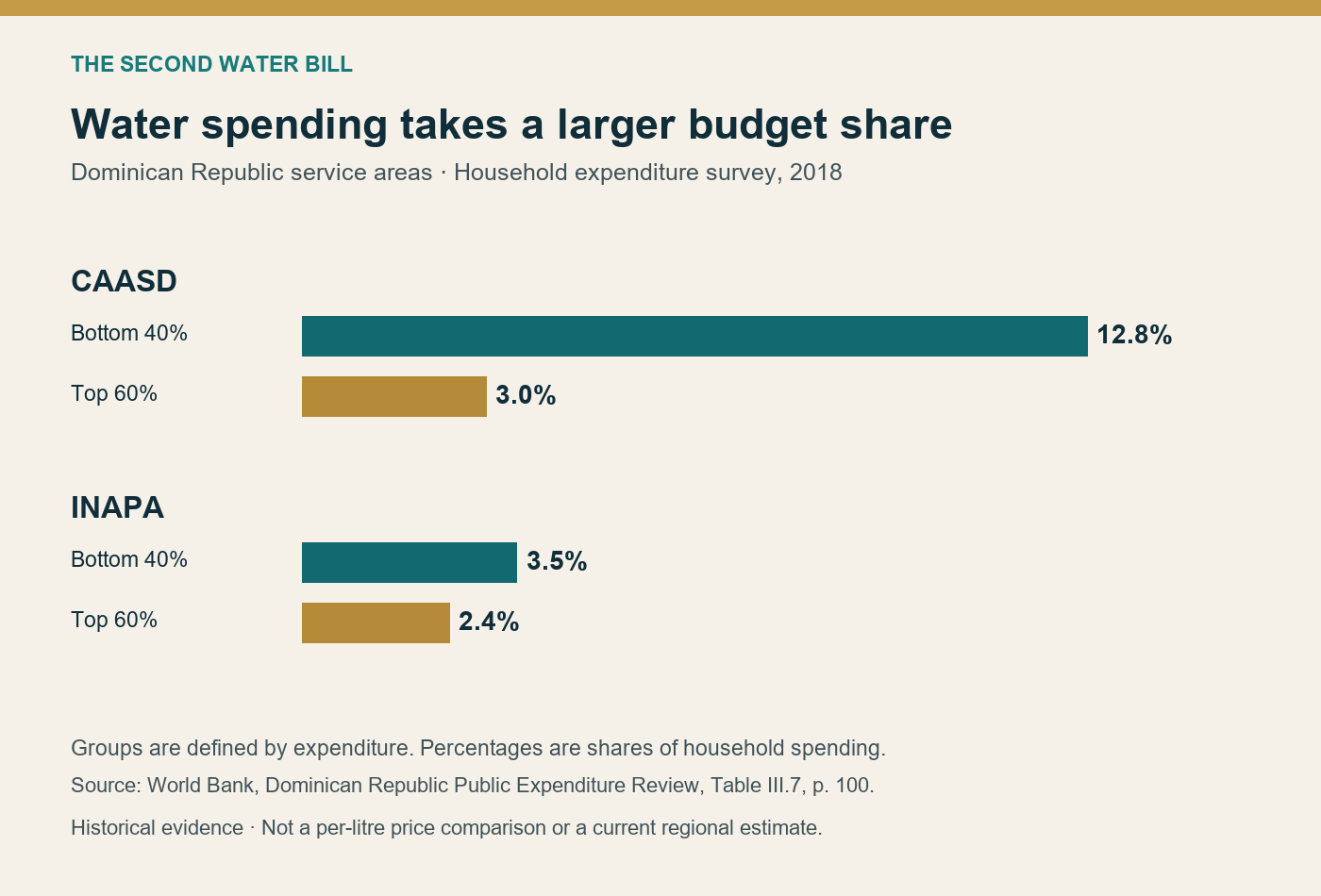
The Dominican Republic provides a measured example. The World Bank’s Public Expenditure Review, using the 2018 household expenditure survey, reported the following water burdens in two providers’ service areas:
Water spending as a share of household expenditure, 2018: CAASD bottom 40%: 12.8%; top 60%: 3.0%. INAPA bottom 40%: 3.5%; top 60%: 2.4%.
In the CAASD area, bottled water alone absorbed 11.7% of the lower group’s total spending. Its overall water burden was about 4.3 times the budget share of the upper group, calculated from the table’s rounded figures. This measures expenditure pressure in those service areas in 2018, rather than a difference in the price of a litre. World Bank, Dominican Republic Public Expenditure Review, Table III.7, printed p. 100
The finding changes the affordability debate. Public water can be subsidised while the total household burden remains heavy. The price at the utility counter and the cost of having usable water at home are different accounts.
That second bill matters for how governments judge affordability. A low official tariff offers limited protection if the household must repeatedly purchase a substitute. A family that spends little because it cannot afford replacement water may endure the greatest deprivation of all.
Private storage creates another dividing line. A property with a large cistern can carry water from a brief supply window into the next interruption. A tenant without space, permission or money for a tank has fewer options. Both properties can receive the same hours of public supply and emerge with very different hours of usable service.
For Caribbean Issues, the useful measure is the cost of securing reliable water: the public charge, the additional household spending and the time required to obtain enough water for daily life. That measure brings the expense now hidden inside family budgets into the public account.
Puerto Rico: emergency supply has become a recurring service
The tourism operation had a precedent. On 30 July 2025, Puerto Rico’s tourism agency announced that tanker trucks had been contracted to assist hotels affected by interruptions in Condado and Isla Verde. By June 2026, emergency coordination was again helping accommodation providers sustain operations. Puerto Rico Tourism Company, July 2025
Repeated emergency provision should trigger a different budget question. How much is being spent to work around interruptions, and what permanent improvement would reduce the need for that spending? Tankers perform an essential relief function. Their recurring cost should also be visible when government compares repair, treatment and distribution investments.
Protecting accommodation during an emergency has an economic purpose. Closing properties can interrupt employment, business income and visitors’ travel. The public-interest test is whether emergency arrangements protect essential household needs alongside business continuity.
Residential relief was substantial in the utility’s own account. On 8 August 2026, the Puerto Rico Aqueduct and Sewer Authority, AAA, reported deploying 123 water trucks through fixed points and mobile routes in coordination with municipal emergency offices. In the same update, it said service had returned to 70% of customers in Zone 1, while the remaining 30% were still recovering. AAA, 8 August 2026
The next public record should identify the source and volume of each delivery, its destination, the dispatch time, the contractor and the payer. Household and commercial deliveries need to be compared over the same dates. Truck numbers measure resources deployed; litres received and waiting times measure relief delivered.
Those records would distinguish three very different arrangements: additional water brought into service; commercial customers buying from an existing source; and public capacity reassigned between users. Each has different consequences for residents.
Institutional access belongs in that account as well. An industry with a dedicated agency coordinating supply has a route through the emergency. Residents need an equally dependable route, including direct assistance for people who cannot collect or carry water.
The public-finance account needs the same precision. An agency can coordinate deliveries, purchase water, pay a contractor or recover costs from recipients. Those arrangements distribute the expense differently. Contracts, invoices and reimbursements establish whether public money subsidised a particular user and on what terms.
A defensible emergency policy should specify both the household minimum it aims to protect and the terms of assistance to businesses. Essential access should be a service obligation people can invoke before their money or storage runs out.
El Niño puts the next dry season on the public agenda
The current El Niño gives these decisions a deadline. In its 10 September 2026 advisory, NOAA’s Climate Prediction Center reported a strengthening event and a greater than 90% probability of a very strong El Niño during the Northern Hemisphere autumn and winter of 2026–27. Its next diagnostic discussion is scheduled for 8 October. NOAA ENSO advisory, checked 3 October 2026
The Caribbean Regional Climate Centre connects that Pacific climate signal to the region’s rainfall prospects. Its September–November outlook warns of less frequent rain and increasing drought risk. It identifies severe long-term drought in Saint Lucia as imminent by the end of November and warns that regional drought concerns could expand and intensify from December into the 2026–27 dry season. Regional climate outlook
The implications vary across the Caribbean. The centre identifies a tendency towards drier conditions extending into the first half of the ensuing dry season in the Lesser Antilles and Guianas, with less predictable outcomes after October in much of the Greater Antilles. It also warns of unusual heat. Reduced Atlantic hurricane activity does not remove the danger of an individual damaging storm or flooding. CIMH’s explanation of the regional El Niño effects
For water policy, the danger is entering the dry season without the replenishment on which normal operating plans depend. That could mean longer restrictions, more demand for deliveries and greater pressure on farm production and household budgets. These are planning risks to assess against local source levels and demand, rather than a uniform forecast for every island.
The warning should bring decisions forward: repair critical leaks, establish emergency delivery contracts and priorities, verify storage at essential facilities, and publish the dry-season water balance before demand overtakes supply. Governments should be able to show what they changed after receiving the forecast.
Weather sets the pressure; infrastructure shapes the outcome
Drought and service failure need separate accounts. A reduction in rainfall can diminish source water. A broken main, a pumping interruption or inadequate treatment capacity can prevent available water from reaching customers. Emergency policy must identify which constraint it is addressing.
AAA’s August account shows how these pressures interact. It attributed slow recovery at the end of the Cupey system to earlier breakdowns and the time required to restore levels and pressure, with distance, elevation and pipe dimensions affecting the process. It also reported recovering about one million gallons daily by returning filter-wash water to the beginning of the treatment process. AAA operational update
Those are different interventions: repairing distribution, restoring pressure and recovering water within treatment. Each can improve access without relying on a change in rainfall. The spending decision should identify the constraint it will remove and the service improvement residents should expect.
A government cannot schedule rain. It can maintain a pipeline, publish an emergency allocation rule and require a development to demonstrate how it will obtain water during the dry season.
Saint Lucia: tourism relief with a household promise
Saint Lucia’s government made the relationship explicit in March 2026. It announced plans to bring water from Dominica for the hospitality sector, alongside pipeline works and conservation measures. The stated purpose was to reduce demand on local sources and allow greater priority for residential supply. Office of the Prime Minister, 13 March 2026
That is a testable promise. If imported water replaces hotels’ withdrawals from a constrained network, residents should gain access to some of the capacity released. The evidence would be shipment receipts, hotel purchase and meter records, and changes in household supply over the same period. A plan to import water establishes an intention; delivered volumes and service records establish the result.
Saint Lucia also demonstrates why location matters. In June, WASCO reported weak inflows in the systems serving Soufrière and other southern communities. It continued managed supply and reported trucking water to essential services and badly affected communities. Those southern networks require their own accounting; improvements in the north cannot be assumed to resolve them. WASCO, 12 June 2026
In the north, the utility announced in August that work had begun replacing an ageing, leak-prone 14-inch main between Bonne Terre Gap and Gros Islet Town Gap with a 20-inch pipeline. That identifies a physical constraint and a specific intervention against which progress can be checked. WASCO, 25 August 2026
A separate project launched on 18 September provides a larger investment test. The Caribbean Development Bank announced a US$22.83 million financing package to replace and upgrade five kilometres of raw-water pipeline between the Millet and Vanard pumping stations. It expects improvements to reach more than 56,000 residential and commercial customers. Caribbean Development Bank, 18 September 2026
Success should be measured at the tap as well as on the construction site. Before-and-after records should show hours of supply, unplanned interruptions, pressure and emergency deliveries by service area. A completed pipeline is an asset. Reliable household service is the public benefit it must produce.
Water lost and revenue lost require different repairs
The system’s financial condition belongs in the scarcity story. A March 2024 Caribbean Development Bank assessment recorded WASCO’s estimate of non-revenue water at 40–60%, identifying deteriorating infrastructure, theft, meter inaccuracies and billing discrepancies. It is a dated institutional estimate, not a measurement of present leakage. CDB technical-assistance assessment, printed p. 4
The components have different implications. Repairing a physical leak can keep more water in the system. Correcting a meter can improve the account of consumption and the revenue available for operations. Neither result should be reported as the other.
This matters whenever a government announces that it will “recover” water. Residents need to know the volume physically saved, the revenue recovered and where any additional supply will go. Counting every unbilled litre as water available for redistribution exaggerates what a programme can deliver.
It also matters for tariffs. Reliable service requires recurring spending on skilled staff, energy, treatment and maintenance. Holding the public tariff down while families finance expensive alternatives can hide the full cost of failure. Equally, raising tariffs without enforceable service improvements asks households to pay more into the same unreliable arrangement.
The public bargain should connect affordable essential supply, a funded maintenance programme and measurable performance. Support for low-income users should be explicit in that bargain, rather than left to their capacity to buy a tank.
The tariff is only the starting price
Puerto Rico’s published schedule shows how easily the price debate can go wrong. Effective 1 July 2026, its water-only base charge for a half-inch or five-eighths-inch residential meter is US$17.47; the corresponding commercial base charge is US$34.39. Commercial consumption charges also vary by meter size and volume. These are tariff components, not complete bills or estimates of a hotel’s cost. Puerto Rico Aqueduct and Sewer Authority, tariff schedule
Comparing a household’s bottled-water receipt with one commercial consumption rate would obscure as much as it revealed. The commercial account also has fixed charges and may finance storage, pumping or independent supply. Drinking water and water used for washing need separate comparisons. June spending must be matched to the tariff in force in June.
The useful comparison has three measures. Acquisition cost records what people spend to obtain water for a defined use. Budget burden shows how much of their resources it absorbs. Unmet need records the occasions when they cannot obtain enough at all.
Tank installation belongs in a separate capital account. Collection time, additional laundry expense and lost earnings belong in the disruption account. Keeping these visible prevents a cheap-looking litre from concealing an expensive day.
The same discipline should apply to large users. Compare their actual bills, delivered volumes, backup costs and any publicly funded assistance. Then report the household burden as a share of income alongside the business cost.
This produces a defensible account of inequality. It can show who pays more to obtain water, who spends more of their resources doing so and who simply goes without. A single regional price multiplier cannot answer all three.
Reliability follows property as well as pipes
The ability to store water turns property and credit into practical advantages. An owner can decide to install a tank. A tenant may need permission; an apartment may lack suitable space; a household with little spare income may be unable to buy the equipment even when it would lower future costs.
That creates a policy choice. A tank subsidy reimbursed after purchase helps people able to finance the purchase first. Assistance delivered through landlords may not reach tenants unless eligibility and installation obligations are clear. A household resilience programme should account for renters, shared buildings and people unable to handle water containers.
It should also define the public service it supplements. Otherwise, household adaptation can quietly become the assumed replacement for dependable utility supply. The family pays for the equipment while responsibility for continuity becomes less clear.
The same shortage can produce different service
The strongest comparison begins inside one supply system.
A nearby hotel and residential community may share a treatment plant while occupying different pressure zones. They may have different elevations, storage or backup arrangements. A hotel’s running taps could reflect water stored earlier, privately purchased supply or independent production. To test preferential allocation, those differences must be measured alongside the utility’s operating decisions.
The relevant evidence is practical: supply-zone maps, valve schedules, meter readings, pressure records, outage logs and tanker dispatches. The comparison should cover the same dates and identify where each litre entered the system.
Cruise ports belong in that exercise wherever ships take on water locally. Port meter and bunkering records should establish the volume, timing, source and price. Passenger arrivals alone cannot establish a demand on the municipal network. For a property claiming independent desalination, the useful records are metered production and its remaining withdrawals from public supply.
The standard is useful because it identifies a decision that can be changed: a dispatch rule, a maintenance failure, an inadequate pressure zone, or permission to add demand without sufficient supply.
Emergency rules already have a public record
Saint Lucia has published specific relief arrangements before. In February 2024, WASCO announced government-supported free trucking for affected northern communities, organised into zones, with a maximum of 1,000 gallons per customer. Its notice listed community contacts and a separate hotel contact. WASCO relief notice, 29 February 2024
That historical arrangement supplies a practical benchmark: named service areas, an allocation ceiling and a route to request assistance. The next step is to show fulfilment. How many requests were met, how quickly, and how were households without adequate storage served?
Emergency powers also leave a documentary trail. Saint Lucia’s May 2024 Gazette declared a water-related emergency under section 10 of its Water and Sewerage Act; government subsequently announced its revocation, effective 30 July 2024. These records show the importance of publishing when restrictions begin and end. 2024 declaration; revocation notice
For each new emergency, government should publish the operative order, affected sources, permitted uses, exemptions and enforcement results. A general appeal to conserve cannot tell residents whether comparable uses face comparable restrictions.
Agriculture must remain in the account
The argument cannot stop at hotels and homes. In its July 2026 drought update, the US National Integrated Drought Information System reported agricultural water rationing in southern Puerto Rico, including three days a week for farmers in the Southwest District. It also recorded forage shortages in Lajas and increased reliance on supplementary feed. NIDIS, 23 July 2026
Water allocation can therefore reach households through another bill: food. A loss of irrigation or livestock water can raise production costs and weaken local supply. The effect on retail prices requires its own evidence, but the pathway belongs in every drought plan.
Caribbean governments promoting domestic food production should publish the water provision behind that ambition. Farmers need predictable access, suitable storage and rules that account for the consequences of losing a crop or herd. Rainfall risk does not disappear because a food-security target has been announced.
New development should come with a water account
Every major development adds a claim on infrastructure. Its approval should establish the source of water, expected demand in the driest months and the capacity needed to meet that demand without worsening existing service.
A credible assessment should include peak occupancy, staff use, laundry, kitchens, landscaping and any associated residences. It should identify what happens when the proposed source fails, who finances the fallback and which public assets it depends on.
Promises of private storage deserve particular scrutiny. A tank shifts the timing of consumption; it does not create additional water. Independent supply should be verified by production and withdrawal records, while new public infrastructure should have funded operating and maintenance arrangements.
The planning authority’s decision should be public and enforceable. Where adequate dry-season supply cannot be demonstrated, occupancy should be tied to the delivery of the required capacity.
The assessment must also account for developments already approved but not yet occupied. Evaluating each application against today's demand can commit the same spare capacity several times. A public register should show existing use, committed future demand, dependable dry-season supply and the funded works needed to close any gap.
That standard protects investment as well as residents. Approving demand that the system cannot serve creates future emergency expenditure, conflict and interrupted business. The cost is merely postponed until a dry season makes it unavoidable.
Five commitments before the next emergency
The Caribbean needs a water guarantee that can be checked. Five commitments would give it substance:
1. Publish the order of priority. Explain how essential domestic needs, health facilities, schools, agriculture and commercial uses are treated during shortages, including the restrictions on discretionary consumption. 2. Account for emergency supply. Report volumes, destinations by service area, contractors, costs and waiting times. Include a route for residents to challenge missed deliveries without exposing their personal details. 3. Measure the household burden. Track replacement spending, time lost and unmet needs alongside utility tariffs. Use those findings to direct assistance towards people least able to finance alternatives. 4. Require water provision before occupancy. Make new developments demonstrate adequate dry-season supply and pay the agreed cost of the capacity they require. 5. Judge investment by service. Publish dated, area-level results for continuity and interruptions, so residents can connect a funded project to improvements in daily life.
These commitments would make conservation appeals more credible. People asked to use less should be able to see how large users are treated, where emergency water goes and whether promised repairs improve their supply.
The Caribbean earns income by welcoming visitors. The people who make that economy work need dependable water where they live. Their access should be part of the region’s economic infrastructure, funded and measured with the same seriousness as the infrastructure that receives a guest.
The real price of water is what it takes to obtain it. The test of public policy is how much of that burden it removes from the people least able to carry it.
Reporting note: Research expanded on 3 October 2026. This is an analysis of published records, including dated historical evidence. New household diaries, matched commercial–residential delivery records and interviews remain the next stage of reporting.
Questions readers are asking
How does El Niño affect Caribbean water security?
It can increase the risk of rainfall deficits in parts of the region. Local effects depend on the season, territory, source levels and infrastructure; the article identifies the dated NOAA and CIMH outlooks used.
Does the evidence show hotels received water at residents’ expense?
The reviewed records show tourism assistance and residential relief. Establishing displacement requires matched source, dispatch and delivery records.
What is the second water bill?
The additional money and time households spend securing water when public service is unreliable, including replacement purchases, delivery, pumping and disruption.
What does the 4.3-times comparison measure?
A ratio of household budget shares in the CAASD service area using the World Bank’s rounded 2018 data. It is not a per-litre price ratio or a current Caribbean-wide estimate.
Is non-revenue water the same as leakage?
No. Physical losses, unauthorised use, inaccurate meters and billing problems have different consequences. Water physically recovered and revenue recovered should be reported separately.
What should governments publish during a shortage?
Allocation priorities, deliveries and waiting times by area, emergency costs, operative restrictions and the service results of infrastructure investment.
What should a new development demonstrate?
Adequate dry-season supply, funded backup and maintenance, and its effect on existing users after other approved developments are included.
Sources and documentation
Sources are consolidated here so the investigation reads continuously while the record remains directly inspectable. Evidence roles describe how a source is used; they are not automatic truth scores.
Supports: Who secures continuity?
Currency: Verified within the last 45 days.
Supports: Who secures continuity?
Currency: Verified within the last 45 days.
- [3]World Bank, Dominican Republic Public Expenditure Review, Table III.7, printed p. 100Official record
Supports: The second water bill
Currency: Historical baseline; assess relevance rather than recency.
Supports: Puerto Rico: emergency supply has become a recurring service
Currency: Verified within the last 45 days.
Supports: Puerto Rico: emergency supply has become a recurring service
Currency: Verified within the last 45 days.
Supports: El Niño puts the next dry season on the public agenda
Currency: Verified within the last 45 days.
Supports: El Niño puts the next dry season on the public agenda
Currency: Verified within the last 45 days.
Supports: Saint Lucia: tourism relief with a household promise
Currency: Verified within the last 45 days.
Supports: Saint Lucia: tourism relief with a household promise
Currency: Verified within the last 45 days.
Supports: Saint Lucia: tourism relief with a household promise
Currency: Verified within the last 45 days.
Supports: Saint Lucia: tourism relief with a household promise
Currency: Verified within the last 45 days.
Supports: Water lost and revenue lost require different repairs
Currency: Verified within the last 45 days.
Supports: The tariff is only the starting price
Currency: Verified within the last 45 days.
Supports: Emergency rules already have a public record
Currency: Historical baseline; assess relevance rather than recency.
Supports: Emergency rules already have a public record
Currency: Historical baseline; assess relevance rather than recency.
Supports: Emergency rules already have a public record
Currency: Verified within the last 45 days.
Supports: Agriculture must remain in the account
Currency: Verified within the last 45 days.
Editorial standards, corrections and AI-assistance policy · Privacy and data use
Caribbean Issues Reader Forum
What is your view?
Rate the usefulness of this analysis, respond to its evidence and add knowledge from the Caribbean or diaspora. Comments are reviewed before publication.
Was this analysis useful?
How would you describe it?
Reader discussion
Loading approved comments…