
The short answer
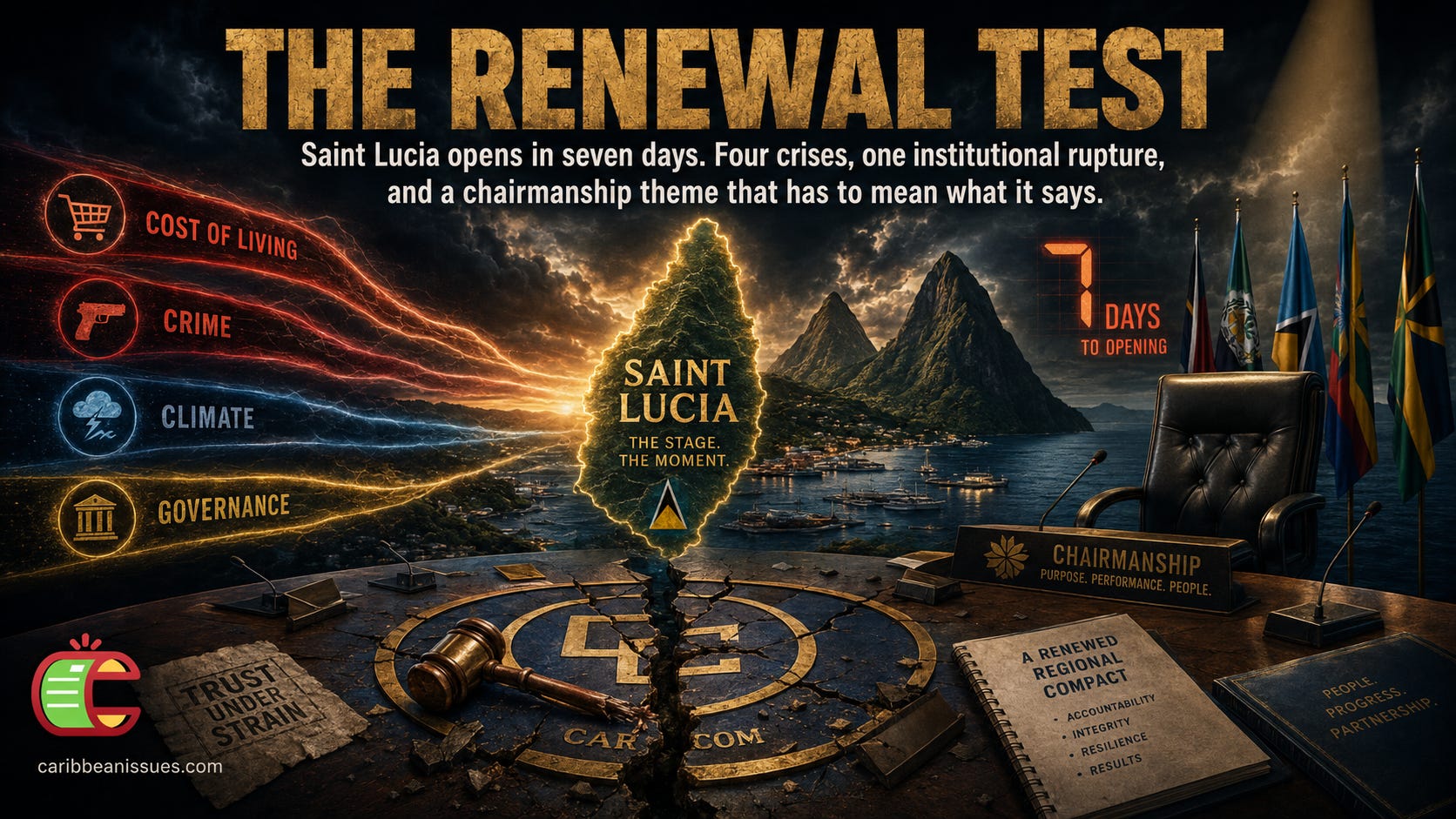
Saint Lucia opens in seven days. Four crises, one institutional rupture, and a chairmanship theme that has to mean what it says.
Publication record
Transparent responsibility and verification details for this Caribbean Issues publication.
- Published
- Updated
- No later revision recorded
- Responsible byline
- Caribbean Issues
- Verification
- Editorially reviewed under our published method
- Sources listed
- 10 sources listed below
- Primary topic
- Caribbean Governance, Politics and CARICOM
The Renewal Test On Sunday, July 5, at 4:00 PM Atlantic Standard Time, in a ballroom at Sandals Saint Lucia in Gros Islet, Philip J. Pierre will stand up and take the chair of the Caribbean Community. The opening ceremony of the 51st Regular Meeting of the Conference of Heads of Government will run for an hour. Pierre will speak as incoming Chair. Outgoing Chair Dr. Terrance Drew of Saint Kitts and Nevis will speak. Secretary-General Dr. Carla Barnett will speak. The CARICOM social-media platforms will livestream it. And then, on Monday morning, in a closed-door retreat the host has moved to a day earlier than usual, the actual work of the summit will begin.
The central argument
That work is more loaded than any Caribbean summit in recent memory.
The Saint Lucia chairmanship is starting under a theme that is itself a quiet admission: CARICOM: From Resilience to Renewal in a Changing World . The word resilience , which the region has worn like a uniform for two decades, is doing less and less of the lifting. Renewal , the Saint Lucian PM has insisted, must replace it — renewal of institutions, of regional cooperation, of the credibility of regional integration in the daily lives of Caribbean people. It is a respectable theme, and it is also an indictment. You only need a renewal when something has stopped working.
Several things have stopped working. The summit a week from now will be a referendum on whether the region’s heads of government still have the bandwidth and the unity to fix them.
This is what is on the table.
Five decisions on the table at Gros Islet. The institutional rupture must be settled before the substantive agenda can be touched The precondition: who runs CARICOM? Before the substantive agenda is touched in Gros Islet, the heads of government will have to settle a question they have been politely declining to settle for months. Dr. Carla Barnett’s first five-year term as Secretary-General ends in August. She was re-elected. Trinidad and Tobago, which says it was not represented at the relevant meeting, has indicated it will not recognise her continuation in office once her current term concludes. Jamaica’s prime minister has gone further and called for a special regional summit to deal with the dispute. The region’s longest-serving diplomat in the Americas — for whom the most likely identification is Antigua and Barbuda’s Ambassador to the United States, Sir Ronald Sanders — has called publicly for Dr. Barnett to resign on principle before her term ends.
This is not a minor administrative matter. The Secretary-General is the institutional spine of CARICOM. She runs the secretariat in Georgetown, manages the negotiating teams that go to climate conferences and trade summits, coordinates with the OECS, and is the public face of the community to third states. The community cannot enter the second half of 2026 — with a hurricane season already begun, a U.S. military operation continuing in Caribbean waters, and a global energy crisis tightening — without a settled answer to the question of who leads it.
The summit will have to produce one. A clean recommitment to Dr. Barnett’s continuation, with Trinidad publicly on board, would be the strong outcome. A negotiated transition with a clear successor would be the workable one. A drift past the question into the second half of the year, with the issue unresolved and Trinidad standing outside the consensus, would be the dangerous one. And dangerous, in the Caribbean’s current circumstances, is exactly what the community cannot afford to compound.
Decision 1 — the case Jamaica has not filed
Eight months ago, Hurricane Melissa made landfall near Black River, in the parish of St. Elizabeth, as a Category 5 storm.
What Hurricane Melissa actually did — the WMO retired the name in March 2026. Eight months on, no climate-damages case has been filed The numbers are not in dispute. 95 people died across the region — 45 in Jamaica, 43 in Haiti, 4 in the Dominican Republic, and 1 in Cuba. 150,000 buildings were damaged ; 120,000 had their roofs ripped off; 24,000 were totaled. 721 of Jamaica’s 1,010 public schools were damaged. 40% of the national health system sustained damage. The country’s losses came to roughly US$8.8 billion . The IMF disbursed US$415 million in emergency financing in January under the Rapid Financing Instrument’s large-disaster window. In March 2026, the World Meteorological Organization retired the name “Melissa” — placing it on a list of storms whose impacts are too consequential ever to be associated with another hurricane again.
What is in dispute, eight months on, is whether anything will be done about it.
Two independent real-time attribution studies have already established that Melissa’s extreme intensity was driven by anthropogenic warming at the location of impact. Three of Jamaica’s leading international legal scholars and a senior climate-development economist have advised that Jamaica has a viable case for redress for the damage the country has suffered, and that Jamaica — by which they mean the country, not a foreign legal team — has the technical capacity to prepare the documentation and support its policymakers in pleading it. Byron Blake, writing in the Gleaner on the very Sunday morning this piece is being written, has laid the case out plainly and added a warning: failure to act, in a case where the evidence is clear and supported by real-time attribution, could create a precedent that other CARICOM states and Small Island Developing States will find it much harder to escape in future cases where cause and effect are less clean.
No case has been filed. There is no public indication one is being prepared. The Saint Lucia summit is the last natural opportunity to put CARICOM political weight behind a Jamaican-led action before another hurricane season — already begun — adds new entries to the ledger.
The summit will have to decide whether the region will lead on this, support it, or let it slip. Each of those answers is a position. The position of not deciding is itself a decision, and not a defensible one.
Decision 2 — the words that disappeared in Belém
At COP28 in Dubai, in December 2023, nearly every country in the world agreed in writing that the planet would “transition away from fossil fuels.” The phrase was the headline of the conference. CARICOM negotiators were part of the coalition that fought to put it in.
Two years later, at COP30 in Belém, Brazil, the language was removed from the final declaration . CARICOM had been advised, in advance, to insist that COP30 be a single-focused conference after COP29 in Baku had failed to produce serious mitigation commitments. The region did not get a single-focused conference. It did not get the language back. It came home from Belém having lost diplomatic ground rather than gained it — and Melissa came two weeks before the conference even started.
The Saint Lucia summit is the first organised regional opportunity to articulate what the response will be. COP31 will be hosted by Türkiye in late 2026. The Caribbean’s posture at that conference — what it will demand, what it will accept, what it will walk out over — will be set by the politics articulated in Gros Islet in the next ten days, not by the negotiating teams that fly to Antalya five months from now. Climate justice and climate resilience sits explicitly in Pierre’s stated priorities for the chairmanship. The summit’s communiqué will be read for what concrete that abstraction is given. Soft language on the loss of the Dubai commitment is not concrete. A formal CARICOM position on what COP31 must restore is.
Decision 3 — a coherent foreign policy
On January 3, 2026, in a pre-dawn operation that closed Caribbean airspace and stranded tens of thousands of holiday travellers, United States special forces seized Venezuelan president Nicolás Maduro and his wife at a military base in Caracas. They were flown by helicopter to New York City to face drug-trafficking and weapons charges. Fifty-five Cuban and Venezuelan military personnel were killed in the raid. Roughly six months on, Operation Southern Spear continues — a US military campaign in the Caribbean Sea that has, by independent count, struck dozens of vessels and killed close to two hundred people without trial.
The region’s response to all of this has not been unified. The CARICOM Council of Foreign and Community Relations Foreign Ministers wrote collectively to U.S. Secretary of State Marco Rubio after the early strikes, asking that military operations in Caribbean waters not be conducted without prior notice or explanation . They received neither. Trinidad and Tobago, meanwhile — under Prime Minister Kamla Persad-Bissessar — has moved publicly in the opposite direction: hosting USS Gravely at the Port of Spain in October, allowing the U.S. military to install an AN/TPS-80 G/ATOR radar at the Crown Point airport in late November, accepting the deployment of more than 100 U.S. Marines, and the prime minister herself praising the U.S. strikes on alleged trafficking vessels in language not heard from a Caribbean head of government in living memory.
CARICOM was founded on a doctrine of non-intervention and sovereign equality. The doctrine has been tested before. It has not, in the modern era, been tested by an active U.S. military campaign in regional waters with one CARICOM member providing logistical support and another formally objecting. The summit will have to decide whether the community still has a shared foreign policy on this question or whether — under the cover of polite communiqué language — it has already conceded that it does not.
Either answer will define the region for a decade. The first answer is the one Pierre’s “renewal” theme implicitly calls for. The second is the one drift will, by default, produce.
Decision 4 — the energy crisis hiding in plain sight
The fourth decision is the one being made for the region whether the heads of government discuss it or not. Crude oil prices have climbed past US$110 a barrel and are pressing toward the kind of levels — US$150, US$200 — that have, in past energy shocks, broken Caribbean fiscal balances clean in two. The region remains overwhelmingly dependent on imported fossil fuels for its electricity, its transport, and the energy intensity that powers its tourism economy. Every US$10 rise in the per-barrel price is a quiet tax on every Caribbean household, paid through electricity bills and the supermarket shelf.
The structural fact behind this is that the region has produced too many policy documents on energy diversification and too few completed projects. Saint Lucia, to its credit, recently established a Sovereign Wealth Fund that includes climate-resilience and energy-transition mandates. Most CARICOM members have not done the equivalent. The CARICOM Caribbean Sustainable Energy Roadmap and Strategy (C-SERMS) targets, set years ago, were aspirational; they have not been met at the regional level. A serious renewal agenda in Saint Lucia would commit, at the heads-of-government level, to a regional financing facility for solar, wind, and storage; to harmonized procurement standards; and to a hard deadline for cutting fossil-import dependence to a stated percentage of regional energy mix by 2030.
If the summit does not produce that, the climbing oil price will produce its own policy — by emptying the budgets of the smaller member states one bill at a time, and forcing emergency measures that always come too late and cost more than the structural reform that should have replaced them.
A word about renewal
It is worth saying out loud, because the summit’s host has chosen the word and it will be repeated at every podium next week. Renewal is not the same word as resilience , and Pierre has chosen carefully.
Resilience is what a society does when something has been done to it. It absorbs the shock. It rebuilds the school, restores the power line, processes the IMF emergency disbursement, and gets back to where it was before the shock arrived. Resilience is dignified, and it is also exhausting. After a certain number of shocks — Beryl, Melissa, the pandemic, the energy spike, the de-risking squeeze, the U.S. military operation — resilience as a national strategy starts to read as a synonym for taking it . The Caribbean has been taking it for a long time.
Renewal is the other thing. Renewal is what a society does when it decides to stop absorbing shocks and to build the institutions that will stop the shocks from landing the same way next time. Renewal is the regional payment infrastructure that does not need a friendly compliance officer in New York. It is the audit transparency rule that does not depend on which government is in office. It is the energy mix that does not move with the per-barrel price. It is the foreign policy that does not have to be invented in the middle of a crisis. It is, in the most ordinary form, the institutional and economic sovereignty Caribbean Issues has been writing about every issue this month.
Pierre has used the right word. The question that Gros Islet will answer over five days is whether the rest of the region’s leaders mean it the way he does.
A small detail, mentioned because it tells you something
The 1983 decision of the Conference of Heads of Government was that the anniversary meeting of the conference includes July 4 — the date the Treaty of Chaguaramas was signed in 1973, the date the community was founded. The 51st conference is set for July 5 to 8 . The anniversary date itself is not on the conference calendar. As Byron Blake noted on Sunday morning, that omission may have an extenuating circumstance, or it may simply be one more example of “drift from agreed practices and moorings.”
A community that drifts past the date of its own founding without comment is a community that, on the margin, takes its institutions slightly less seriously than it used to. The renewal theme is the right answer to that drift. The summit’s communiqué will be read in part for whether the theme survives contact with the work.
The Caribbean Issues take
A summit is a place where work either gets done or visibly does not. CARICOM has, over its 53 years, had summits where neither outcome was clearly produced — where the press release said the work was done, and the next year’s summit revealed it had not been. The strongest defence against that pattern, this week, is concrete deliverables on each of the five decisions above .
The Secretariat question is settled, on the record, with Trinidad either on board or formally outside the consensus. The Jamaica climate-damages case is endorsed at the heads-of-government level, with regional legal and diplomatic resources committed to it. The COP30 regression is named and a CARICOM COP31 position is published. The Caribbean’s posture on Operation Southern Spear is articulated as a community position rather than left to individual member states. The energy crisis is met with a regional financing facility and a hard 2030 target.
Five concrete outcomes, set against four days of meeting time. None of that is impossible. All of it is winnable. The question is whether the community’s leaders treat this summit as a routine entry in the long calendar of regional gatherings, or as the moment Pierre has framed it to be — the moment when the word resilience yields, finally, to the word renewal , and the institutions that the region has spent fifty years arguing about begin to behave like institutions that mean what they say.
In seven days we will know. The communiqué is published on the afternoon of Wednesday, July 8. Caribbean Issues will read it the same way it has read every CARICOM communiqué of the last twelve months: line by line, against the actual decisions on the actual table, with the same question we have been asking on this masthead all month — did the region apply what it already knows, or did it once again, politely, drift past it?
The answer matters. The clock is running.
Update:
Day 2: The Room Where It Happens
The Morning After: The Verdict
Sources and documentation
Sources are consolidated here so the investigation reads continuously while the record remains directly inspectable. Evidence roles describe how a source is used; they are not automatic truth scores.
Supports: • CARICOM Secretariat , “Saint Lucia to host CARICOM Heads of Government Meeting in July” (5 June 2026)
Currency: Date metadata is missing; recheck before relying on current conditions.
Supports: • CARICOM , “Regional integration must deliver results people can see and feel” — incoming Chair Pierre’s national media launch (15 June 2026)
Currency: Date metadata is missing; recheck before relying on current conditions.
Supports: • 51st HGC online platform , https://caricom.org/51hgc/
Currency: Date metadata is missing; recheck before relying on current conditions.
Supports: • Byron Blake , “Hurricane and heat wave — What a message for CARICOM conference?” , Jamaica Gleaner (28 June 2026)
Currency: Date metadata is missing; recheck before relying on current conditions.
Supports: • The Voice St. Lucia , “Why All CARICOM Leaders Should Attend Their 51st Heads-of-Government Meeting” — including the Barnett succession dispute and oil-price context
Currency: Date metadata is missing; recheck before relying on current conditions.
Supports: • St. Kitts Nevis Observer , “CARICOM leaders to hold retreat day after ceremonial opening of summit” (15 June 2026)
Currency: Date metadata is missing; recheck before relying on current conditions.
Supports: • Wikipedia / WMO , Hurricane Melissa — confirmed damages, deaths, and the March 2026 name retirement
Currency: Date metadata is missing; recheck before relying on current conditions.
Supports: • IMF , “Executive Board Approves a US$415 Million Disbursement to Jamaica” (16 January 2026)
Currency: Verification is older than 45 days; review before relying on current conditions.
- [9]“U.S. Military Action in Venezuela Triggers Caribbean Airspace Closures and Flight Disruptions”Official record
Supports: • U.S. Congressional Research Service , “U.S. Military Action in Venezuela Triggers Caribbean Airspace Closures and Flight Disruptions” (6 January 2026)
Currency: Verification is older than 45 days; review before relying on current conditions.
Supports: • Wikipedia , U.S. military buildup in the Caribbean during Operation Southern Spear
Currency: Date metadata is missing; recheck before relying on current conditions.
Editorial standards, corrections and AI-assistance policy · Privacy and data use
Caribbean Issues Reader Forum
What is your view?
Rate the usefulness of this analysis, respond to its evidence and add knowledge from the Caribbean or diaspora. Comments are reviewed before publication.
Was this analysis useful?
How would you describe it?
Reader discussion
Loading approved comments…