
The short answer
Reparations must change who controls the value. Codrington’s history connects church ownership of enslaved labour with a present-day test: whether reparative funding gives Caribbean communities lasting authority over budgets, assets and decisions.
Publication record
Transparent responsibility and verification details for this Caribbean Issues publication.
- Published
- Updated
- No later revision recorded
- Responsible byline
- Caribbean Issues
- Verification
- Editorially reviewed under our published method
- Sources listed
- 14 sources listed below
- Primary topic
- Caribbean Governance, Politics and CARICOM
In Barbados, an Anglican missionary society marked its ownership of enslaved people with a word burned onto their bodies: SOCIETY.
The institution that owned the labour
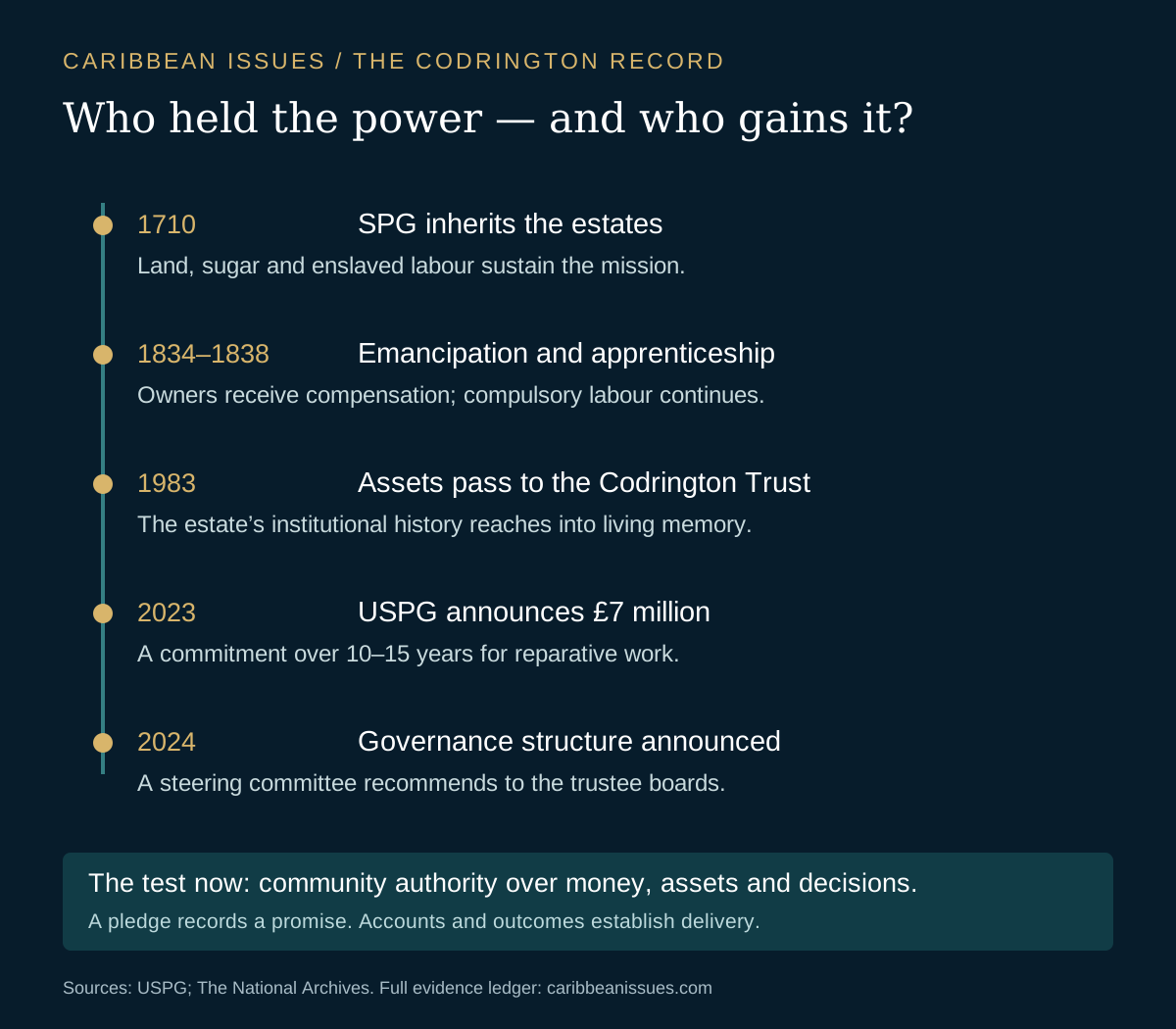
The owner was the Society for the Propagation of the Gospel in Foreign Parts, known as SPG. In 1710, Christopher Codrington left it two sugar plantations and approximately 300 enslaved Africans. An All Souls College historical account documents the branding of newly purchased enslaved people on SPG’s Barbados plantations between 1724 and 1732. The organisation that claimed responsibility for people’s souls also asserted property rights over their bodies.
At Codrington, Christian mission had a material foundation: land, sugar and people compelled to work. Religious authority helped sustain an arrangement in which the institution controlled both the proceeds of labour and the purposes those proceeds served.
More than three centuries later, USPG has pledged £7 million towards reparative work in Barbados. The historical record now meets a present-day test: how much authority will the communities living with that inheritance gain over the money, the projects and the assets they produce?
Reparations must change who controls the value. That is the argument running from the plantation ledger to the proposed repair. A community can receive assistance for generations while other people retain the power to decide what it needs.
When the missionary became the plantation owner
Codrington’s bequest linked a religious and educational project to an existing slave economy. Its importance lies in that arrangement: the resources intended to sustain Christian instruction depended on people denied control over their own labour.
USPG acknowledges that SPG benefited from coerced labour on the Codrington estates between 1710 and 1838. For more than a century, the missionary society drew on the work of people it held in bondage. Even the emancipation settlement of 1834 prolonged compulsory labour through the apprenticeship system.
The economic relationship was direct. Sugar production sustained a religious institution while the people producing that value remained legally unfree. The estate’s charitable purpose depended on their captivity. Christian instruction and plantation discipline operated within the same arrangement: the Society claimed to serve people whose labour it owned.
Emancipation protected the owners’ balance sheets
Britain’s Slavery Abolition Act was passed in 1833 and took effect on 1 August 1834. In much of the British Caribbean, apprenticeship prolonged compulsory labour until 1838. The settlement provided £20 million in compensation to enslavers for the loss of what the law had recognised as their property. It did not compensate the formerly enslaved for the labour and freedom taken from them.
SPG collected compensation too. Historian J. Harry Bennett Jr.’s Bondsmen and Bishops records £8,823 8s. 9d. for 411 people at Codrington. An Anglican missionary society received public money for losing its ownership of human beings.
The owner’s loss had a price. The stolen years of the people who worked the estate earned them no compensation under the scheme.
That settlement carried the plantation’s priorities into emancipation. It protected the financial interests of those who had held people captive. Freedom arrived without an equivalent settlement of the enslaved population’s claim to the wealth its labour had created.
Spending on people while deciding for them
The next chapter is especially revealing. USPG says SPG established a £171,777 Education Fund in 1835, most of which was invested in the Caribbean. It supported clergy, catechists, schoolmasters, churches and schools. USPG also acknowledges who controlled that spending: SPG and other actors under colonial occupation, rather than the newly emancipated people.
Money could be spent in the Caribbean while the power to direct it remained elsewhere. A school could serve a community without giving that community authority over what was taught. A religious institution could finance improvements while retaining the right to define improvement.
This is the distinction that matters for reparations today. The location of expenditure tells us where money is spent. The ownership of assets and the authority over budgets tell us who gains lasting power.
USPG’s stewardship of the Codrington estate continued until 1983, when its land and financial assets passed to the Codrington Trust in Barbados. The institutional history therefore extends well beyond emancipation into the living memory of the region.
The gospel of possession
The plantation was one setting in which religious authority supported colonial power. European claims to Indigenous lands had their own religious justifications, associated with papal documents including Dum Diversas (1452), Romanus Pontifex (1455) and Inter Caetera (1493).
These documents helped supply the religious authority behind what became known as the Doctrine of Discovery. Through colonial practice and later law, European powers turned claims of Christian superiority into claims over other peoples’ lands.
In March 2023, the Vatican repudiated the legal and political Doctrine of Discovery. While distancing the doctrine from Catholic teaching, it acknowledged that the associated papal bulls failed to uphold Indigenous peoples’ equal dignity and rights. The repudiation came centuries after the dispossession those claims had helped justify.
The Caribbean significance is clear: claims of a civilising mission helped make domination appear compatible with a professed concern for other people’s welfare. At Codrington, that supposed concern coexisted with ownership.
A Bible edited for obedience
A plantation required control over labour. A missionary publication sought control over the meaning of freedom itself.
In 1807, the Society for the Conversion of Negro Slaves sponsored the London publication of Select Parts of the Holy Bible, for the Use of the Negro Slaves in the British West-India Islands. It is now widely known as the Slave Bible.
The editing served the slave system. Passages that could encourage liberation, including the Exodus narrative, were removed. Material supporting submission was emphasised. The Museum of the Bible documents that deliberate choice: readers were offered a version of scripture shaped around the demands of their captivity.
Read alongside the plantation record, it exposes two forms of power. Ownership controlled labour. Selective religious instruction attempted to shape how people understood their condition and what they could legitimately demand.
Caribbean people made their own claims on freedom
Enslaved Caribbean people challenged that control. They read, preached, organised and claimed a freedom that plantation Christianity sought to withhold.
Samuel Sharpe, an enslaved Baptist deacon in Jamaica, used congregational networks to organise resistance in 1831. His plan involved refusing to continue working as slaves. The mobilisation developed into the uprising remembered as the Baptist War, followed by violent repression. Sharpe was executed in 1832. The National Library of Jamaica documents his leadership and the spread of the movement through western Jamaica.
Faith could therefore become a language through which enslaved people challenged the order that missionary institutions sometimes defended. Congregations created relationships, opportunities for communication and forms of authority that people could put to their own purposes.
The economic demand at the heart of Sharpe’s resistance matters here. Refusing unpaid, compulsory work challenged the plantation’s claim to command both a person and the value that person produced. Religious belief and material freedom were inseparable in that struggle.
Sharpe’s struggle belongs at the centre of this history. The people whose obedience the plantation demanded were building their own networks of resistance, using the same faith to insist that their lives and labour belonged to them. Their organising gives the reparations argument its direction: people claiming the authority to determine their own future.
The ledger comes due
The institutions confronting this history now face a question that an apology alone cannot answer: what will they return?
In September 2023, USPG pledged £7 million—announced as BDS$18 million—over 10–15 years for work in Barbados with the Codrington Trust and the Church in the Province of the West Indies. The programme includes work on burial and habitation sites, historical research, tenants’ living conditions, enterprise and theological education. Its roots lie in the estates the Society once operated.
The Church Commissioners face a reckoning over the inheritance of Queen Anne’s Bounty, a predecessor fund. Their research identified holdings in South Sea securities, mainly annuities but also company shares, alongside benefactions connected to slavery. The South Sea Company traded in enslaved Africans. These findings brought the Church’s financial inheritance under scrutiny through Project Spire.
The Commissioners have committed £100 million to a proposed Fund for Healing, Justice and Repair. In January 2026, they defended the commitment to parliamentarians and described a fund intended to exist in perpetuity.
For the Caribbean, the measure of these commitments will be what reaches communities and what those communities gain the power to decide. Announcements establish promises. Published accounts, transferred resources and lasting improvements in people’s lives will establish delivery.
Who controls the repair at Codrington?
The Codrington project already has a published governance structure against which that question can be tested.
In September 2024, the Codrington Trust and USPG announced an eleven-member steering committee: three representatives from each trustee body, three independent members and two local community representatives. The latter were Antonio Roberts and Rosanna Springer, a nurse living in the Codrington tenantry. The committee reviews proposals and makes recommendations to the two trustee boards.
USPG also describes a ten-person Community Council, with two representatives from each estate district. It says the Codrington Trust proposed the funding amount, which USPG accepted.
The practical question is what those arrangements allow residents to do. Can community representatives change a budget? How are they selected and held accountable to residents? What happens when a community priority conflicts with a trustee preference? Who will own an enterprise or other asset financed through the project?
The answers belong in the public record. They will show whether consultation gives residents the power to shape decisions, and whether the project builds institutions they can govern long after its funding period ends.
The Caribbean has already articulated an agenda
Caribbean governments and advocates are advancing their own terms for repair.
In July 2026, CARICOM Heads of Government approved a revised Ten-Point Plan for Reparatory Justice. At its September relaunch, CARICOM Secretary-General Carla Barnett identified priorities including public health, education, psychological rehabilitation, cultural development, Indigenous communities, gender justice, debt cancellation and monetary compensation. This agenda places reparations within the region’s development priorities.
That agenda sets a challenge for church initiatives: respond to priorities Caribbean people have identified for themselves. An institution accustomed to deciding how its resources are used must now negotiate with communities whose ancestors had no say in how those resources were produced.
The 25×25 food-security investigation raised a related problem: a public commitment needs a public method for judging its results. Reparative programmes should face the same discipline. Communities should be able to inspect five things:
- Community authority. How representatives are chosen; their voting and budget powers; how residents can challenge decisions.
- Money delivered. Annual amounts pledged, received and spent, with administration separated from community projects.
- Assets owned. Who holds title to funded land, buildings and enterprises, and who controls any income they generate.
- Access. Eligibility rules that include descendants in the diaspora and do not make religious membership a condition of benefit.
- Lasting results. Resident-agreed measures for housing, livelihoods, education and access to historical records, with dated progress reports.
The people living with this inheritance should be able to judge the results, demand answers and change the priorities. Their authority must be built into the work from the beginning.
What it would mean for the value to come home
In “Knowledge Is Not Power”, Caribbean Issues argued that knowledge becomes collective power through application, organisation and ownership. Codrington shows the cost of being denied those last two terms. People produced the wealth while the institution held the estate, directed the proceeds and collected compensation when its legal claim over their bodies ended.
Repair must confront that distribution of power. Open the records. Account for the benefits. Put resources behind the acknowledgement, and give affected communities authority over their use.
The word SOCIETY asserted that an institution could possess a human being. Meaningful repair must give the descendants of those denied ownership over their lives greater authority over the resources and decisions that shape their future.
The brand named the owner. A reparations programme should be judged by the ownership and authority it leaves in Caribbean hands.
Questions readers are asking
Did an Anglican missionary society own enslaved people in Barbados?
Yes. The Society for the Propagation of the Gospel in Foreign Parts inherited two Codrington sugar plantations in 1710. USPG, its successor, acknowledges that SPG benefited from coerced labour there until 1838.
Why is the article called Baptized and Branded?
The title captures the contradiction between Christian mission and ownership of human beings. An All Souls College historical account documents newly purchased enslaved people on SPG’s Barbados plantations being branded SOCIETY between 1724 and 1732.
Who received compensation when slavery was abolished?
Britain allocated £20 million to compensate enslavers. The formerly enslaved received no compensation under that scheme. Historian J. Harry Bennett Jr. records £8,823 8s. 9d. paid for 411 people at Codrington.
What has USPG pledged for reparative work at Codrington?
In September 2023, USPG announced £7 million, presented as BDS$18 million, over 10–15 years. The programme includes historical research, burial and habitation sites, tenants’ living conditions, enterprise and theological education.
Is the Codrington pledge the same as the Church Commissioners’ £100 million commitment?
No. USPG’s Codrington commitment concerns its plantation inheritance in Barbados. The Church Commissioners’ proposed £100 million Fund for Healing, Justice and Repair follows research into their financial inheritance, including Queen Anne’s Bounty and South Sea securities.
Who makes decisions in the Codrington project?
The September 2024 announcement describes an eleven-member steering committee, including two community representatives, which makes recommendations to the two trustee boards. USPG also describes a ten-person Community Council. The article asks for public disclosure of residents’ voting, budget and asset-ownership powers.
How should Caribbean communities judge a reparations programme?
Caribbean Issues proposes five public tests: community authority, money delivered, assets owned, access and lasting results. Each requires published records that allow affected people to judge delivery and influence priorities.
Sources and documentation
Sources are consolidated here so the investigation reads continuously while the record remains directly inspectable. Evidence roles describe how a source is used; they are not automatic truth scores.
Supports: Documents branding with SOCIETY between 1724 and 1732 and the relationship between mission and plantation ownership (slide 10).
Currency: Historical baseline; assess relevance rather than recency.
Supports: USPG’s September 2023 commitment: £7 million, announced as BDS$18 million, over 10–15 years; SPG benefited from coerced labour from 1710 to 1838.
Currency: Historical baseline; assess relevance rather than recency.
Supports: The 1833 abolition legislation, emancipation in 1834, apprenticeship and compensation paid to owners.
Currency: Historical baseline; assess relevance rather than recency.
Supports: Bennett’s account on page 131 records £8,823 8s. 9d. compensation for 411 people at Codrington.
Currency: Historical baseline; assess relevance rather than recency.
Supports: SPG’s £171,777 Education Fund; control of post-emancipation spending; transfer of estate assets in 1983; Community Council and funding process.
Currency: Verification is older than 45 days; review before relying on current conditions.
Supports: The Vatican’s March 2023 repudiation of the Doctrine of Discovery and acknowledgement concerning the associated papal bulls.
Currency: Historical baseline; assess relevance rather than recency.
Supports: The 1807 edited Bible, sponsoring society and removal of liberation passages.
Currency: Historical baseline; assess relevance rather than recency.
Supports: Samuel Sharpe’s leadership of resistance in Jamaica in 1831 and execution in 1832.
Currency: Historical baseline; assess relevance rather than recency.
Supports: The Codrington project’s programme of work and September 2024 progress account.
Currency: Verification is older than 45 days; review before relying on current conditions.
Supports: Queen Anne’s Bounty held South Sea securities, including annuities and shares, and received slavery-linked benefactions.
Currency: Verification is older than 45 days; review before relying on current conditions.
Supports: The Commissioners’ January 2026 defence of the proposed £100 million fund intended to exist in perpetuity.
Currency: Verification is older than 45 days; review before relying on current conditions.
Supports: The September 2024 eleven-member steering committee, two community members and recommendations to the trustee boards.
Currency: Verification is older than 45 days; review before relying on current conditions.
Supports: CARICOM Heads approved a revised Ten-Point Plan in July 2026.
Currency: Verification is older than 45 days; review before relying on current conditions.
Supports: The September 2026 relaunch and CARICOM’s stated reparatory priorities.
Currency: Verification is older than 45 days; review before relying on current conditions.
Editorial standards, corrections and AI-assistance policy · Privacy and data use
Songs from the Headlines
Now hear the story: Caribbean Hands
This article inspired a song on Caribbean Issues, Vol. 1 — Songs from the Headlines. Listen to the sample, then support independent Caribbean journalism by buying the complete Digital Album Edition directly from Caribbean Issues.
One-minute song sample
Caribbean Issues Reader Forum
What is your view?
Rate the usefulness of this analysis, respond to its evidence and add knowledge from the Caribbean or diaspora. Comments are reviewed before publication.
Was this analysis useful?
How would you describe it?
Reader discussion
Loading approved comments…