
The short answer
CARICOM’s four published country figures sum to 1,076, while its first-year release reports 939 people processed. Different measures and incomplete reporting periods require reconciliation. Neither figure alone establishes new settlement, employment or whether the benefits of free movement are shared across workers and communities.
Publication record
Transparent responsibility and verification details for this Caribbean Issues publication.
- Published
- Updated
- No later revision recorded
- Responsible byline
- Caribbean Issues
- Verification
- Editorially reviewed under our published method
- Sources listed
- 8 sources listed below
- Primary topic
- Caribbean Governance, Politics and CARICOM
Nine hundred and thirty-nine people. Four participating countries. One year of a wider right to live and work across Caribbean borders.
CARICOM’s anniversary report presents a policy taking hold. But the country figures in that same release add to 1,076, not 939.
The difference is 137. It needs an explanation. It does not establish that anybody is missing, that officials manipulated data, or that free movement has failed.
It does establish a problem with the public account: readers cannot reproduce the combined figure from the country numbers supplied. And beyond that arithmetic lies a more important question. What would count as success for the people moving, their families, and the communities they leave and join?
That question deserves attention as Grenada and Saint Lucia take steps towards participation. The region is expanding an important freedom. Its evidence should be strong enough to help citizens judge the results.
What changed at the border
The enhanced-cooperation arrangement began on 1 October 2025 among Barbados, Belize, Dominica, and Saint Vincent and the Grenadines. Participating nationals can remain indefinitely and work without a work permit, with access to specified services governed by national arrangements. This is a four-country arrangement, not unrestricted settlement rights throughout CARICOM. CARICOM’s launch explanation [2]
Removing a permit requirement can matter enormously. Someone considering a job, joining family or starting a business has one fewer obstacle to negotiate. The value of a right also extends beyond the people who immediately exercise it: a person can benefit from having an option they do not yet need.
There is another distinction. Dominica and Saint Vincent and the Grenadines already participate in the OECS free-movement framework. Its benefits include indefinite stay and work-permit exemptions within participating Protocol Member States. The wider CARICOM initiative therefore builds on existing mobility, rather than creating movement from nothing. OECS explanation [3]
Evaluating the new arrangement means identifying what it adds to the rights people already had.
The arithmetic CARICOM needs to explain
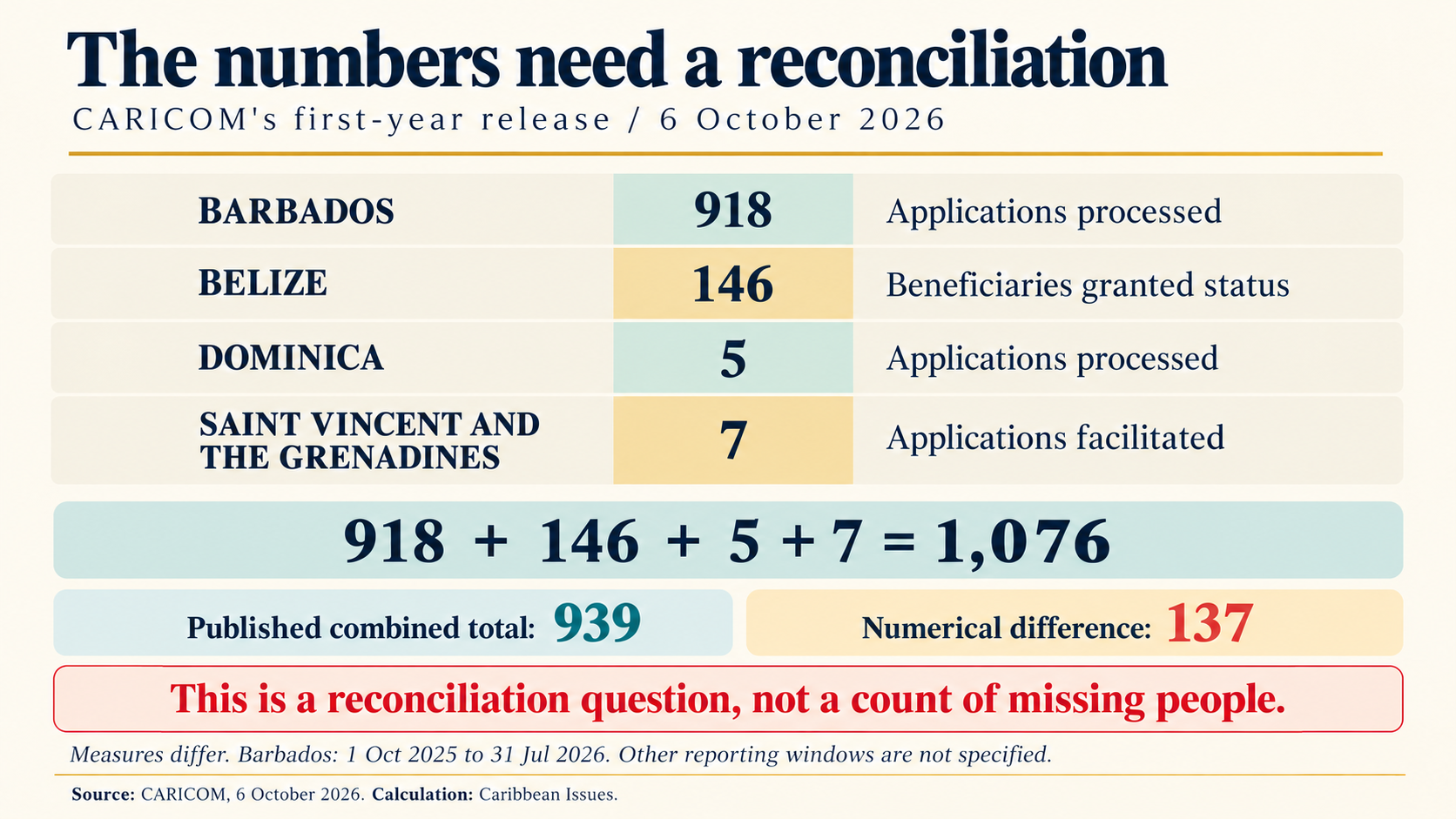
CARICOM’s original release, dated 6 October 2026, supplies the following figures:
Barbados: 918 applications processed. Reporting period: 1 October 2025 to 31 July 2026.
Belize: 146 beneficiaries granted free-movement status. Reporting period: not specified.
Dominica: 5 applications processed. Reporting period: not specified.
Saint Vincent and the Grenadines: 7 applications facilitated. Reporting period: not specified.
918 + 146 + 5 + 7 = 1,076. The release nevertheless states a combined total of 939 people processed, including some who already lived in the participating countries before the arrangement began. Read the original CARICOM release [1]
The figures need a reconciliation before they can be treated as a comparable regional total. Applications, beneficiaries and facilitated applications are different descriptions. The release also does not establish a common reporting window.
That means 1,076 should not be substituted as the “real” number of migrants. It is the arithmetic sum of four published figures, not an independently verified count of unique people.
Nor does the inclusion of existing residents explain the difference by itself. That detail tells us something about who may be included. It does not show how the country figures produce the combined total.
There could be different stages of processing, different cut-off dates, an adjustment not explained in the summary, or a transcription error. These are possible explanations, not findings. The reporting authorities can resolve the question by publishing definitions, dates and the calculation behind the total.
Travel is not settlement and status is not employment
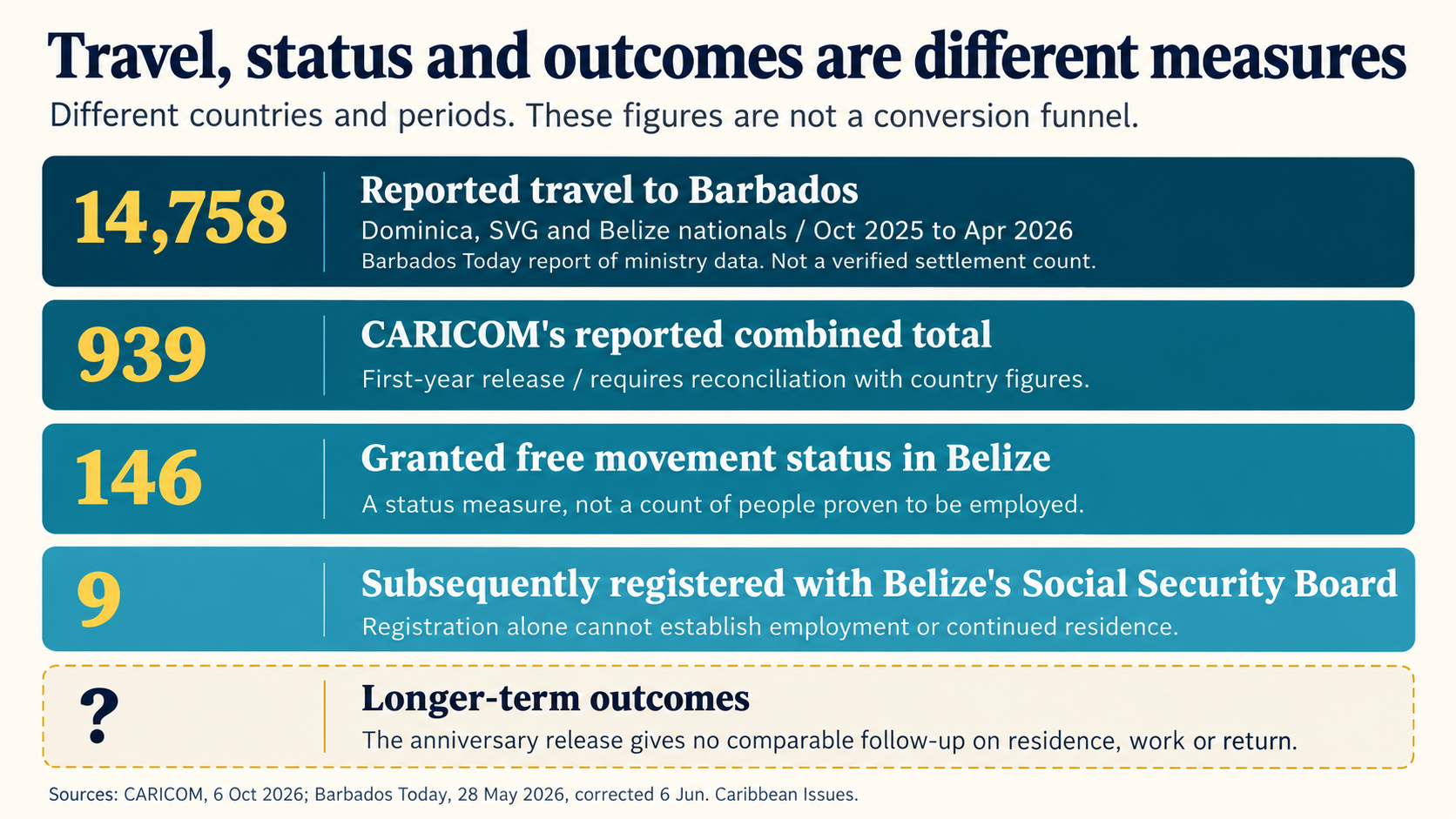
A much larger number appeared earlier in the year. In a corrected report, Barbados Today attributed to Ministry of Home Affairs data approximately 14,758 nationals of Dominica, Saint Vincent and the Grenadines, and Belize travelling to Barbados between October 2025 and April 2026. The outlet explicitly corrected an earlier description of uptake. Barbados Today’s corrected report [4]
That figure cannot be read as 14,758 new residents. The published account does not establish whether it represents unique travellers or how repeat journeys were handled. Visiting, receiving a status, taking a job and establishing a home are different events.
It would also be misleading to divide CARICOM’s combined total by this travel figure and call the result a settlement rate. They cover different places, periods and measures. They do not describe successive stages of one tracked group.
Belize’s nine subsequent Social Security Board registrations, reported alongside its 146 status beneficiaries, raise a further question about what happens after approval. Registration alone does not tell us who obtained employment, who remained resident, or who returned home. Treating nine divided by 146 as an employment rate would claim more than these data establish.
The same care applies to the word “processed”. Without a definition, it cannot safely be equated with unique applications handled, approvals issued or new residents arriving.
Who gains when a worker moves
In July, Barbados Today reported Prime Minister Mia Mottley’s assessment that most people using the arrangement had gone to Barbados. She linked this to labour and skills shortages. That is a reported government assessment, not a harmonised migration series independently demonstrating the size or composition of the flow. Mottley’s July assessment [5]
It does, however, make the policy question more concrete.
Imagine a trained worker taking a better-paid position in another participating country. The worker may gain income and experience. An employer may fill a vacancy. Relatives at home may receive support. A later return could bring skills, savings and business connections.
The sending community might also lose someone difficult to replace. Whether it does depends on the occupation, existing vacancies, training capacity and whether the worker would otherwise have left the Caribbean altogether.
These are possible outcomes of mobility, not findings about the first-year participants. They show why destination-country uptake cannot describe the whole regional balance.
People also have a right to pursue better lives. A debate about staffing shortages should not turn workers into national property or make migrants responsible for weak wages and inadequate training systems.
The practical question for governments is how to support mobility while strengthening the services and opportunities that make staying a viable choice.
Caribbean Issues’ Maroon Economics framework [6] offers a useful editorial lens: examine where the value created by Caribbean people circulates. Applied here, that means following earnings, skills, family support and enterprise across borders. It is a way to frame questions, not a statistical result supplied by the anniversary figures.
The price of using a new freedom
Permission to work does not pay for the move.
A prospective mover may need a fare, baggage allowance, accommodation, a rental deposit and enough money to manage until the first salary. Children or dependent relatives can change the calculation again. An employer paying relocation costs can make an option possible that a household could not finance alone.
These are costs worth investigating through documented cases. The anniversary figures do not establish how strongly they affected participation, or whether people with particular incomes were more able to move.
That is why neither a small total nor a larger one is a sufficient verdict. Low uptake could reflect limited interest, substantial barriers, existing alternative rights or the timing of administrative processes. High uptake could reflect attractive opportunities or difficult conditions at home.
Interviewing movers and people who considered moving would help distinguish these possibilities. Administrative totals cannot do that work alone.
What Grenada and Saint Lucia should ask
CARICOM’s communiqué of 10 July 2026 records that Grenada and Saint Lucia were actively taking steps to participate. CARICOM’s October anniversary release still describes four participating countries. Those records establish movement towards expansion; they do not establish a commencement date for either additional country. July summit communiqué [7]
Both countries already belong to the OECS mobility framework. Joining the four-country initiative would therefore need to be explained in terms of the additional rights and obligations it creates, including relationships with Barbados and Belize, rather than presented as their first experience of regional free movement.
Residents deserve clear answers about which occupations have vacancies, where recruitment is difficult, and how schools, housing and public services would be planned for. Potential movers need practical information about documentation, family arrangements, professional registration and access to services.
Workers and employers should also be part of that discussion. Freedom from a work-permit requirement is not, by itself, evidence that pay is fair, qualifications are recognised or complaints are resolved.
This is already an institutional concern: the ILO’s May 2026 mission to Barbados focused on labour-migration governance, data systems and dialogue involving government, employers and workers. ILO account of its technical mission [8]
Expansion is an opportunity to improve the reporting framework alongside the rights.
Five things to publish in year two
A reconciled administrative account. Explain the published discrepancy and distinguish applications, decisions, beneficiaries and unique people. Use common dates and show revisions openly.
New movement separated from existing residence. Identify people newly arriving under the arrangement separately from those already resident who acquire or record a status. Explain how repeat applications and journeys are handled.
The broad pattern of movement. Publish origin, destination, age bands and occupation or sector where data quality and privacy allow. Suppress small categories that could identify individuals.
Outcomes over time. Follow comparable groups long enough to examine work, residence, return and onward movement. A twelve-month follow-up should cover people eligible for twelve months of observation, rather than treating recent entrants as if a full year has passed.
The experience of exercising the right. Report processing delays, refusals, complaints and access to services, alongside appropriately designed research on moving costs and workplace treatment.
These are proposed standards for accountability, not a claim that every indicator can be produced immediately or without resources. Some data collection or sharing may require legal review and safeguards. Publish what can be produced responsibly, explain what is missing and give a timetable for improvement.
A right worth defending and results worth checking
Free movement should not have to prove its worth through a dramatic first-year headcount. A new right can matter before large numbers use it. Equally, an announcement that a regime works does not settle whether its benefits are broadly shared.
The arithmetic question is limited and answerable. The question about livelihoods requires a wider evidence base.
People need enough information to judge whether opportunities are opening, whether public services can adapt and whether those who move are treated fairly. People who remain at home belong in that assessment too.
The region should be able to defend a freedom and scrutinise its results at the same time.
Tell us about the decision behind the journey
Have you used the arrangement, or considered it and decided against moving? Tell us the countries involved, the approximate date, what you hoped to do and what made the decision easier or harder. If you share moving costs, give the currency and year.
If you employ or work alongside people who moved, which practical issue needs attention: recruitment, pay, qualifications, housing, paperwork or something else?
Diaspora readers are welcome too. Explain how regional mobility affects your plans, and which nationality or status you would rely on; residence overseas does not by itself establish eligibility.
Remove names, passport numbers, booking references and other identifying details from documents. Reader accounts can guide follow-up questions, but they are not a representative survey. We would seek permission before quoting an identifiable account in a follow-up article.
Sources and method
Caribbean Issues checked CARICOM’s original anniversary release and launch explanation, its July summit communiqué, the OECS and ILO accounts, and the linked Barbados Today reports. The travel figure is attributed to the outlet’s corrected account of ministry data; the underlying ministry dataset was not independently examined.
The arithmetic can be reproduced from the four figures shown above. It cannot establish a corrected total of unique movers. No participant-level dataset was available for this review, and the article does not calculate migration, employment or retention rates from incompatible measures.
References to gaps in reporting concern the named public releases and linked material reviewed. They do not establish that no government holds additional data.
Cover image: AI-generated editorial illustration. The people shown are not documented participants in the arrangement.
Questions readers are asking
Why do CARICOM’s free-movement figures not add up?
The four country figures in CARICOM’s 6 October 2026 release sum to 1,076, while it reports a combined total of 939. The measures differ and a common reporting window is not established. The release does not reconcile the figures, so the difference cannot be treated as missing people or 1,076 as a corrected count of unique migrants.
Which countries participate in this free-movement arrangement?
The October 2026 anniversary release identifies Barbados, Belize, Dominica, and Saint Vincent and the Grenadines. Their enhanced-cooperation arrangement began on 1 October 2025. It does not give every CARICOM national unrestricted settlement rights in every member country.
Does the Barbados travel figure mean 14,758 people settled there?
No. Barbados Today’s corrected report describes travel by nationals of three countries between October 2025 and April 2026. It does not establish new residence or explain how repeat journeys were counted. It cannot be used as a verified settlement total.
Do Belize’s Social Security Board registrations establish an employment rate?
No. The reported nine subsequent registrations among 146 status beneficiaries do not establish who obtained work, remained resident or returned home. Registration and status are different measures, and their ratio is not a verified employment rate.
Have Grenada and Saint Lucia joined the four-country arrangement?
CARICOM’s July 2026 communiqué says both were actively taking steps to participate. Its October anniversary release still names four participating countries. These records do not establish a commencement date for either additional country. Both already participate in the separate OECS mobility framework.
What evidence would help assess whether free movement is working?
Comparable definitions and reporting periods, a separation of new arrivals from existing residents, privacy-protected movement patterns, follow-up on work and residence, and evidence about moving costs, delays, complaints and access to services would support a fuller assessment.
Sources and documentation
Sources are consolidated here so the investigation reads continuously while the record remains directly inspectable. Evidence roles describe how a source is used; they are not automatic truth scores.
Supports: The four country figures, the reported combined total, existing-resident qualification and Belize Social Security Board registrations.
Currency: Verified within the last 45 days.
Supports: The initial participating countries, commencement date, rights and enhanced-cooperation framework.
Currency: Verified within the last 45 days.
Supports: Pre-existing indefinite-stay and work-permit exemptions within the participating Protocol Member States.
Currency: Verified within the last 45 days.
Supports: The outlet’s corrected report of ministry travel data for October 2025 to April 2026; not a verified count of new residents.
Currency: Verified within the last 45 days.
Supports: Attributed government assessment of movement towards Barbados and labour and skills shortages.
Currency: Verified within the last 45 days.
Supports: The publication’s editorial framework for asking where the value created by Caribbean people circulates, not measured outcomes of free movement.
Currency: Verified within the last 45 days.
Supports: Grenada and Saint Lucia were actively taking steps towards participation; the communiqué does not establish commencement.
Currency: Verified within the last 45 days.
Supports: Institutional work on labour-migration governance, data systems and social dialogue.
Currency: Verified within the last 45 days.
Editorial standards, corrections and AI-assistance policy · Privacy and data use
Caribbean Issues Reader Forum
What is your view?
Rate the usefulness of this analysis, respond to its evidence and add knowledge from the Caribbean or diaspora. Comments are reviewed before publication.
Was this analysis useful?
How would you describe it?
Reader discussion
Loading approved comments…