
The short answer
Tourism is indispensable to several Caribbean economies, but its development value depends on ownership, wages, local supply chains, taxation and how much visitor spending circulates locally rather than on arrival numbers alone.
Publication record
Transparent responsibility and verification details for this Caribbean Issues publication.
- Published
- Updated
- No later revision recorded
- Responsible byline
- Caribbean Issues
- Verification
- Editorially reviewed under our published method
- Sources listed
- 4 sources listed below
- Primary topic
- Caribbean Tourism and Development
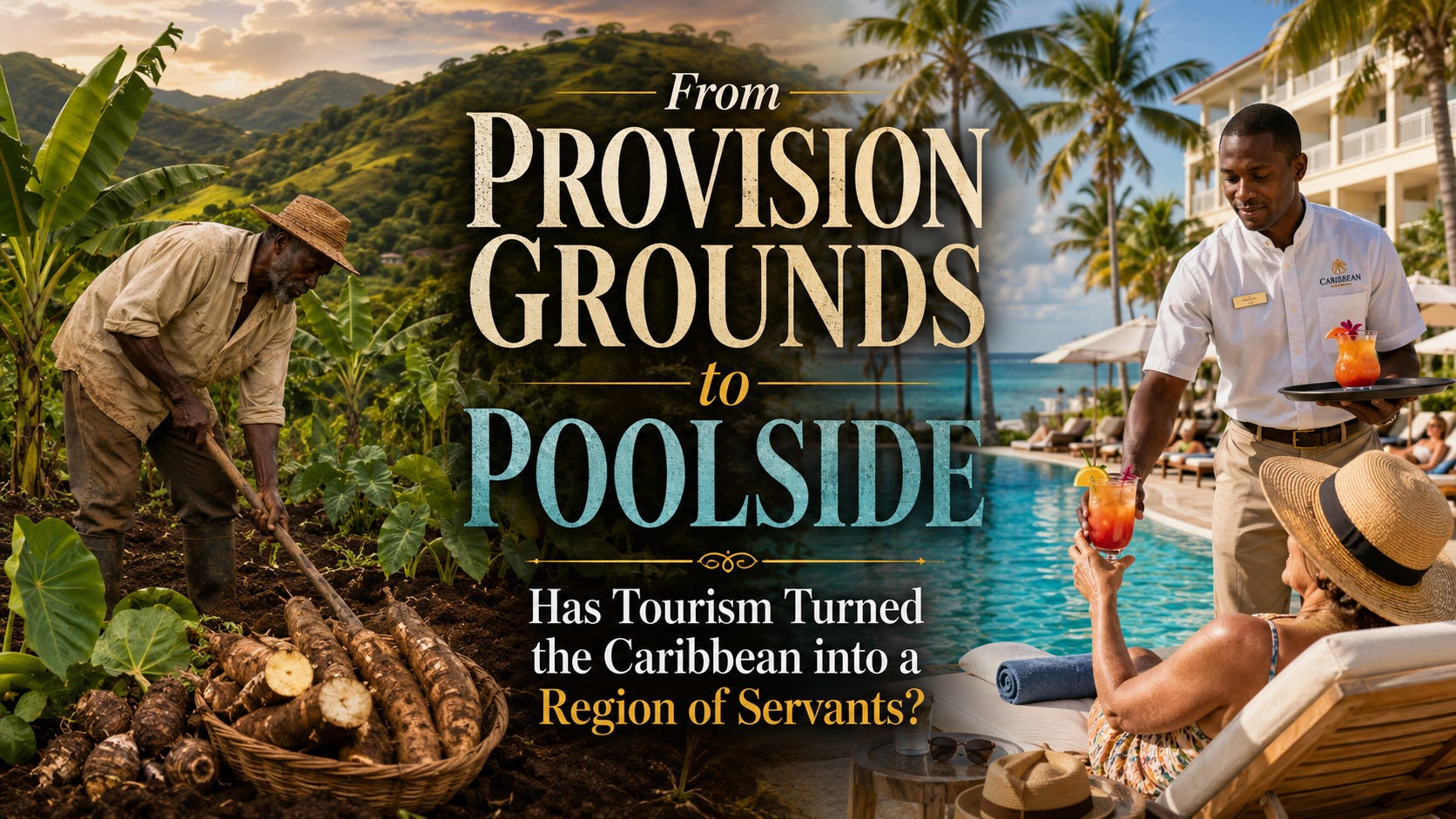
From Provision Grounds to Poolside Tourism drives up to 93% of GDP in parts of the Caribbean — but roughly 80% of that money leaves the region.
The central argument
Every year the region rolls out the same welcome. Steel pan at the airport, rum punch on arrival, “no problem” on command. Behind that welcome sits one of the most concentrated single-sector economies on Earth — and a question the region has mostly avoided asking out loud: did we trade a nation of producers for a nation of servants?
The instinct to answer yes is understandable. But the honest answer is more precise, and more useful, than yes or no. The data shows something sharper: it isn’t service work itself that degraded the region’s economic standing — it’s who owns the value that service work creates. That distinction is the difference between a servant economy and a service economy, and it’s the difference this investigation is built to draw out.
The Numbers Behind the Dependency
Start with how total tourism’s grip on the region has become. Regionally, tourism directly accounted for roughly 11.4% of Caribbean GDP in 2023 — about US$84.9 billion — but that average flattens out wild variation between islands.
Antigua and Barbuda sits at the extreme: WTTC projected travel and tourism would generate 93% of national GDP in 2024, the most tourism-dependent economy anywhere in the world. St. Kitts and Nevis isn’t far behind — services now make up roughly 78–80% of GDP, with tourism alone estimated at well over 40% and, by some counts, over 60% of total output, a complete inversion of an economy that was built on sugar until the last cane factory closed in 2005. St. Lucia runs around 40%. Jamaica sits at 33.6%, with tourism providing about a third of all jobs, direct and indirect, and standing as the country’s single largest earner of foreign exchange. Barbados runs close behind at roughly a third of GDP. Dominica, the “Nature Isle,” sits lower at around 24% — still tourism-led, but with more room left for agriculture than its OECS neighbours. Grenada has tourism contributing somewhere between 20% and 40% of GDP depending on the measure used, and roughly 80% of foreign exchange earnings — with cruise passengers (around 300,000 a year) far outnumbering stay-over visitors (120,000–140,000), even though stay-overs spend eight to ten times more per person. St. Vincent and the Grenadines remains more agriculturally anchored than most of its OECS peers but has followed the same trajectory since the 1980s.
Tourism vs. agriculture as a share of GDP across the OECS and wider Caribbean. Figures are best-available estimates and vary by year and methodology. Across the wider English- and Dutch-speaking Caribbean, tourism directly employs about 18% of the labour force, rising to 43% once indirect and induced jobs are counted. That’s close to one million of the region’s 2.3 million workers whose livelihood traces back to a single, externally-driven sector.
The deeper structural problem isn’t the size of tourism — it’s the shallowness of it. Over 83% of Caribbean tourism arrivals travel for cruise or “sun, sand, sea” purposes, the lowest-yield tourism segment there is. Caribbean spend-per-arrival (roughly US$712) runs about half of the Pacific’s (roughly US$1,428). We built the region’s whole economic identity around the visitor category that spends the least.
Where the Money Actually Goes — Leakage, Mapped Properly
This is where the “servant economy” critique earns its teeth, and it deserves more than a single statistic.
The headline number. A 2014 UNWTO study put Caribbean tourism leakage at roughly 80% — the share of visitor spending that exits the region through foreign-owned hotels, airlines, imported food and construction materials, and repatriated profits. Multiple sustainability-tourism analyses since have confirmed the same range for all-inclusive resort models specifically: 70–80% leakage is the norm, not the exception. Jamaica’s tourism minister has publicly conceded that import leakage alone — food and beverages the resorts bring in rather than source locally — costs the country roughly 30% of tourism revenue before profit repatriation is even counted.
The cruise economy makes this worse, not better. Three companies — Carnival, Royal Caribbean, and Norwegian — control roughly 73–75% of the entire Caribbean cruise market. All three are incorporated offshore specifically to avoid taxation: Carnival in Panama, Royal Caribbean in Liberia, Norwegian tied to a Malaysian conglomerate. None of the “flag of convenience” registrations have anything to do with the Caribbean — they exist purely to keep tax obligations offshore. Cruise ships pay Caribbean ports a head tax of roughly US$4–15 per passenger. Onboard, the ships increasingly capture spending that never touches land at all: cruise lines now lease or own private islands and beaches across the region — Norwegian’s Great Stirrup Cay was the first, in 1977 — precisely so that food, drink, and excursion revenue stays inside the company rather than reaching a local vendor. Where a passenger does step onto sovereign Caribbean soil, industry insiders describe onshore vendor arrangements where cruise lines still take up to 70% of that onshore revenue in commissions.
The Caribbean Tourism Organization’s own comparison is the cleanest evidence available: land-based, stay-over visitors spend roughly 13 times more per person than cruise passengers. Cruise tourists make up about 40% of all Caribbean visitors, yet account for under 10% of total tourist expenditure in the region.
Booking platforms take another cut before a guest even arrives — 15–30% of booking value flows to Booking.com, Airbnb, or Expedia rather than the property or the destination.
Estimated share of visitor spending that leaves the region at a typical all-inclusive resort. Put a number on what’s left. Of every US$100 a visitor spends at a typical Caribbean all-inclusive resort, roughly US$80 is estimated to leave the region before it reaches a local farmer, fisherman, taxi driver, or craftsperson. For cruise tourism, the number retained locally is lower still, since the passenger’s meals, drinks, entertainment, and often even their excursions were pre-purchased from a foreign-flagged corporation before the ship ever left Miami.
This is the real substance behind the “servant” accusation: it isn’t really about who’s smiling at the front desk. It’s that the enterprise doing the smiling for you was, disproportionately, never built to keep the money here in the first place.
The Nature of the Work — Servant, Professional, or Something the Language Hasn’t Named Yet
Wage data gives the “servant” framing its sharpest edge.
A waiter earns roughly US$500 a month in Barbados, US$725 in St. Lucia. Hotel cleaners earn around US$600 a month in Barbados and Jamaica, and as little as US$400 in St. Lucia — figures reported by regional tourism labour sources. The general secretary of the Antigua and Barbuda Workers’ Union — representing 99% of hotel workers on the world’s most tourism-dependent island — has said plainly that wages haven’t kept pace since the 1980s: workers today can’t qualify for a mortgage on wages that once supported homeownership. Academic research on small island tourism economies documents structurally embedded precarity: low pay, seasonal layoffs, informal employment, and job insecurity that persists even in periods of high demand — meaning the problem isn’t a lack of tourists, it’s the terms tourism labour is hired on. The ILO’s own data shows tourism hourly wages sit well below national averages across most countries where it operates. Set against US$60 billion-plus in annual Caribbean tourism revenue, the region’s average poverty rate still hovers around 30% — the clearest available signal that revenue and wage growth in tourism have decoupled from each other.
That’s the honest case for “servant.” Now the honest complication: locals in tourism-dependent economies frequently prefer tourism jobs to the local alternatives on offer, because the alternatives are often worse, not because tourism jobs are good in any absolute sense. Aruba’s tourism boom cut unemployment from 40% in 1985 to near zero within a decade — real, material improvement for real households. And the region’s own Nobel laureate economist, Sir Arthur Lewis, warned as far back as 1950 — decades before mass tourism existed — against over-reliance on agriculture specifically, arguing that low-wage farm labour needed to move into higher-value work for the region to develop at all. The ILO now frames the modern moment as a swap of one “reliance trap” for another: agriculture’s low-wage trap exchanged for tourism’s low-wage trap, with the same root problem in both — the higher-value links in the chain (ownership, processing, marketing, distribution, finance) sit outside the region either way.
So here’s the reframe that actually holds up under the evidence: the problem was never that Caribbean people do service work. The problem is that “servant” and “service” have been allowed to mean the same thing.
A doctor is in the service economy. A lawyer, a software engineer, an accountant, a teacher, a financial analyst, an architect — all service economy. Nobody calls a Barbadian actuary managing offshore reinsurance a servant. The distinction was never about whether you serve someone’s needs for a wage — every economy on Earth beyond subsistence farming runs on people serving other people’s needs. The distinction is about ownership, bargaining power, and whether there is a ladder — whether the person doing the serving can rise into ownership, management, or a specialized, well-compensated profession within that same service, or whether they’re structurally capped at the bottom of a chain owned entirely offshore.
And the Caribbean already runs a much larger, much less discussed service economy that proves the point. Financial services are the second-largest contributor to Caribbean GDP in several CARIFORUM states — over 20% of GDP in St. Lucia, St. Kitts and Nevis, Montserrat, Antigua and Barbuda, Barbados, and the Bahamas as of recent data. Business process outsourcing — finance and accounting, legal process work, medical services, human resources, insurance, risk and compliance — now employs over 100,000 people across the region, much of it in Caribbean-headquartered or Caribbean-managed firms serving clients abroad, with the Caribbean acting as the seller of expertise rather than the seller of poolside towels. One Barbadian entrepreneur building BPO capacity put it precisely: the model that works is the one where the intellectual property is created and owned locally, then monetized to offshore customers — the exact inversion of the tourism leakage pattern.
That’s not a servant economy. That’s a service economy where ownership stayed home. The difference between a Bajan call-centre worker with no equity in the platform they operate and a Bajan software firm licensing its own IP to a European client isn’t the nature of the work — both are service work. It’s who’s holding the deed.
What Agriculture Used to Be — and Why It Isn’t Now
The “agriculture was better” argument has to reckon honestly with why agriculture declined, because it wasn’t simply out-competed — much of it was dismantled from outside the region.
Up to the 1950s, agricultural exports were the backbone of the Commonwealth Caribbean economy. By the 1960s, Jamaica’s agricultural GDP share had already fallen to roughly 11%. Trinidad’s fell from just over 6% in 1970 to about 2% by 1980 as the oil boom pulled rural labour into Port of Spain. Sugar collapsed first, undercut from the 1930s onward by European beet-sugar subsidies and later by the erosion of preferential EU trade access. St. Kitts closed its last sugar factory in 2005 after decades of losses, ending an industry that had defined the island since the 1600s.
Bananas replaced sugar as the Windward Islands’ cash crop and peaked in 1992 at 274,000 tonnes — roughly 20% of GDP across Dominica, St. Lucia, St. Vincent and the Grenadines, and Grenada. A US-backed WTO challenge to the EU’s preferential banana quota system then triggered collapse: banana’s GDP share fell to under 5%, and the number of registered growers across the Windward Islands dropped from roughly 24,000 farmers in 1993 to about 5,000 by 2005 — a farming population wiped out by nearly 80% in just over a decade, with women, who made up a large share of banana farmers, hit hardest.
Grenada’s nutmeg industry — the island supplies roughly a fifth of world nutmeg, second only to Indonesia — was devastated by Hurricanes Ivan (2004) and Emily (2005) and still hasn’t fully recovered decades later; nutmeg and cocoa together now contribute a low single-digit share of GDP, down from being the country’s economic backbone.
Today, agriculture’s share of GDP across the OECS and wider Caribbean is a fraction of tourism’s: roughly 18% in Guyana, 17% in Dominica, 9% in Jamaica and Belize, around 8% in St. Vincent and the Grenadines, 4% in Barbados, 2–3% in Grenada and St. Kitts and Nevis, 2.1% in St. Lucia, and 0.5% in Trinidad and Tobago.
This history changes the moral shape of the argument. The region didn’t casually choose service over production. Production was made structurally unviable by the withdrawal of colonial-era trade preferences and hostile trade rulings, at almost exactly the moment tourism infrastructure was being built as the obvious replacement. Servitude, if that word applies at all, was substituted in — not chosen.
Why “Producer” Still Beats “Server” on Sustainability Grounds
Set the labour debate aside for a moment and look purely at structural resilience — this is where the producer argument is strongest and most measurable.
CARICOM imports 80–90% of its food in several member states, with a regional food import bill exceeding US$6 billion annually. As of recent CARICOM/WFP data, an estimated 4 million of 7.1 million people — 57% — in the English-speaking Caribbean experienced food insecurity. Food inflation hit 7.4% in Jamaica, 5.6% in Guyana, and 4.8% in St. Vincent and the Grenadines in early 2025. CARICOM’s own “25 by 2025” initiative — now extended to 2030 — exists precisely because governments recognised this dependency as an emergency, explicitly naming “economic leakage” as the mechanism: tourism dollars earned locally leave again immediately to pay for imported lettuce or tomatoes the region could grow itself.
Climate shocks expose both models at once, but food security has no substitute when it fails. Hurricane Beryl in July 2024 destroyed over US$6.4 million in Jamaican crops, disrupted nearly 50,000 farmers, and contributed to a 1.9% GDP contraction. In Grenada, the same storm caused damage estimated at 2.7% of GDP across agriculture, fisheries, and tourism infrastructure simultaneously. The uncomfortable truth analysts have pointed to: a country reliant on imports for most of its food can survive a domestic agricultural wipeout — but only if tourism-driven foreign exchange holds up at the same time, and a hurricane routinely threatens both at once.
There’s also a structural asymmetry that no amount of wage negotiation changes. A farmer selling breadfruit, callaloo, or nutmeg at a domestic market keeps the transaction inside the local economy by default — there’s no foreign hotel chain, cruise line, or booking platform positioned to take a cut. Ownership of output is built into farming in a way it is not built into hospitality labour. A waiter can’t own the dinner they serve. A farmer owns the crop until the point of sale, and every point after that where they choose to sell it.
There are working models proving the combination isn’t theoretical. Guyana’s agricultural GDP share, around 18%, remains the region’s highest, anchored by rice and now expanding through agri-investment partnerships with Barbados. Barbados’ government has pushed agritourism models like Coco Hill Forest — a 53-acre site combining farming, agro-processing, and tourism — and the Oistins Fish Fry, cited by regional agricultural bodies as a working example of tourism revenue flowing through local food production instead of around it. Even so, Barbadian commentary this year remained skeptical that “linkages” between tourism and agriculture amount to more than a repeated campaign promise: more hotel rooms, the critique goes, are not the same thing as a diversified economy.
The Honest Counter-Case
A fair investigation has to state the strongest objections to its own thesis.
Agricultural labour was also exploitative and low-wage — a Windward Islands banana farmer selling into a colonial preference system was, in a real sense, just as dependent on a distant buyer’s decisions as a hotel worker is on a distant tour operator’s. The customer was an importer instead of a tourist, but the structural powerlessness was similar. Sir Arthur Lewis’s 1950 warning was explicitly against over-reliance on agriculture — his prescription was movement into higher-value industry, not a return to the land. Land, water, and scale constraints are real and physical, not just political: several islands do not have enough arable land to feed themselves at any plausible scale, no matter the policy will behind it. And rebuilding export-grade agriculture — irrigation, agro-processing capacity, cold chains, market access — after fifty years of disinvestment is a multi-decade undertaking, while tourism infrastructure, whatever its flaws, is already built and earning foreign exchange today.
Not Servant vs. Farmer — Owner vs. Renter
The evidence doesn’t support the claim that tourism turned the Caribbean into servants in any literal sense. Tourism jobs are jobs, and for many households they remain a better option than the local alternatives on offer — Aruba’s employment history proves that plainly. But the evidence strongly supports a sharper, more useful claim: the current tourism model concentrates ownership and value capture outside the region at a scale — roughly 80% leakage, cruise ownership consolidated in three offshore-flagged corporations, private islands built to keep spending off Caribbean soil entirely — that agriculture, structurally, never did to the same degree. A $6 billion regional food import bill sitting alongside a tourism sector earning tens of billions isn’t two separate problems. It’s one leakage economy funding the other’s dependency.
The answer was never “abolish tourism and return to the land” — the counter-evidence closes that door. And it was never really “servant vs. producer” either — that framing lets the real culprit hide behind a labour category. The sharper line, the one the numbers actually draw, is service economy versus servant economy — and the difference between them has nothing to do with whether you’re carrying a tray or a hoe. It’s whether the person doing the work has a stake in what they’re building. A Bajan-owned BPO firm licensing software to a European bank is a service economy. A foreign-flagged cruise ship capturing 70% of onshore vendor revenue through a private-island loophole is a servant economy, no matter what the person on the beach is wearing.
Maroon Economics doesn’t ask the region to choose between the hoe and the tray. It asks who owns what’s grown, who owns what’s served, and whether the surplus either one creates ever makes it back to the people who made it. Right now, on the evidence, it mostly doesn’t. That’s the trade that needs renegotiating — not the choice of industry, but the terms of ownership inside whichever industry the region chooses to build.
Questions readers are asking
Does 80 percent of tourism revenue leave every Caribbean economy?
No. Leakage varies substantially by country, tourism model and measurement method. The 80 percent figure should be treated as a broad historical estimate sometimes applied to highly import-dependent Caribbean tourism, not as a uniform current rate for every island.
How can Caribbean countries retain more value from tourism?
They can strengthen local ownership, agricultural and manufacturing supply chains, transport and creative-industry links, workforce progression, tax compliance and procurement systems that help domestic firms meet tourism demand.
Is the argument that Caribbean countries should abandon tourism?
No. The stronger case is to improve tourism's domestic linkages and bargaining structure so that more of its income, skills and enterprise development remain in Caribbean economies.
Sources and documentation
Sources are consolidated here so the investigation reads continuously while the record remains directly inspectable. Evidence roles describe how a source is used; they are not automatic truth scores.
- [1]International Monetary Fund — Caribbean Tourism in the Global MarketplaceIntergovernmental record
Supports: Comparable evidence on tourism's GDP and employment contribution across Caribbean economies and the sector's links to agriculture, trade, transport and construction.
Currency: Verification is older than 45 days; review before relying on current conditions.
Supports: Recent regional evidence on tourism expenditure, economic structure, diversification and development constraints.
Currency: Verification is older than 45 days; review before relying on current conditions.
Supports: Evidence on hotel food imports, weak domestic supply linkages, import substitution and opportunities to retain more tourism value in Caribbean agriculture.
Currency: Verification is older than 45 days; review before relying on current conditions.
- [4]World Bank — Linking farmers and agro-processors to tourism in the Eastern CaribbeanIntergovernmental record
Supports: Eastern Caribbean evidence on agricultural-tourism supply chains, hotel food imports and realistic limits and opportunities for local substitution.
Currency: Verification is older than 45 days; review before relying on current conditions.
Editorial standards, corrections and AI-assistance policy · Privacy and data use

Songs from the Headlines
Now hear the story: What We Build Must Come Home (bonus track)
This article inspired a song on Caribbean Issues, Vol. 1 — Songs from the Headlines. Listen to the sample, then support independent Caribbean journalism by buying the complete Digital Album Edition directly from Caribbean Issues.
One-minute song sample
Caribbean Issues Reader Forum
What is your view?
Rate the usefulness of this analysis, respond to its evidence and add knowledge from the Caribbean or diaspora. Comments are reviewed before publication.
Was this analysis useful?
How would you describe it?
Reader discussion
Loading approved comments…