

The short answer
Tourism success should include whether the people who sustain a destination can secure suitable homes within reach of their wages. Evidence from Cayman and Puerto Rico, alongside housing commitments in Jamaica, shows why promises, delivery and continuing affordability must be measured separately.
Publication record
Transparent responsibility and verification details for this Caribbean Issues publication.
- Published
- Updated
- No later revision recorded
- Responsible byline
- Caribbean Issues
- Verification
- Editorially reviewed under our published method
- Sources listed
- 12 sources listed below
- Primary topic
- Caribbean Tourism and Development
A Caribbean destination needs people who can afford to stay. Hotel rooms cannot teach children, care for patients or prepare a meal. Yet the housing available to the people doing those jobs is too often treated as a separate question from the growth they make possible.
The housing test behind the job offer
In May 2024, Cayman International School director Jim Urquhart told the Cayman Compass that 17 job offers had been declined over four years because of cost-of-living concerns, including six that year. Housing was part of a wider calculation that included the costs of bringing a family. One school’s experience does not establish a regional recruitment crisis. It does show how an employment offer can fail the test of everyday life. [1]
The evidence from Cayman and Puerto Rico, alongside housing commitments in Jamaica, points towards a more demanding definition of successful development: measure whether the people an economy needs can secure suitable homes within reach of their wages. These jurisdictions are case studies, not a statistical sample of the Caribbean. Together they reveal the difference between recognising a housing problem, promising a response and delivering a home.
Housing is part of the economy that visitors depend on
A hotel’s workforce extends beyond its payroll. A functioning destination also needs the people who staff schools and clinics, maintain roads, repair electrical systems and provide transport. The housing question therefore reaches well beyond whether a resort can recruit enough employees for its opening date. It concerns the capacity of a place to sustain the services that make both residence and tourism possible.
The analytical distinction is between creating a job and making that job viable for the person expected to take it. An employment package has to work after housing, transport and family responsibilities enter the calculation. Employers may respond with higher pay, allowances or accommodation. Workers may share a home, accept a longer commute or move elsewhere. Those options have different costs and should not be treated as interchangeable evidence that a shortage has been solved.
This article does not estimate how often each adjustment occurs. It asks governments and employers to measure them. A worker who keeps a job by accepting overcrowding, insecure accommodation or an exhausting journey has remained employed; that alone would be a poor measure of policy success.
What a wage can actually support
Cayman’s 2026 housing audit reports that the average monthly apartment rent in its series reached CI$1,945 in 2024, up 42% from 2019. That is an unweighted average across studio, one-, two- and three-bedroom categories in George Town, West Bay and Bodden Town. It is not the rent of every dwelling, a minimum asking price or a current island-wide median. [2]
Set that beside the territory’s Occupational Wage Survey 2023. Its compensation figures include more than basic wages: overtime, gratuities and other reported components can matter. Even on that broader measure, the distance between earnings and housing costs is substantial for many service jobs. [3]
Monthly earnings and an illustrative housing budget
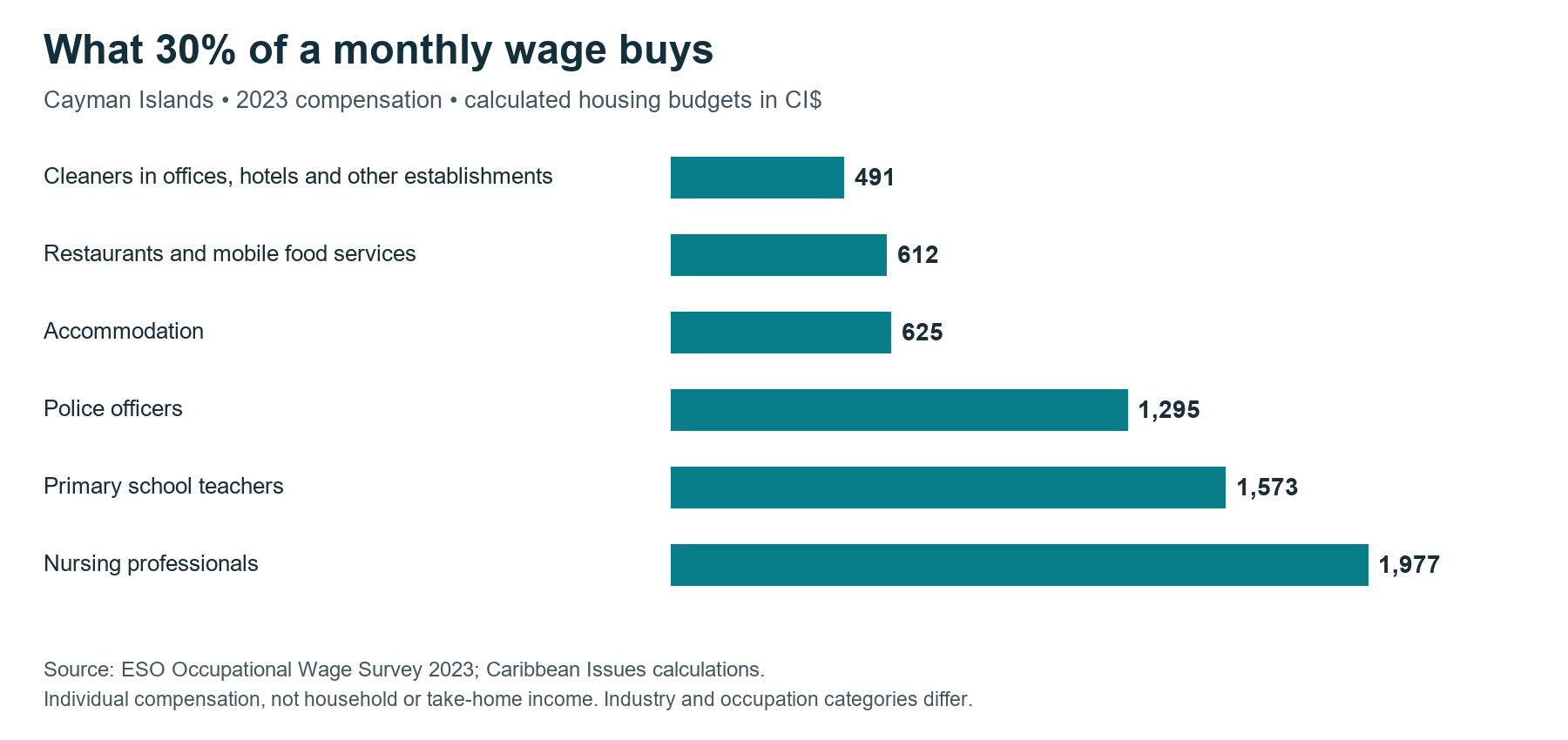
Cleaners and helpers in offices, hotels and other establishments: median total compensation CI$1,637 monthly; 30% housing budget CI$491.
Restaurants and mobile food service activities: median total compensation CI$2,039 monthly; 30% housing budget CI$612.
Accommodation: median total compensation CI$2,083 monthly; 30% housing budget CI$625.
Police officers: median total compensation CI$4,317 monthly; 30% housing budget CI$1,295.
Primary school teachers: median total compensation CI$5,243 monthly; 30% housing budget CI$1,573.
Nursing professionals: median total compensation CI$6,590 monthly; 30% housing budget CI$1,977.
Source: ESO Occupational Wage Survey 2023. Restaurants and accommodation are industry categories covering different jobs; the other rows are occupations. The last column is our calculation, rounded to the nearest dollar. These are individual earnings, not household incomes or take-home pay. The survey had a 12.8% establishment response rate, limiting how confidently it describes the whole workforce. [3]
The 30% threshold is a screening benchmark used in the housing audit, not a guarantee of comfort. Housing costs should include utilities; food, transport, childcare and other obligations still have to fit in the remainder. Two earners, shared accommodation or employer support can change a household’s position. None can be assumed for every worker. [2]
This comparison uses 2023 earnings and 2024 rents to show scale. It cannot establish the percentage of today’s workers who are rent-burdened. That requires current household-level data, with housing size, location, benefits and the number of earners recorded together.
The current wage floor supplies a second test. Cayman’s general minimum wage is CI$8.75 an hour from January 2026. At an assumed 40 paid hours a week for 52 weeks, that is roughly CI$1,517 a month before deductions. Thirty per cent is CI$455. For workers in approved gratuity arrangements, the permitted CI$6.56 hourly employer contribution is supplemented by gratuities; it must not be presented as their entire pay. [4]
A higher minimum wage matters. So does the availability of homes at costs that those earnings can sustain. A policy that addresses only one side of that relationship leaves the other side to determine the result.
The household behind the percentage
Consider two explicitly hypothetical households, each with CI$4,000 in gross monthly income. A 30% benchmark gives both a CI$1,200 housing allowance. One is an adult living alone near work. The other supports children and needs paid childcare and daily transport. The arithmetic is identical; the money remaining for essential life is not. Neither household is a reported interview subject, and these figures are not local price estimates.
That is why the percentage test should be paired with a second question: after reasonable housing costs, how much income remains for necessities? Analysts call this a residual-income approach. Here it is a proposed complement to the audit’s benchmark, not a claim that a validated Caribbean household budget has already been calculated. It would require local prices, household composition and realistic costs of getting to work. [12]
Pay itself also needs closer inspection. A monthly compensation figure may contain gratuities or overtime that fluctuates, while rent is due on a fixed date. Before judging a home affordable, a household or programme should examine the dependable component of earnings and the consequences of a quieter month. A contract that works only with sustained overtime is different from one supported by normal working hours.
Sharing accommodation can be a deliberate and satisfactory choice. It should not become an invisible assumption that makes every wage appear adequate. Public reporting needs to distinguish household preferences from arrangements accepted because suitable alternatives are unavailable. It also needs to measure the quality and legal occupancy of the housing, rather than counting a roof as sufficient.
Affordable housing must remain affordable after purchase
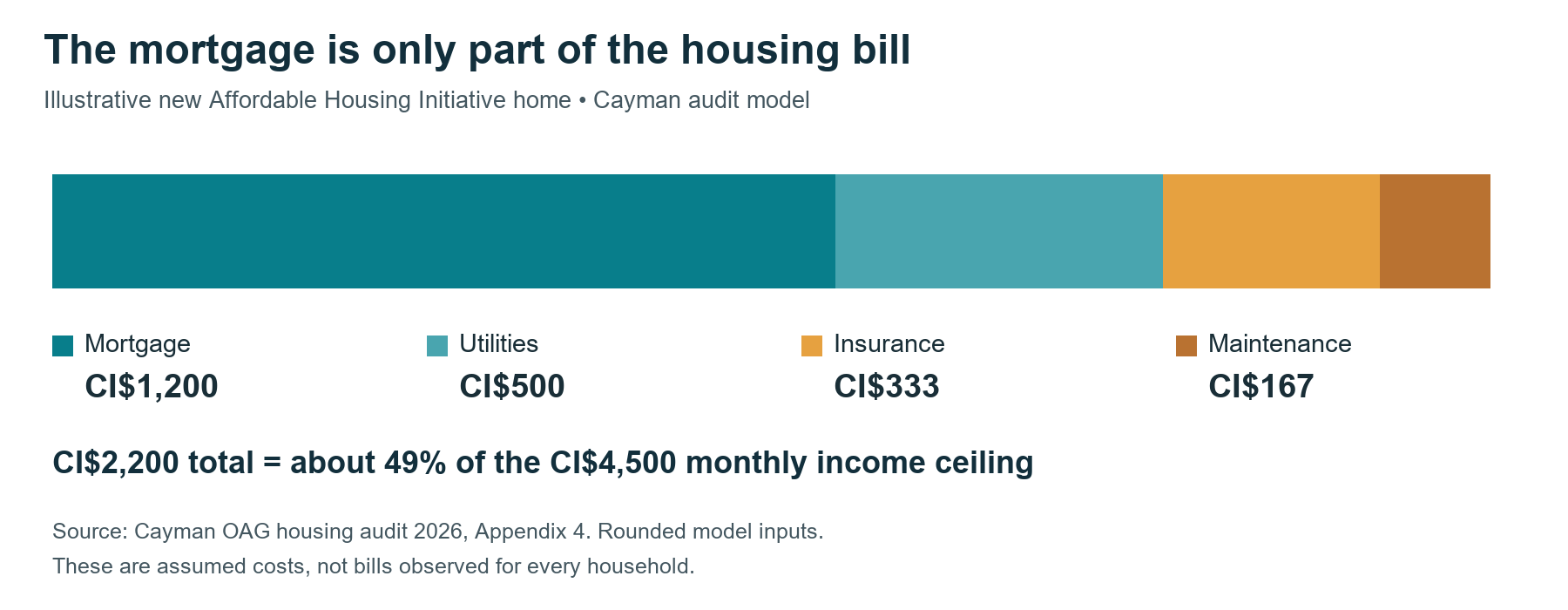
Cayman’s audit also challenges the assumption that a subsidised purchase automatically solves affordability. Its model for a new Affordable Housing Initiative home puts the mortgage at about CI$1,200 monthly and total costs at CI$2,200 after utilities, insurance and maintenance. Against the programme’s CI$4,500 qualifying gross monthly income ceiling, that is about 49%. These are modelled costs, not observed bills for every buyer. [2]
The policy question is what remains after the keys are handed over. A household can qualify for assistance and still struggle with the continuing cost of occupying the property. Governments should publish those assumptions alongside the purchase price, and test how the result changes with interest rates and essential household expenses.
The same principle applies to rental housing for workers. A unit’s existence says little about its usefulness without its rent, condition, occupancy rules, location and tenancy security. Employer-provided accommodation should be assessed on those terms too, including what happens if the job ends.
Public spending needs a delivery record
The Cayman audit’s programme record puts scale beside the affordability calculations. Between 2019 and 2024, government support totalled almost CI$68 million: CI$41.5 million in direct programme costs and CI$26.5 million in stamp-duty waivers. Over those six years, the National Housing Development Trust delivered 36 affordable homes, with 50 more under construction at the end of 2024. The Sister Islands corporation delivered none during that period, although it began four in 2025. [11]
By February 2026, the NHDT had 1,194 approved applicants waiting, with an average wait of 3.6 years. These are different measures and dates. Dividing all programme spending by the 36 homes would produce a misleading unit cost: the expenditure includes other programmes and tax relief. Likewise, the waiting-list count should not be divided by past completions to predict an individual’s future wait. [11]
The defensible conclusion is that spending, construction and access must be reported separately. A government can commit resources without producing enough usable homes for eligible applicants. A better delivery record would show which intervention each dollar funded, when a dwelling became available, who qualified and whether its continuing cost matched the intended income group.
It should also distinguish people on an administrative waiting list from total housing need. Some households may not meet programme rules; others may need rental housing rather than ownership. A list designed for one programme cannot stand in for a complete assessment of the workforce. Citizen-focused assistance and broader workforce housing require explicit eligibility rules and separate measures of demand.
Puerto Rico shows why ownership and concentration matter
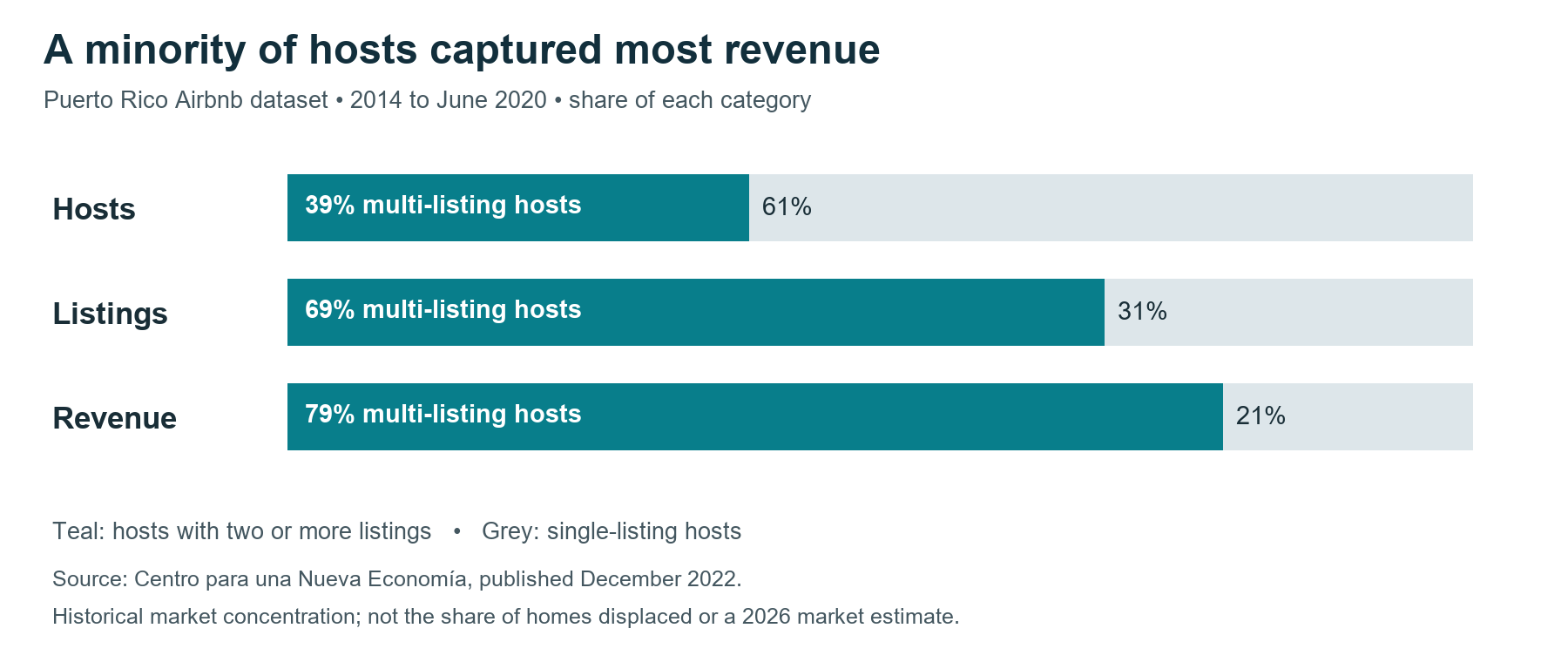
Short-term rentals deserve scrutiny, but the distinction between a household renting a room and a business controlling multiple properties is essential. Research published in 2022 by Puerto Rico’s Centro para una Nueva Economía examined Airbnb activity from 2014 to June 2020. Hosts with multiple listings accounted for 39% of hosts, 69% of listings and 79% of revenue in its dataset. [5]
The study also found an association between short-term-rental concentration and higher rents and home values in its 2017–2019 analysis of the San Juan metropolitan area. That finding supports closer examination of neighbourhood effects. It does not prove that every holiday listing displaced a resident, establish the same effect in every Caribbean territory or describe the market in 2026. [5]
The distinction matters for policy. Rules that treat an occasional host exactly like a portfolio operator may miss where commercial activity is concentrated. Conversely, describing all holiday rentals as household income support can conceal the scale of larger businesses. A useful register should identify unique properties and ownership patterns while protecting personal information.
Puerto Rico’s 2026 affordability figures illustrate a different part of the problem. The National Low Income Housing Coalition reports a two-bedroom fair market rent of US$602 a month, including utilities, and a housing wage of US$11.57 an hour. The stated minimum wage is US$10.50. At 40 hours a week, the corresponding 30% housing budget is US$546. [6]
These figures must not be ranked directly against Cayman’s rent average: the currencies, measures, dwelling sizes and periods differ. The useful comparison is within each jurisdiction, between local earnings and a clearly defined housing cost. Regional analysis becomes stronger when it preserves those differences.
Regulation should follow the local mechanism
There are several possible mechanisms behind a holiday-rental housing problem, and each calls for different evidence. If existing long-term homes are being converted, a property-level record can track the change. If new construction is being directed towards visitors, planning approvals and completed units matter. If listings are concentrated in a few neighbourhoods, an island-wide average can obscure the pressure experienced on particular streets.
Counting advertisements is not enough. A property can appear on more than one platform; a listing may be a room rather than an entire home; an unavailable listing may no longer operate. A government should publish how it deduplicates addresses, defines active operation and separates occasional hosting from a commercial portfolio. Otherwise, policy can be built around a market size that nobody has properly measured.
The strongest case for intervention would connect those records to actual rental availability, prices and resident outcomes. Where restrictions are proposed, publish the intended result and a review date. Where incentives encourage a return to long-term renting, require evidence that the home stayed in that use. Either approach needs an enforcement budget and a way to identify avoidance.
The tourism industry already recognises the housing issue
The Caribbean Hotel and Tourism Association’s April 2026 short-term-rental briefing explicitly discusses housing impacts. It recommends registration, taxation, safety standards and proportionate density management, while arguing against fixed annual limits on rental nights. It also proposes directing a portion of short-term-rental tax revenue towards affordable housing, infrastructure or community improvements. [7]
That is an industry position, not an independent finding that one regulatory model will work everywhere. But it creates common ground: the debate can move to which rules protect local housing, which operators they cover and how results will be measured. Registration and tax collection alone cannot demonstrate that residents have better access to homes.
Tourism should be examined alongside the other possible pressures on housing: population change, construction costs, land availability, financing and the condition of the existing stock. The evidence assembled here does not isolate their respective contributions. It supports local investigation rather than a single regional culprit.
Jamaica offers a commitment that can be tested
In August 2025, Jamaica’s Office of the Prime Minister reported that the planned Moon Palace Grande Jamaica Resort in St. James would include 1,200 rooms and 500 worker apartments. The announcement described worker housing as a government stipulation. This is an official statement of intended provision, not independent evidence that the apartments have been completed or occupied. [9]
It illustrates a useful policy direction: discuss worker housing when a major development is being agreed, rather than only after recruitment begins. But the announcement leaves the questions that determine whether the commitment will work. What will the apartments cost? Who will qualify? How many people can occupy each unit? Will families be accommodated? Which public body will inspect the homes and verify delivery?
An apartment count cannot answer those questions. Nor should a room-to-apartment ratio be mistaken for the share of staff who will be housed. Visitor rooms, employees, apartments and residents are different units. A credible agreement should identify the expected workforce and household needs, then set a dated housing obligation that can be inspected against those needs.
Employer housing needs protection as well as provision
Employer accommodation can place a worker closer to the job and remove the immediate difficulty of finding a rental. It also creates a policy risk worth addressing in advance: the same organisation may control both employment and access to a home. The safeguards below are recommendations, not allegations about the Jamaican project or a statement of existing law across the region.
Terms should be written, understandable and separate enough to make the housing obligation clear. Workers should know the total charge, deductions, occupancy limits, maintenance responsibilities and complaint process. There should be an independent route to raise a housing concern and a defined transition arrangement when employment ends, consistent with local law.
Housing should also fit the people who will use it. Dormitory-style accommodation may serve some short placements but is not a substitute for every family’s needs. Public policy should avoid assuming that a worker has no dependants, requires no privacy or can remain indefinitely in a temporary arrangement. The relevant outcome is a suitable home, not simply a bed allocated.
Recovery policy should include the homes behind the hotels
The connection becomes especially visible after a storm. In December 2025, Jamaica Information Service reported the launch of the Tourism Housing Assistance & Recovery Programme for workers affected by Hurricane Melissa. The announced initial allocation was J$100,000 each for 700 workers, with support packages covering different levels of repair and rebuilding. These were announced allocations and programme arrangements, not proof that every beneficiary subsequently received the full assistance. [10]
The example broadens the meaning of tourism resilience. A property may be able to welcome guests while an employee is still dealing with damage at home. A recovery programme should therefore track household repairs and safe return to accommodation alongside the reopening of visitor facilities. The relevant questions include who can apply, what documentation is required and how informal or contract workers can demonstrate eligibility.
Repair assistance and long-term affordability serve different purposes. Replacing a roof does not by itself resolve a recurring rent burden. Equally, a newly announced ownership scheme will not necessarily meet an urgent need for safe temporary shelter. Governments should distinguish emergency accommodation, repairs, rental access and permanent housing, with a responsible agency and delivery measure for each.
A workable housing policy needs several tools
No single instrument in this evidence can substitute for a housing system. Wages and employment benefits affect purchasing power. Public or supported housing affects access for selected households. Planning and infrastructure shape where new homes can be provided. Rental standards and tenancy rules address conditions and security. Short-term-rental policy concerns a particular use of the stock. Each needs its own stated objective.
Trade-offs should be made visible. An allowance may help a worker immediately, but its effect on access depends on the homes available. A subsidised purchase may reduce the initial price while leaving high running costs. A development contribution can help fund housing, but only if the obligation is feasible, collected and translated into provision. Restrictions on tourist rentals should be judged by resident outcomes as well as compliance numbers.
Location belongs in that calculation. A cheaper home far from work may shift costs into transport and time. An assessment of worker housing should therefore include realistic access to employment, schools and services, including travel outside ordinary office hours. This is a proposed planning test; the sources here do not supply a comparable regional measure of commuting burdens.
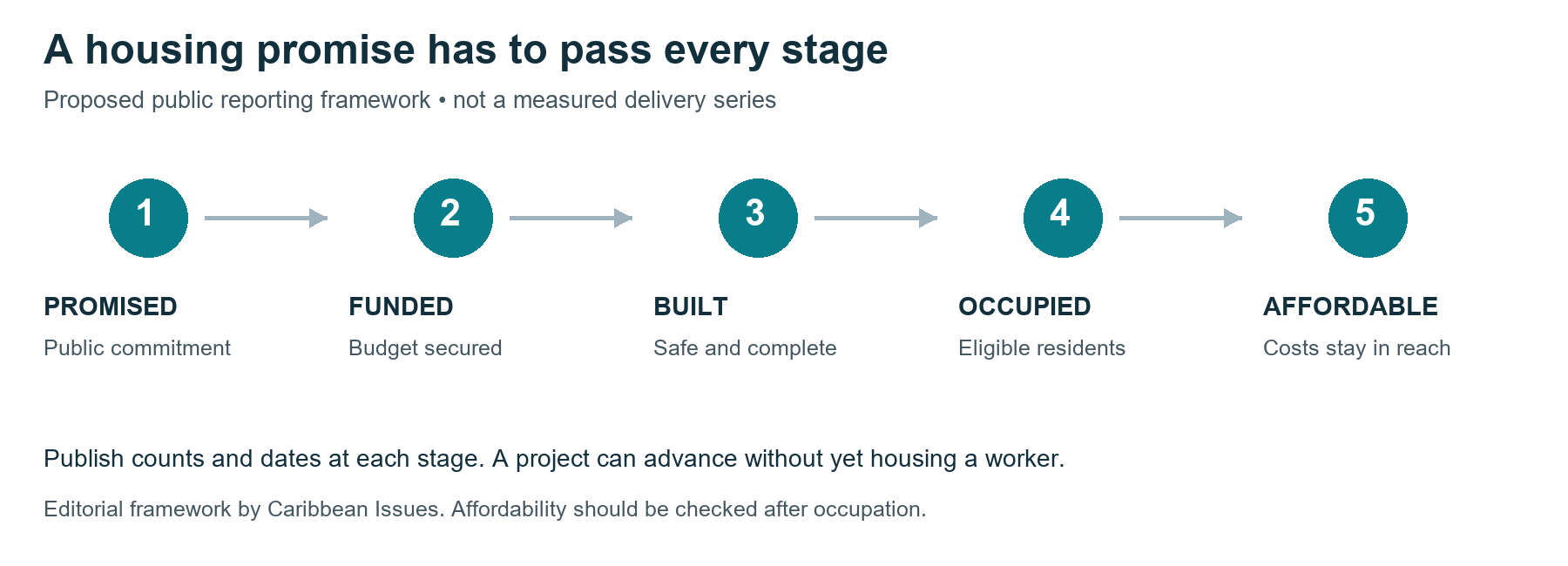
The sequence matters. Establish the baseline and identify the households affected. Choose the intervention that addresses the demonstrated problem. Assign resources, responsibility and a review date. Then publish whether households are better housed. Without that final test, another programme can become another announcement whose success is measured by its existence.
Give the public a housing test it can follow
There is already a concrete accountability date in Cayman’s record. The ministry’s response in Appendix 5 of the audit says an implementation plan for the housing policy and ten-year strategy will be presented to the minister by the end of the fourth quarter of 2027. That is a commitment to submit a plan, not a promise that the housing programme will be completed by then. [2]
Legal status also needs precision. On 18 October 2026, Cayman’s official register still lists the Residential Tenancies Act 2009 as not in force. That does not mean tenants have no legal rights; it means this particular Act must not be described as an operative protection. [8]
Caribbean Issues proposes six measures for an annual public housing report, published alongside tourism and employment results. These are recommendations, not an existing regional standard:
This would make it possible to ask a sharper question of each new development: what additional demand will it place on housing, and where will the people who work there live? The answer should be available before approval, then tested after opening.
A tourism economy depends on people whose lives continue after the guests leave. Housing belongs in the definition of its success. A destination should be able to welcome visitors while giving the people who sustain it a realistic chance to make a home.
- Housing costs against household income. Publish the share spending more than 30% and more than 50% on housing and utilities, with results by income band and household type.
- Homes delivered and retained. Distinguish announcements, approvals, construction, completed homes and occupied homes. State how long affordability protections last.
- Homes available for long-term rent. Track unique dwellings by neighbourhood, size and rent, separately from tourist listings and repeat advertisements.
- Jobs lost to housing costs. Ask schools, health services and tourism employers to record declined offers and departures, distinguishing housing from other reasons.
- Public support and public benefit. Disclose housing subsidies, relevant development concessions, eligibility, enforceable commitments and the outcomes purchased.
- Responsibility and deadlines. Name the agency responsible for each target, publish progress and explain corrective action when delivery slips.
Explore the region and the stories behind it
Planning a visit or a journey home? The Caribbean Destination Finder compares destinations around your travel priorities. Use it to plan a trip; it is not a rating of local housing affordability.
For another way into the questions of work, ownership and belonging, explore Caribbean Issues Music and the reporting behind Songs from the Headlines, including What We Build Must Come Home.
Sources and method
This is a document-based analysis using evidence from Cayman, Puerto Rico and Jamaica, not new interview reporting or a region-wide housing survey. Sources were reviewed on 18 October 2026. Historical findings and announced commitments retain their original dates. CI$ denotes Cayman Islands dollars, US$ United States dollars and J$ Jamaican dollars. Calculations, hypothetical examples and policy proposals are identified. Figures 1–3 visualise the cited records; Figure 4 is an editorial framework. The references below are clickable.
Questions readers are asking
Does tourism alone cause the Caribbean housing problem?
The evidence does not establish a single regional cause. The article examines local wage and housing records, short-term-rental research and government commitments while distinguishing tourism from other possible pressures on housing.
What does the 30% housing affordability benchmark mean?
It compares housing costs with income. It is a screening tool rather than a guarantee that a household can meet all other needs. Utilities, household size, dependable earnings and transport costs also matter.
Have the Jamaican worker apartments been completed?
The cited August 2025 government announcement describes planned worker apartments at the Moon Palace Grande development. The article does not present that announcement as independent confirmation of completion or occupancy.
What should governments publish about worker housing?
Publish housing costs against household incomes, completed and occupied homes, long-term rental availability, housing-related recruitment outcomes, public subsidies and benefits, and the agencies responsible for delivery deadlines.
Sources and documentation
Sources are consolidated here so the investigation reads continuously while the record remains directly inspectable. Evidence roles describe how a source is used; they are not automatic truth scores.
Supports: The housing test behind the job offer
Currency: Historical baseline; assess relevance rather than recency.
Supports: What a wage can actually support; Affordable housing must remain affordable after purchase; Give the public a housing test it can follow
Currency: Verified within the last 45 days.
Supports: What a wage can actually support
Currency: Historical baseline; assess relevance rather than recency.
Supports: What a wage can actually support
Currency: Verified within the last 45 days.
Supports: Puerto Rico shows why ownership and concentration matter
Currency: Historical baseline; assess relevance rather than recency.
Supports: Puerto Rico shows why ownership and concentration matter
Currency: Verified within the last 45 days.
Supports: The tourism industry already recognises the housing issue
Currency: Verified within the last 45 days.
Supports: Give the public a housing test it can follow
Currency: Verified within the last 45 days.
Supports: Jamaica offers a commitment that can be tested
Currency: Historical baseline; assess relevance rather than recency.
Supports: Recovery policy should include the homes behind the hotels
Currency: Historical baseline; assess relevance rather than recency.
- [11][11] Housing remains unaffordable for most Caymanians and government programmes are not delivering value for moneyPrimary record
Supports: Public spending needs a delivery record
Currency: Verified within the last 45 days.
Supports: The household behind the percentage
Currency: Historical baseline; assess relevance rather than recency.
Editorial standards, corrections and AI-assistance policy · Privacy and data use
Caribbean Issues Reader Forum
What is your view?
Rate the usefulness of this analysis, respond to its evidence and add knowledge from the Caribbean or diaspora. Comments are reviewed before publication.
Was this analysis useful?
How would you describe it?
Reader discussion
Loading approved comments…